
What is a Consistent Compounder?
A Consistent Compounder is a company that delivers sustained long-term returns, backed by strong fundamentals and steady business performance. Unlike stocks that experience short-lived surges, a true consistent compounder maintains a predictable upward trajectory over years, rewarding patient investors with compounded wealth.
Fundamental Strength: The Backbone of Compounding
At the core of a consistent compounder lies strong financial fundamentals. These companies exhibit steady revenue growth, expanding operating margins, healthy return on equity (ROE), and a robust balance sheet. Their ability to generate consistent free cash flow ensures they can reinvest in growth, maintain profitability, and navigate economic downturns with resilience.
Key Traits of a Consistent Compounder:
- Sustainable Revenue & Profit Growth – Sales expansion is steady, driven by strong business models, pricing power, and demand.
- High Return on Capital (ROE & ROCE) – Efficient capital allocation ensures long-term value creation.
- Strong Cash Flows & Low Debt – Financial discipline allows them to withstand economic cycles and reinvest efficiently.
- Competitive Moat – A strong brand, technological edge, or unique market position protects long-term growth.
Why Investors Trust Consistent Compounders
From an investor psychology perspective, consistent compounders provide a sense of security. Their predictability makes them ideal for long-term investors who seek stable, inflation-beating returns without excessive volatility. Investors in these stocks are often willing to hold through market corrections because the underlying business remains strong, reducing panic-driven selling. Over time, these companies attract institutional investors, reinforcing their stability and driving further long-term appreciation.
Volatile Compounders May Look Like Consistent Compounders in the Early Stages.
Not every stock that experiences rapid price appreciation turns out to be a true compounder. In the early stages, some volatile stocks may appear to be consistent compounders, as they show strong growth momentum. However, the difference lies in the sustainability of their fundamentals. Many volatile compounders rely on short-term tailwinds, aggressive expansion, or speculative narratives that can fade over time. Once market conditions shift, these stocks often experience sharp corrections, exposing weak financials or unsustainable business models.
How Investors Perceive Compounding Stocks Differently
Investor psychology plays a crucial role in distinguishing between consistent and volatile compounders. Retail investors are often drawn to stocks with rapid price appreciation, mistaking them for reliable compounders. The lure of quick gains can overshadow a company’s actual fundamentals, leading to misjudgments. Many early-stage volatile compounders attract retail enthusiasm, only to disappoint when growth slows or external factors change.
Institutional investors, on the other hand, focus on long-term sustainability. They analyze financial statements, management efficiency, and historical performance to separate genuine compounders from temporary winners. These investors look for companies with consistent earnings growth, strong return on capital employed (ROCE), and prudent debt management. A key differentiator is that institutional investors prioritize earnings quality over short-term price surges, ensuring they back true consistent compounders.
Market perception also plays a role in how these stocks are valued. A true consistent compounder enjoys premium valuations as investors reward its predictable earnings trajectory. Meanwhile, a volatile compounder might see extreme fluctuations in valuation, rising sharply during bullish phases but facing steep corrections when sentiment shifts. Understanding these psychological biases helps investors make informed decisions rather than chasing stocks based on price action alone.
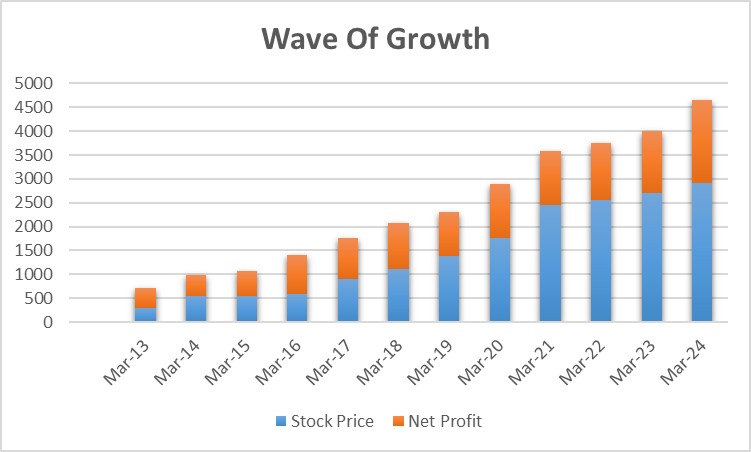
Identifying a consistent compounder—a stock that delivers steady, long-term growth backed by robust fundamentals—is a challenging endeavor for investors. The difficulty lies in distinguishing between companies with genuine, sustainable growth and those experiencing temporary surges that may appear promising initially but lack the foundational strength to maintain their trajectory. To illustrate this, let's examine two Indian companies: Persistent Systems (a consistent compounder) and Suzlon Energy (a volatile compounder).
Example of a Consistent Compounder: Persistent Systems
Persistent Systems, established in 1990, is a Pune-based IT services firm specializing in software development and technology solutions. Over the years, Persistent has demonstrated consistent growth, underpinned by strong fundamentals.
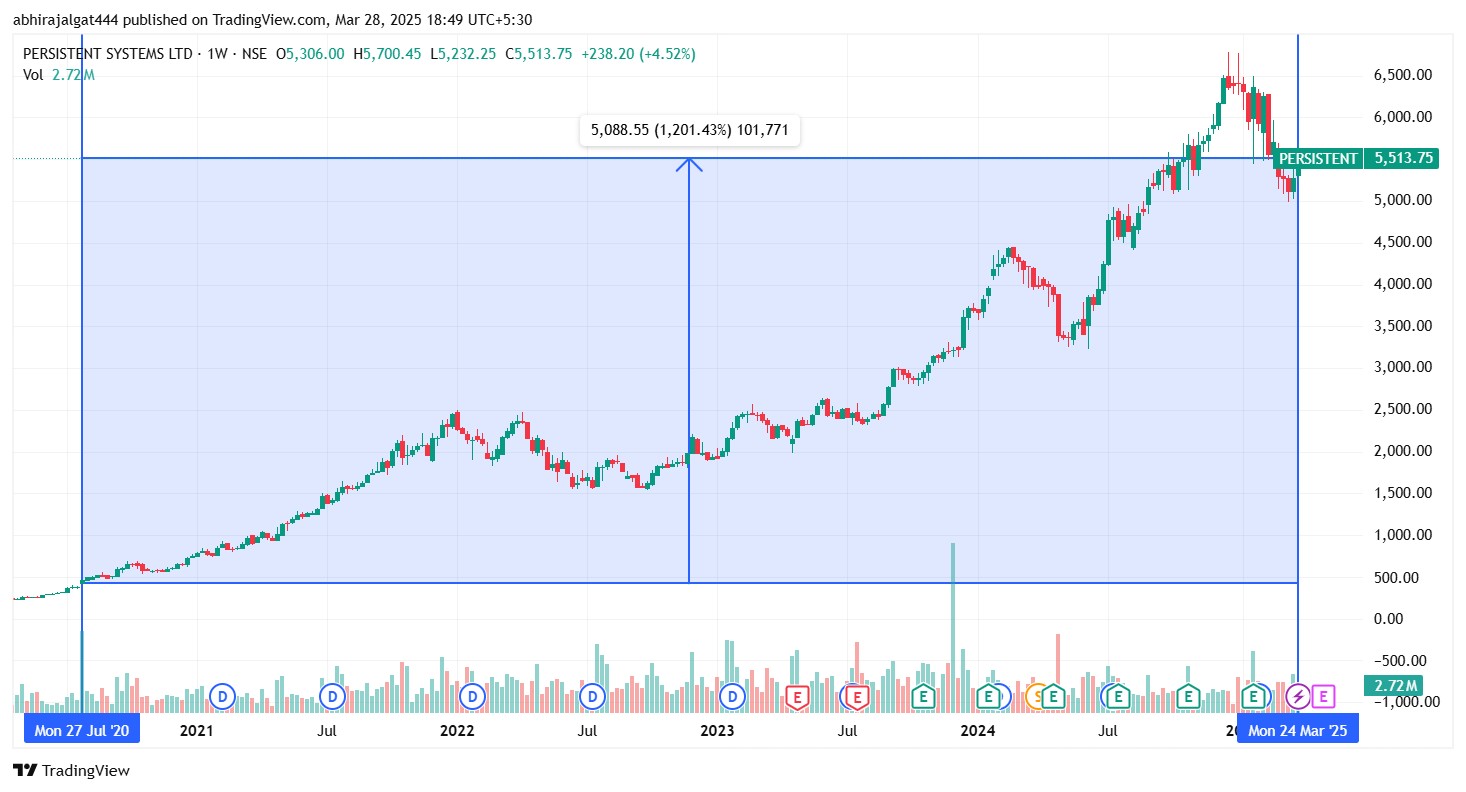
The company’s revenue has grown at a CAGR of 18.39%, indicating a strong and steady expansion. Meanwhile, net profit has maintained a CAGR of 15.80%, reflecting effective cost management and the company’s ability to consistently convert earnings into profit. Additionally, EBITDA has sustained a CAGR of 15%, highlighting stable operational efficiency.
Stock Performance:
Persistent Systems' stock has mirrored its strong financial performance, delivering substantial returns to investors. The company's consistent growth and strategic advancements, particularly in AI-led services, have bolstered investor confidence.
Example of a Volatile Compounder: Suzlon Energy
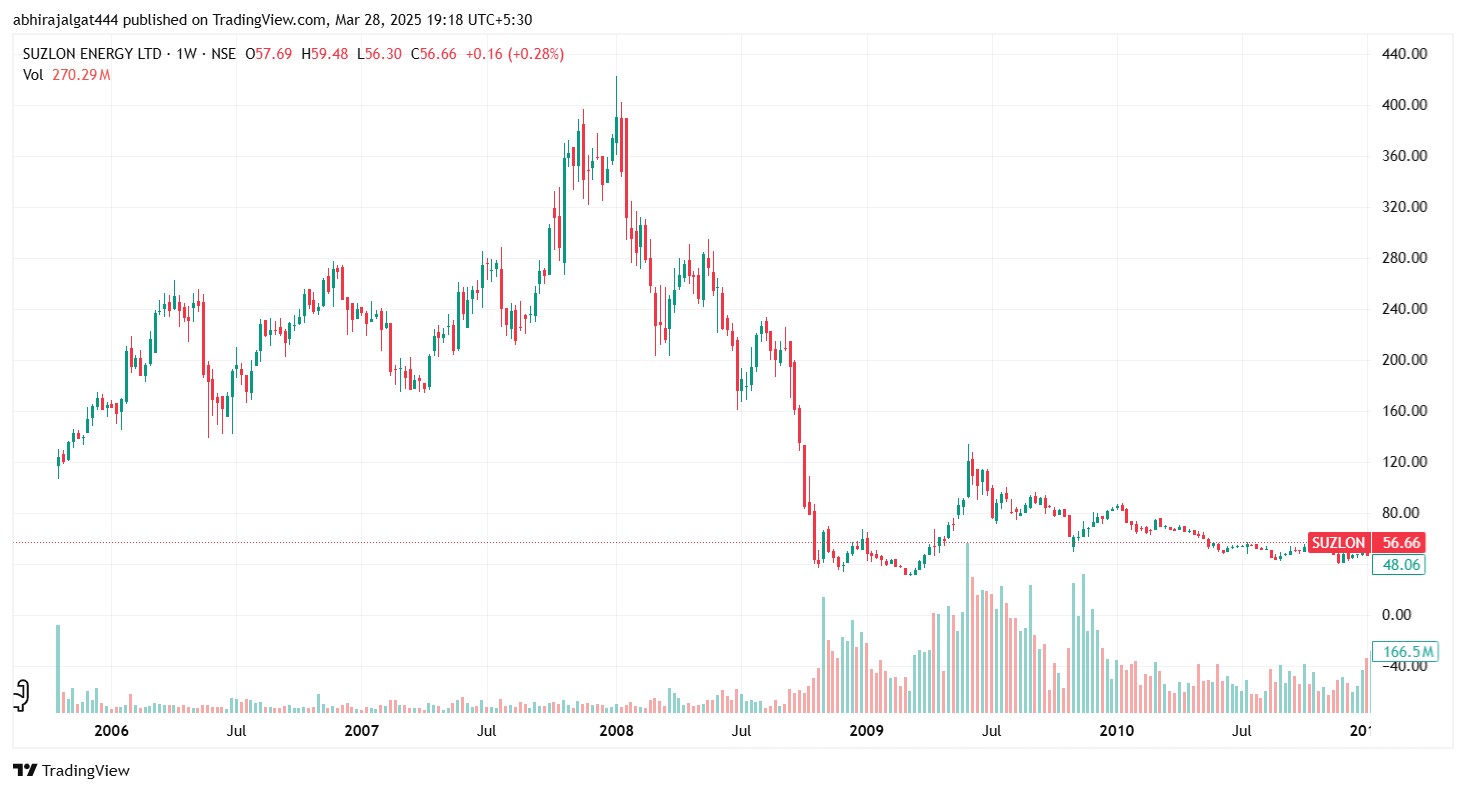
Suzlon Energy, once a dominant player in India’s renewable energy sector, appeared to be a strong growth stock in its early years. However, despite its initial surge, it failed to sustain long-term compounding due to fundamental weaknesses.
Financial Performance and Fundamentals:
- Revenue and Profitability: Suzlon saw peak revenue in the late 2000s, emerging as a global wind turbine leader. However, high operational costs and inconsistent profitability weakened investor confidence.
- Debt Burden: At its peak, the company’s debt exceeded ₹10,000 crore, leading to prolonged financial distress.
- Operational Challenges: Rising interest costs, supply chain inefficiencies, and regulatory hurdles hampered profitability, contributing to years of financial instability.
- 2010-2020 Struggles: Suzlon faced declining revenues and persistent losses, largely due to its heavy debt burden and inefficient operations.
- FY2023-24 Turnaround: The company reported ₹6,497 crore in revenue, with an EBITDA of ₹1,029 crore and a PAT before exceptional items of ₹714 crore. A net cash position of ₹1,148 crore signaled improved financial stability.
Suzlon’s stock saw phases of rapid appreciation, especially during the early 2000s renewable energy boom. However, it later crashed due to financial instability, leaving long-term investors disappointed.
What This Suggests
While companies like Persistent Systems showcase the characteristics of a consistent compounder with strong financials and stable growth, stocks like Suzlon Energy highlight the risks associated with volatile compounders. Many investors mistook its short-term price surges for sustainable compounding, only to suffer losses when the stock collapsed due to weak fundamentals. Identifying a true consistent compounder requires rigorous fundamental analysis rather than chasing temporary uptrends.
Consistent Compounders Survive Economic Downturns
Economic downturns test a company's resilience. While many businesses struggle, consistent compounders withstand volatility due to strong fundamentals, stable cash flows, and efficient management. These companies not only recover quickly but often emerge stronger.
Case Study: Pidilite Industries
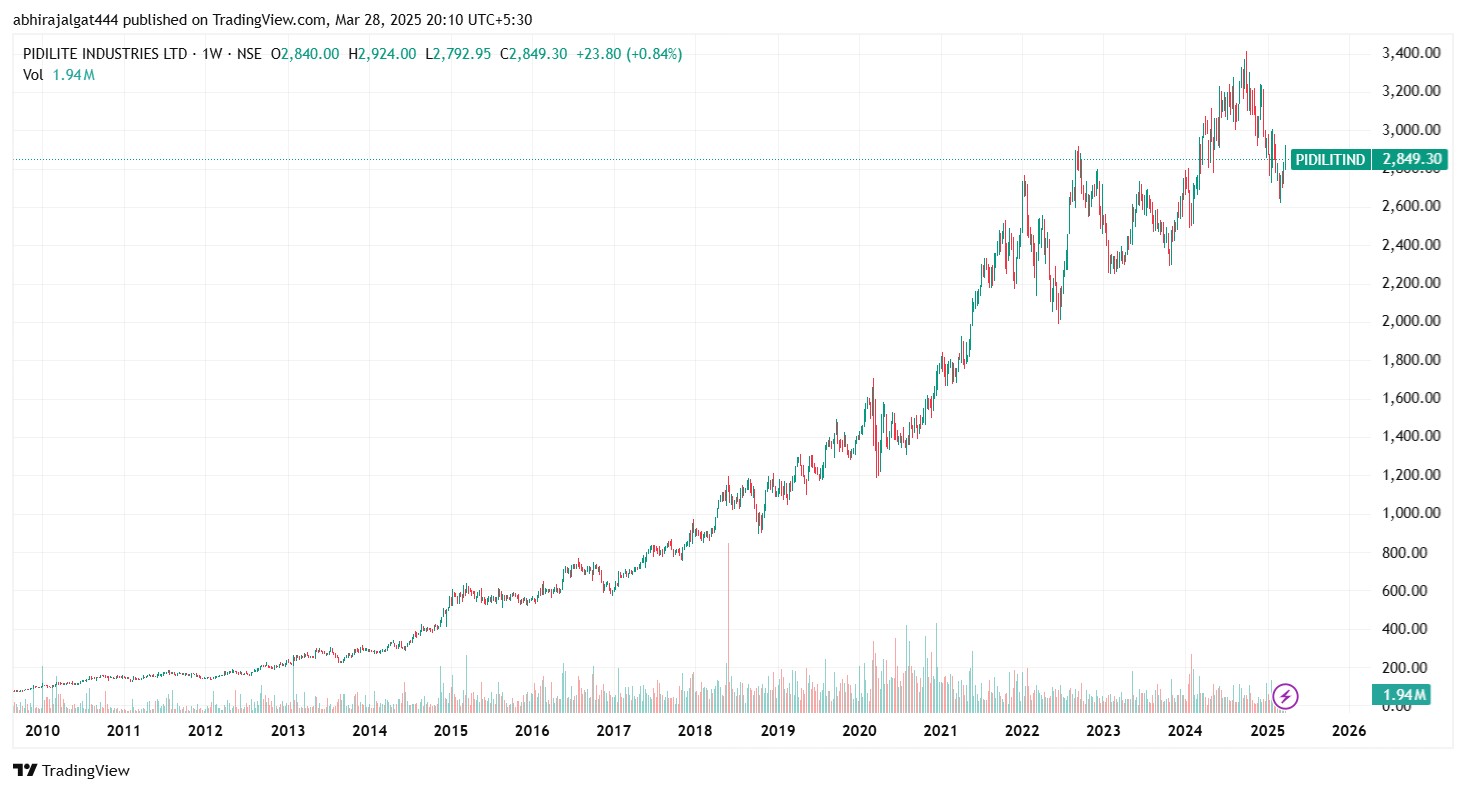
Pidilite Industries, the maker of Fevicol, has been a classic example of a consistent compounder that has thrived across multiple economic cycles. Despite facing inflationary pressures, raw material cost fluctuations, and market slowdowns, the company has managed to sustain growth and protect investor wealth.
- Revenue Growth: Between 2010 and 2024, Pidilite’s revenue grew from ₹2,000 crore to over ₹14,000 crore, reflecting a CAGR of ~14%.
- Net Profit Growth: From ₹250 crore in 2010 to over ₹1,800 crore in 2024, showing CAGR of ~17%, driven by strong brand value and operational efficiency.
- Debt-Free Status: The company operates with minimal debt, ensuring financial stability during crises.
- Pricing Power & Brand Loyalty: Despite inflationary pressures in 2022-2023, Pidilite successfully passed on cost increases to customers without losing market share, proving its pricing power.
How Pidilite Navigated Past Economic Downturns
- 2008 Global Financial Crisis: Despite the stock market crash, Pidilite’s brand strength and steady demand for adhesives helped it recover quickly, with revenue growing 10% YoY.
- COVID-19 Pandemic (2020): The company saw a temporary revenue dip but rebounded swiftly as home improvement demand surged post-lockdowns. Stock price doubled from ₹1,400 in March 2020 to ₹2,800 by mid-2021.
- Inflation Shock (2022-2023): With rising raw material costs, many companies struggled with margins, but Pidilite maintained stable OPM (Operating Profit Margin) above 20%, reinforcing its cost control and pricing power.
Why Consistent Compounders Survive Market Turbulence
- Resilient Business Model: Strong brand loyalty and high-margin businesses protect profits during downturns.
- Financial Discipline: Low debt and efficient capital allocation reduce financial stress in tough times.
- Investor Trust: Institutional investors prefer stable, cash-generating businesses, reducing stock volatility.
- Adaptability & Pricing Power: The ability to adjust pricing without losing customers keeps earnings stable.
Consistent compounders like Pidilite not only endure downturns but emerge stronger, making them preferred choices for long-term investors. They reinforce the idea that strong fundamentals and financial discipline matter more than short-term price movements.
Conclusion
Consistent compounders stand out by delivering stable, long-term returns while weathering market fluctuations. Investors who focus on sustainable growth rather than short-term price movements are better positioned to build lasting wealth. The key lies in patience, rigorous fundamental analysis, and understanding the difference between temporary surges and true compounding potential.