
 (1).jpg)
Our Essential Guide to Using Moving Averages for Entry, Holding, and Exit
In the complex world of investing, simple tools often become your best allies. Moving averages (MAs) are one such tool fundamental, versatile, and powerful. Whether you are a beginner trying to find a reliable way to identify market trends or a seasoned investor looking to refine your strategy, understanding moving averages can make a significant difference.
Moving averages don’t just help you find entry points in stocks or other assets; they also provide guidance on when to hold onto your positions and when to exit. In this blog, we’ll explore the different types of moving averages, how to use them effectively, and why they should be part of every investor’s toolkit.
What is a Moving Average?
At its core, a moving average is the average price of an asset over a specified period, updated continuously as new prices come in. This “moving” or rolling average smooths out price data, filtering short-term fluctuations and revealing the underlying trend.
Think of it like the average speed of a car over the last 10 minutes: while speed fluctuates every second, the average speed gives you a smoother picture of how fast you’ve been going.
Types of Moving Averages:
The most popular moving averages are:
- Simple Moving Average (SMA): The SMA is the straightforward average of prices over a chosen number of periods. For example, a 20-day SMA adds up the closing prices of the last 20 days and divides by 20. Each day, the oldest price drops out, and the newest price is added, creating a “moving” average.
- Exponential Moving Average (EMA): Unlike SMA, EMA gives more weight to recent prices, making it more responsive to recent market changes. This makes EMA faster at reflecting recent price movements, which some investors prefer for more timely signals.
- Weighted Moving Average (WMA): WMA also assigns weights to prices but does so linearly the most recent price gets the highest weight, and the weights decrease uniformly for older prices. It sits somewhat between SMA and EMA in responsiveness.
Each type has its own advantages, depending on your investing style and time horizon.
Moving Averages: Beyond Entry Holding and Exit Decisions
Most DIY investors first learn moving averages as a way to spot good entry points “buy when price crosses above the moving average.” While this is useful, moving averages offer much more.
Holding:
Once you buy, moving averages can help you decide whether to continue holding. For example, if you buy when the price crosses above the 50-day SMA, you may choose to hold as long as the price stays above it, riding the uptrend. This systematic approach helps avoid panic selling during short-term dips.
Exit:
Exiting at the right time is as important as entering at the right time. A drop below a key moving average can signal trend weakness or reversal, prompting you to reduce or exit your position. Using moving averages as exit triggers reduces emotional decisions and helps preserve capital.
Why this matters:
Markets are volatile and emotions often cloud judgment. Moving averages provide a mechanical, emotion-free framework that helps you stay invested in winning trends and exit losing ones in a timely fashion.
No Standard Use It’s Your Style, Your Rules
There is no universally “correct” way to use moving averages. Different investors and traders have their own styles based on risk tolerance, timeframe, and market preferences.
- Short term traders might use 10 or 20-day EMAs to catch quick moves but accept more false signals.
- Medium term investors often prefer 50-day or 100-day SMAs for balanced responsiveness and smoothing.
- Long term investors or conservative portfolio managers might use the 200-day SMA to filter out noise and identify the broad trend.
Some combine multiple MAs for crossover signals (e.g., the “golden cross” of 50-day crossing above 200-day). Others use moving averages purely as dynamic support or resistance levels.
Your key takeaway? Experiment, backtest, and find what fits your comfort level. Be consistent once you find your method.
Moving Averages Are Not Just for Stocks Use Them Across Assets
Moving averages are simple mathematical tools their power comes from the way they clarify trends, not from what asset you apply them to.
They work equally well for:
- Commodities: Like gold, crude oil where trends can be volatile but MAs smooth out noise.
- Currencies: In forex markets, MAs help identify trend direction and potential reversal points.
- Cryptocurrencies: Cryptocurrencies: Given their volatility, faster-moving averages like EMA can help capture quick trends.
- Indices and ETFs: For broad market exposure or sector rotation strategies.
This universality means once you master moving averages, you can apply them in any market.
Common Pitfalls and How to Avoid Them
Moving averages are powerful but not foolproof. Here are some common mistakes investors make:
- Chasing moving averages: Jumping in immediately when price crosses above an MA without confirming volume or other factors can lead to whipsaws.
- Ignoring the timeframe: Using a short-term MA in a long-term investing strategy (or vice versa) causes mixed signals.
- Blindly following crossovers: Not all crossovers indicate strong trends; sometimes, markets “fake out” and reverse. Confirm with other indicators or price action.
- Overcomplicating: Adding too many moving averages can confuse signals rather than clarify.
The best approach is to use moving averages as a part of a broader decision-making framework, not as the sole determinant.
Practical Tips for Investors
- Choose MA periods aligned to your time horizon: Longer MAs for long-term, shorter MAs for short-term.
- Use MA as dynamic support/resistance: Prices often bounce off major moving averages during trends.
- Combine with volume and price patterns: Confirm MA signals with other data points.
- Be patient: Sometimes moving averages lag; combine them with price action to avoid premature exits or entries
- Backtest your strategy: Use historical data to see how your chosen MAs would have worked on your target assets.
How We at BossInvestor Use Moving Averages
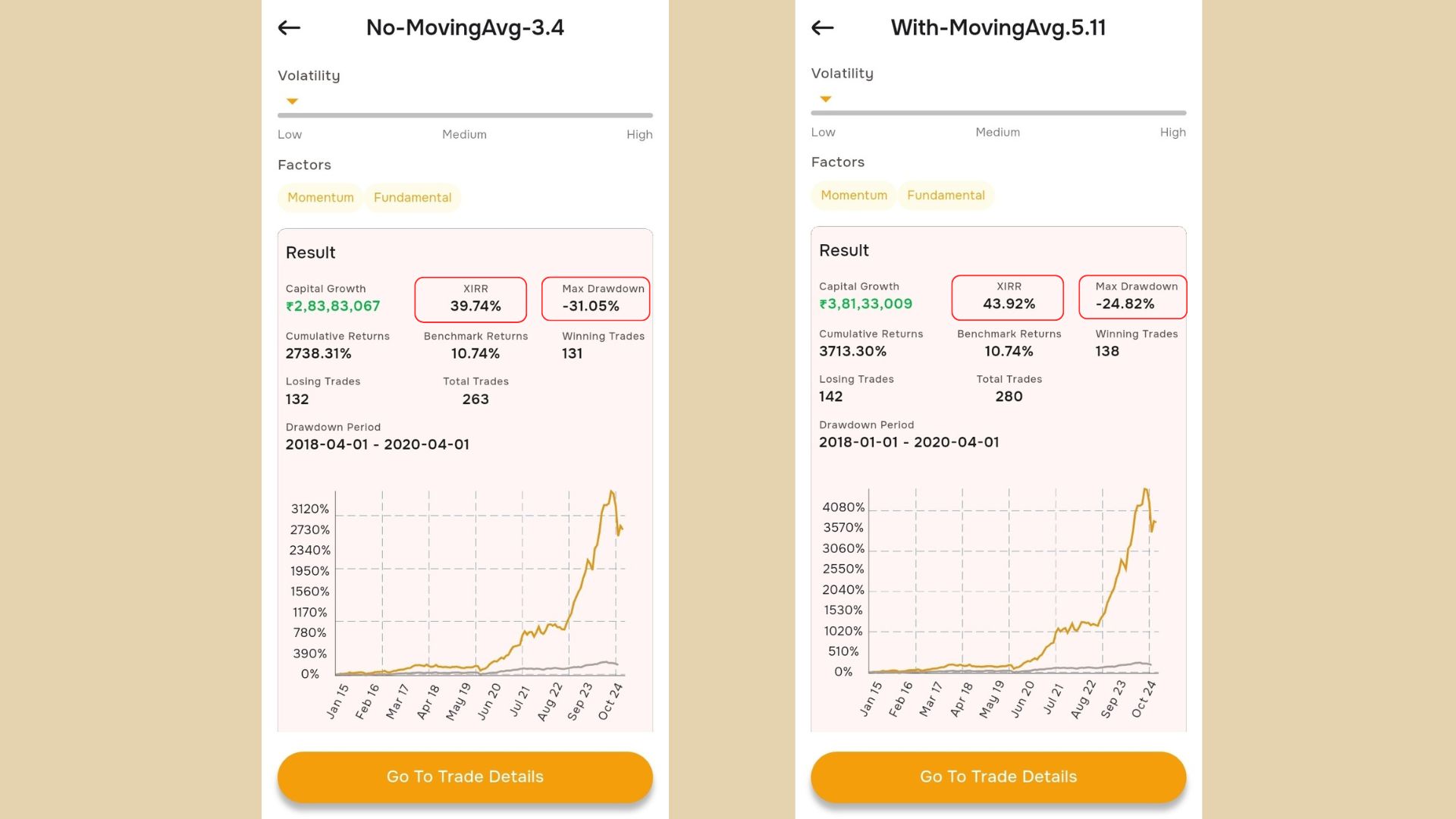
We have backtested stocks with a market cap greater than ₹1,000 crore, using an initial capital of ₹10 lakh, for a maximum 15-stock portfolio rebalanced on a quarterly basis.
At BossInvestor, we don’t just talk about moving averages we test them. Through our Backtesting feature, investors can clearly see how moving averages impact not just stock selection, but also holding duration and exit timing. We treat moving averages as a measure of trend strength a way to stay in sync with the market’s rhythm.
To illustrate this, we’ve included two sets of backtesting results below:
- Scenario 1: Strategy with no moving average filters applied.
- Scenario 2: Strategy where moving averages are applied across entry, hold, and exit decisions.
You’ll notice a significant difference in drawdowns and the consistency of returns. Over a 10-year horizon, strategies using moving averages demonstrate better downside protection and smoother compounding helping DIY investors avoid emotional exits during short-term volatility.
Note: PEG and PE ratios were also considered as part of the entry criteria in this backtest. This comparison is solely intended to highlight the role of Moving Averages for a clearer picture. The strategy with Moving Averages can be further enhanced by combining it with other fundamental parameters to achieve better results in terms of drawdown and winning trades.
Stay tuned — we’re launching this backtesting feature soon!
Before You Conclude, Use Moving Averages But Don’t Rely on Them Alone
Moving averages are powerful, no doubt they help spot trends, provide structure, and guide entries and exits. But should you deploy capital just because a stock crossed above its 50-day or 200-day line? Not quite. At BossInvestor, we go a step further. Our momentum theory is built on a foundation of strong fundamentals - earnings growth, solid balance sheets, and consistent performance. This combination of technical signals and financial strength offers double confirmation, giving us the confidence to act decisively. So while moving averages can be your guide, fundamentals should be your compass together, they create a smarter, more reliable path to long-term success.