Capital Expenditure (CapEx) Growth
Capital expenditure (CapEx) drives long-term business growth. Learn how Indian companies like Marico and UltraTech deploy CapEx to scale efficiently.

What Is the Role of Capital Expenditure (CapEx) in Company Growth?
Capital expenditure (CapEx) serves as the primary engine for long-term corporate growth and scalability. By strategically allocating funds toward acquiring, upgrading, or maintaining physical assets like technology and manufacturing plants, companies actively build the infrastructure required to meet future market demand. Examining past efficiency through metrics like ROCE alongside future value creation indicators like ROIIC ensures capital is deployed effectively.
Definition: Capital expenditure refers to the funds a business invests to purchase, upgrade, alter, or maintain physical assets such as buildings, machinery, equipment, or technology. These long-term investments are capitalized on the balance sheet rather than expensed immediately. The ultimate purpose of CapEx is to expand operational capacity, improve production efficiency, and sustain competitive advantages over time.
Key Takeaways
- CapEx decisions are forward-looking strategies designed to prepare a business for future market demand and long-term expansion rather than just managing current requirements.
- Brownfield CapEx involves expanding or modernizing existing facilities to achieve lower risk and quicker execution, as seen with Britannia in Ranjangaon.
- Greenfield CapEx entails building entirely new production units from scratch, which carries higher execution risks and longer gestation periods but offers greater upside.
- Tracking the Return on Incremental Invested Capital (ROIIC) helps investors assess future value creation and determine if successive CapEx cycles compound capital efficiently.
- Capital expenditure requirements vary significantly by industry sector, meaning a specific investment amount might be standard for a cement firm but substantial for a consumer brand.
Capital Expenditure (CapEx): The Foundation of Long-Term Growth
When companies speak about their long-term ambitions, it often begins with one word — CapEx. Capital Expenditure, or CapEx, is the money companies spend to acquire, upgrade, or maintain physical assets such as buildings, plants, technology, or equipment. But CapEx is not just about spending — it's about vision, strategy, and scalability.
Let’s dive deeper into how CapEx works, why it matters, and how investors should analyze it with real-world context.
Why Do Companies Do CapEx?
CapEx is a forward-looking decision. Whether it’s a new factory, warehouse, retail outlet, or automation system — companies do CapEx to prepare for future growth, not just current demand.
- Marico undertook CapEx in automation and digitization to reduce dependence on manual processes and improve supply chain visibility. This improved gross margins over time.
- UltraTech Cement, a capital-intensive business, regularly expands its clinker and grinding capacity through CapEx to meet demand and maintain market leadership.
CapEx shows us how ambitious a management team is. Are they thinking only about quarterly profits? Or are they building something that can scale sustainably over the next decade?
When companies consistently reinvest in growth, they create the foundation for becoming consistent compounders — businesses that can grow steadily over long periods.
Why Companies Communicate CapEx Early
CapEx plans are typically shared in analyst calls, investor presentations, or earnings guidance. Companies that do this well build credibility with the investor community.
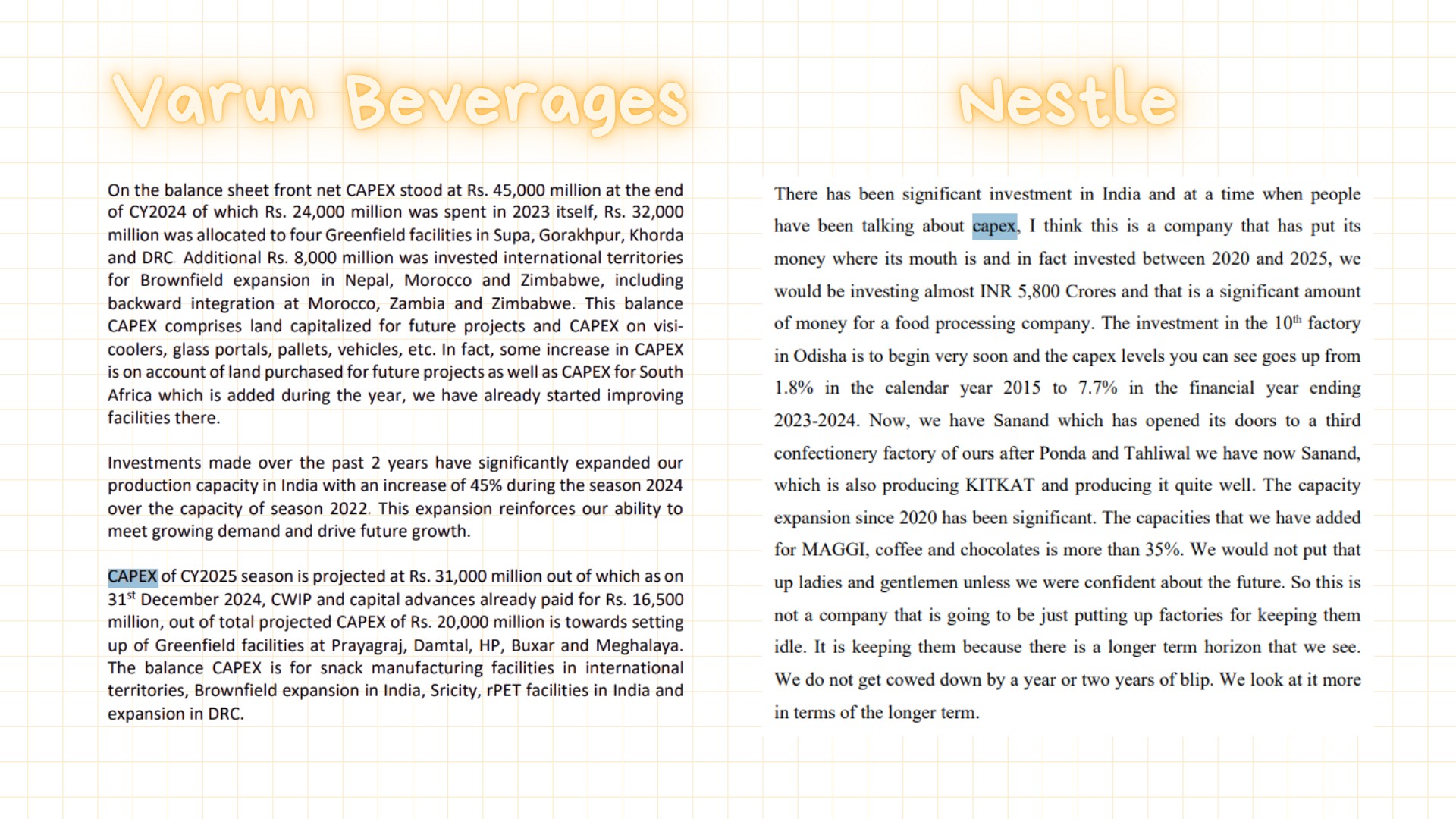
A prime example is Varun Beverages. In multiple analyst calls, the management clearly laid out:
- Planned CapEx over the next 12–18 months
- Reasons behind the expansion (increased demand for PepsiCo products in Tier 2 and Tier 3 cities)
- How this CapEx will be funded (internal accruals + debt)
- Timeline for execution
This level of transparency helps investors understand not just the “how much,” but the “why now” — which is crucial. Early communication reduces uncertainty, and markets tend to reward companies that offer clarity and vision.
Another good example is Nestlé India, which consistently communicates its CapEx around expanding capacity in high-growth categories like nutrition, baby foods, and beverages. This clarity reinforces the company’s long-term growth story.
Types of CapEx: Brownfield vs. Greenfield

Understanding how a company is deploying CapEx helps gauge risk and return expectations.
- Brownfield CapEx: Expansion or modernization of existing facilities. This is generally lower risk and faster to execute.
- Example: Britannia expanding its Ranjangaon factory to include automation and new product lines.
- Greenfield CapEx: Setting up new units or plants from scratch. Higher risk, longer gestation, but higher upside.
- Example: Tata Steel investing in new plants in Odisha to increase long-term production capacity.
Both types have different implications for investors. Brownfield may lead to quicker margin improvement, while Greenfield may stretch financials before returns kick in.
What Triggers a CapEx Decision?
CapEx is usually triggered by one or more of the following:
- Demand-Driven Expansion
If a product is seeing rising consumer demand, companies need to scale capacity.
- Asian Paints expanded its decorative paints capacity after consistent volume-led growth in urban and rural markets.
- Page Industries (Jockey) added new units to meet demand from growing innerwear and athleisure segments.
- Efficiency Push
Companies also invest in automation, logistics, or energy-saving technologies to reduce cost per unit.
- Hindustan Unilever (HUL) has automated parts of its supply chain to improve efficiency and respond to market changes faster.
- FOMO or Peer Pressure
Sometimes companies announce CapEx just because competitors are doing it — not always with a well-thought-out plan. This is risky. Poorly timed CapEx can stretch balance sheets and destroy shareholder value.
- Some textile and chemical companies during 2021–2022 went on a CapEx spree due to high commodity cycles and government incentives (PLI), but saw poor returns when demand slowed.
As investors, it’s important to separate well-reasoned CapEx from reactionary CapEx.
CapEx Differs by Industry
CapEx requirements vary significantly across sectors. Understanding this helps avoid flawed comparisons.
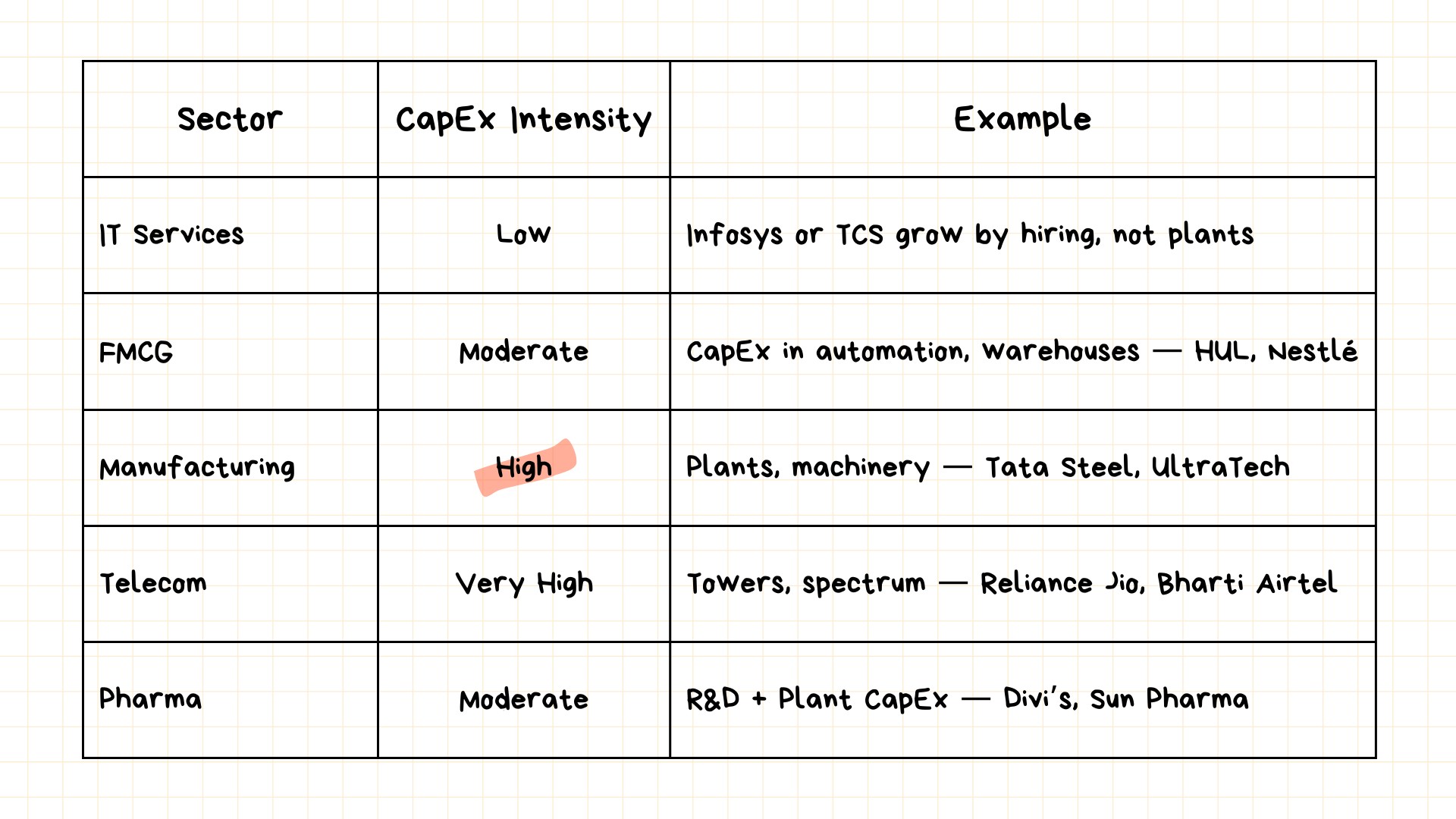
This is why a ₹500 crore CapEx by a cement company might be “normal,” but the same by a midcap consumer brand might be huge.
Also, regulatory factors, asset intensity, and scalability shape CapEx needs. Always evaluate CapEx in the right industry context.
CapEx Alone Means Nothing — Context Is Everything
Big numbers don’t automatically mean good news. Investors must dig deeper.
Ask:
- Has the operating efficiency improved after the CapEx?
- Is the ROCE increasing or declining post-investment?
- What’s the peer benchmark — are others investing more efficiently?
Also, look at how the CapEx is funded:
- If it’s through internal accruals, it’s more sustainable.
- If funded through debt, is the return higher than the cost of capital?
Most importantly, track ROIIC — Return on Incremental Invested Capital.
While ROCE tells us about past efficiency, ROIIC tells us about future value creation. A company that maintains high ROIIC over several CapEx cycles is truly compounding capital efficiently.
- Asian Paints has consistently delivered high ROIIC by smartly reinvesting in distribution and plant expansion.
- Nestlé has grown capacity in high-margin categories, improving both ROCE and ROIIC.
CapEx is meaningful only when it leads to tangible, measurable improvement in return metrics.
Wrapping It Up: CapEx Is a Window Into a Company’s Ambition
CapEx tells us more than just how much a company is spending. It tells us what the company is building.
- Is the company planning ahead or playing catch-up?
- Is the CapEx focused and well-communicated?
- Will the returns justify the risk?
As long-term investors, we must go beyond the headlines and understand the quality of CapEx — not just the quantity.
BossInvestor is a SEBI Registered Research Analyst (INH000024143). Results shown are based on historical data and do not guarantee future performance.
Frequently Asked Questions
How does a capital expenditure cycle impact Indian stock market sectors differently?
Capital expenditure requirements vary greatly depending on asset intensity. Heavy industries in India, such as cement, steel, and power infrastructure, naturally require massive physical allocations to add manufacturing volume, meaning outlays of hundreds of crores are standard operational baseline requirements. Conversely, fast-moving consumer goods companies or digital platforms operate with lighter structures, where even a moderate investment in distribution automation or factory upgrades represents a substantial operational pivot capable of generating swift incremental margins.
What is the difference between operational expenditure and capital expenditure for listed companies?
Operational expenditure involves the routine, short-term spending necessary to run daily business functions, such as paying worker wages, purchasing raw materials, and covering administrative costs, which are fully expensed within the current financial year. Capital expenditure involves substantial funds allocated toward long-term assets, such as purchasing manufacturing machinery or expanding factory footprints. These capital costs are recorded on the balance sheet and gradually depreciated over the multi-year useful lifespan of the acquired asset.
Why should an investor track Return on Incremental Invested Capital when analyzing manufacturing firms?
While the traditional Return on Capital Employed metric calculates historical structural efficiency based on legacy assets, Return on Incremental Invested Capital focuses entirely on the future financial value generated by newly deployed capital cycles. Evaluating this metric allows investors to determine whether recent management allocations actually yield profitable growth or dilute corporate value, signaling whether the company possesses the structural capability to remain an efficient compounder over the next decade.
What are the primary risks associated with debt-funded capital expansion plans?
Funding large corporate expansions through debt increases fixed interest obligations, heavily leveraging the balance sheet. If consumer demand slows down right as the new facilities commence operations, the company faces compressed profitability margins alongside rigid debt repayment schedules. Reactionary spending triggered by cyclical peaks or peer pressure can easily destroy shareholder value if the projected asset utilization rates fail to materialize during an economic downturn.
How do government incentives like the Production Linked Incentive scheme affect corporate investments?
Government initiatives such as the Production Linked Incentive scheme provide financial subsidies that encourage companies to scale domestic manufacturing capabilities across targeted sectors. While these programs reduce the initial financial strain of setting up major facilities, prudent investors must verify that corporate investments are backed by long-term strategic demand rather than short-term opportunism, as building excess capacity solely for regulatory incentives poses underutilization risks when cycles normalize.
Related Blogs

Biocon Shares Jump 6% on Volume Breakout & Biosimilars Growth
Published: Thu Jul 16 2026Read more…

SBI Funds Management IPO Closes: ₹11,693 Cr Issue Sets Record
Published: Thu Jul 16 2026Read more…

Alok Industries Q1 FY27 Results Board Meeting Today
Published: Thu Jul 16 2026Read more…
ITC Hotels Slips 5% Despite 36% Jump in Q1 Net Profit
Published: Fri Jul 17 2026Read more…