Value Investing Principles
Value investing principles help identify undervalued stocks using intrinsic value and margin of safety. Learn how BossInvestor builds resilient portfolios.

What are the core value investing principles for finding undervalued stocks?
Value investing principles focus on identifying fundamentally strong companies trading below their true worth[cite: 37]. By utilizing metrics like P/E, P/B, and DCF analysis alongside a significant margin of safety, investors protect capital against market downside[cite: 37]. This data-driven, long-term framework allows market participants to compound returns safely across volatile market cycles[cite: 37].
Definition: Value investing is a disciplined investment methodology centered on purchasing securities at a price significantly lower than their calculated intrinsic value[cite: 37]. This approach relies heavily on fundamental analysis of corporate financials, earnings potential, and competitive moats rather than short-term market speculation[cite: 37].
Key Takeaways
- Intrinsic value reflects a company's true worth based on financials, evaluated using DCF models, P/E ratios, and P/B ratios[cite: 37].
- A structural margin of safety serves as a crucial buffer against valuation errors and unexpected market downturns[cite: 37].
- Successful value investing requires a dedicated long-term perspective to benefit fully from the compounding effects of strong businesses[cite: 37].
- Fundamental analysis must balance quantitative metrics with qualitative factors like management integrity and durable competitive moats[cite: 37].
- Relying on a multi-metric valuation approach overcomes the limitations and asset misrepresentations of single-model strategies[cite: 37].
What is Value Investing?
Value investing is a time tested strategy that involves buying stocks that are trading below their intrinsic value[cite: 37]. Pioneered by Benjamin Graham and popularized by Warren Buffett, this approach focuses on long-term wealth creation by identifying fundamentally strong companies at a discount[cite: 37]. In today's volatile markets, value investing remains a reliable path to financial success[cite: 37].
"Price is what you pay. Value is what you get." – Warren Buffett[cite: 37]
Value investing revolves around the idea of buying undervalued stocks with strong fundamentals[cite: 37]. The philosophy is simple: "Buy ₹100 worth for ₹50."[cite: 37] Unlike growth investing, which focuses on companies with rapid revenue expansion, value investing prioritizes intrinsic value and margin of safety[cite: 37].
The Core Principles of Value Investing
Intrinsic Value : Intrinsic value reflects a company's true worth based on financials and future earnings[cite: 37]. Investors assess it using DCF Analysis, which estimates value by discounting future cash flows to present value; P/E Ratio, which compares stock price to earnings per share to gauge valuation; and P/B Ratio, which contrasts market price with book value, where a ratio below 1 may indicate an undervalued stock[cite: 37].
Margin of Safety : Buying stocks at a significant discount to their intrinsic value protects investors from downside risks[cite: 37]. This principle ensures that even if market conditions fluctuate, the investment remains relatively secure[cite: 37]. The margin of safety acts as a buffer against errors in valuation and unexpected market downturns[cite: 37]. It provides peace of mind, knowing that even if short-term price fluctuations occur, the underlying business remains strong, reducing the risk of permanent capital loss[cite: 37].
Long-Term Perspective : Value investing requires patience and discipline[cite: 37]. Unlike short-term trading strategies, which focus on quick gains, value investors hold onto stocks for years or even decades[cite: 37]. Warren Buffett's investments in companies like Coca-Cola and American Express demonstrate the power of long-term investing[cite: 37]. Over time, these companies have compounded returns, generating significant wealth[cite: 37]. By holding onto fundamentally strong businesses through market cycles, investors benefit from the effects of compounding and avoid the pitfalls of frequent trading and speculation[cite: 37].
Fundamental Analysis : To find undervalued stocks, investors analyze key financial metrics[cite: 37]. Earnings growth signals profitability and sustainability, while low debt levels indicate financial stability and lower risk[cite: 37]. Strong cash flow ensures a company can cover expenses, reinvest, and pay dividends, reflecting long-term viability[cite: 37]. A competitive moat, like brand strength or patents, helps companies maintain market dominance, as seen with Reliance Industries and Tata Group[cite: 37].
Historical Triumphs in Value Investing
Great investors have repeatedly used these principles to identify value stocks[cite: 37]. Some prime examples include :
- Warren Buffett’s Investment in Apple : Buffett, known for avoiding tech stocks, invested heavily in Apple because he recognized its durable competitive advantages—brand loyalty, pricing power, and a strong ecosystem of products and services[cite: 37]. Apple was also returning significant value to shareholders through stock buybacks and dividends[cite: 37].
- Warren Buffett’s Investment in Coca-Cola : Buffett’s investment in Coca-Cola after the 1987 market crash was another textbook value play[cite: 37]. He saw that despite short-term volatility, Coca-Cola’s global brand, distribution network, and loyal customer base made it a long-term winner[cite: 37].
- Rakesh Jhunjhunwala’s Investment in Titan : Rakesh Jhunjhunwala, often called "India’s Warren Buffett," is known for his exceptional stock-picking skills[cite: 37]. One of his most famous investments was Titan Company Limited, a subsidiary of the Tata Group[cite: 37]. In 2002-03, Titan traded at ₹3-4 per share, struggling with debt and low investor interest[cite: 37]. Recognizing its strong brand and retail potential, Jhunjhunwala invested early[cite: 37]. As Titan expanded, strengthened Tanishq, and dominated retail, its stock soared past ₹3,000 in 2021, becoming one of his most successful bets[cite: 37].
Common Mistakes to Avoid in Value Investing
- Beware of Value Traps: Stocks with low P/E or P/B ratios may remain cheap due to declining revenues, unsustainable dividends, or outdated business models[cite: 37].
- Look Beyond Numbers: Strong financials mean little if the company has weak leadership, operates in a declining industry, or lacks brand strength[cite: 37].
- Assess Key Qualitative Factors: Evaluate management integrity, industry trends, and competitive advantages before investing[cite: 37].
- Control Emotions in Investing: Panic selling, overconfidence, and confirmation bias often lead to poor decisions stick to a disciplined strategy based on valuation and fundamentals[cite: 37].
- Consider Macroeconomic Factors: Inflation, interest rates, and geopolitical risks significantly impact businesses, so monitoring economic trends is crucial[cite: 37].
- Stay Rational for Long-Term Success: Avoiding emotional decisions and economic neglect improves investment outcomes[cite: 37].
The Power of Multi-Metric Valuation in Smarter Investing
Valuation is a cornerstone of investing, guiding decisions on whether a stock is undervalued or overvalued[cite: 37]. While many investors rely heavily on Discounted Cash Flow (DCF) models, using a single valuation method can lead to an incomplete analysis[cite: 37]. A more effective approach incorporates multiple valuation metrics such as DCF Valuation, PE Valuation, PB Valuation and an overall valuation rating etc. (includes avg ratings of PE, PB, PEG, DCF, ROE and ROA etc.) to create a more comprehensive investment strategy[cite: 37].
The Limitations of DCF Valuation
DCF valuation estimates the intrinsic value of a stock based on projected future cash flows[cite: 37]. While a powerful tool, it comes with inherent limitations:
- Sensitive to Assumptions: Small changes in discount rates, growth projections, or terminal values can significantly impact valuation[cite: 37].
- Not Ideal for Certain Sectors: Cyclical industries and Startups with unpredictable cash flows can be misrepresented by a DCF analysis[cite: 37].
- Excludes Market Sentiment: DCF models do not account for macroeconomic conditions or investor sentiment, making them less effective in volatile markets[cite: 37].
Why Overall Valuation Ratings Matter
To address the shortcomings of DCF valuation, additional valuation metrics are essential[cite: 37].
- Earnings Growth Potential: Companies with strong earnings growth can justify higher valuations[cite: 37].
- Market Trends and Sentiment: Incorporating investor behavior ensures alignment with real-world market conditions[cite: 37].
- Sector-Specific Metrics: Different industries require different valuation benchmarks[cite: 37].
- Historical Performance: Trends in valuation ratios help assess long-term investment potential[cite: 37].
By combining ratios or ratings of DCF, PE, PEG, PB, ROE and ROA etc. investors can gain deeper insights into stock performance and market positioning[cite: 37].
Data-Driven Insights from 2021 to 2024
Over the past sections, we’ve explored valuable insights into market trends and valuation methods[cite: 37]. Now, let’s take a step forward[cite: 37]. Rather than just understanding past trends, it's time to dive into how we apply these insights in our investment approach[cite: 37]. We’ve gathered and visualized extensive data, identified crucial observations, and refined our strategies accordingly[cite: 37]. In this section, we’ll break down how these data-driven insights shape our decision-making and how they help us adapt to market fluctuations[cite: 37].
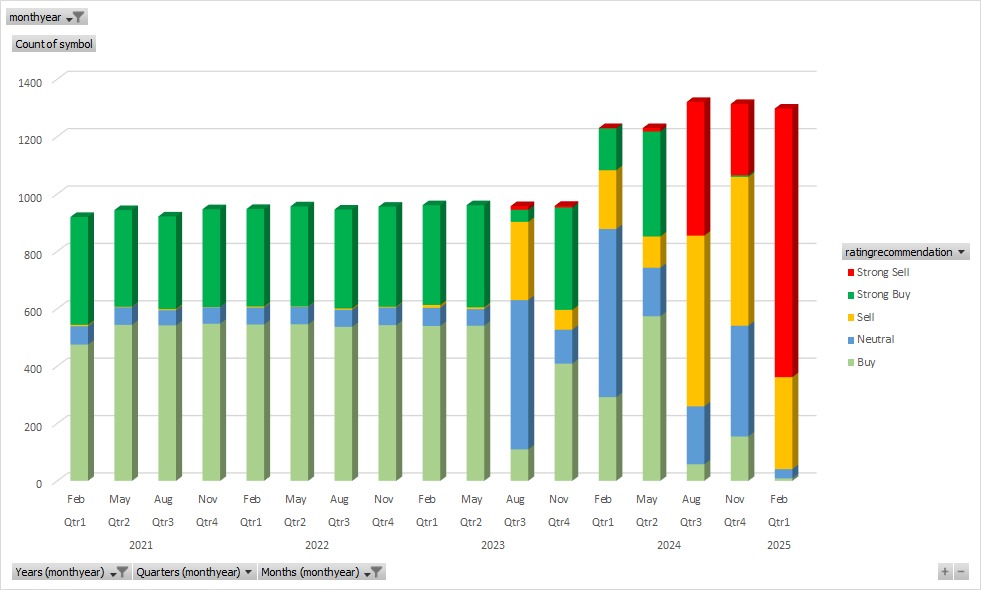
Our analysis from 2021 to 2025 showcases how using a multi-metric valuation approach provides deeper insights:[cite: 37]
Market Sentiment Shift: What It Means for Value Investors
The chart above tracks the evolution of rating recommendations over time, covering multiple years and showing trends in Buy, Neutral, Sell, Strong Buy, and Strong Sell ratings[cite: 37]. From a value investing perspective, these trends provide crucial insights into market sentiment, valuation shifts, and potential opportunities for long-term investors[cite: 37].
Key Insights for Value Investors:
- Steady Ratings in 2021-2022: A Bullish Market?
- The dominance of Buy (light green) and Strong Buy (dark green) ratings in early years suggests a phase where analysts found many stocks fairly valued or attractive for investment[cite: 37].
- 2023: Market Volatility Begins to Surface
- A noticeable shift occurs as Sell (yellow) ratings begin increasing while Buy ratings decline[cite: 37].
- This suggests that valuation metrics may have started revealing overvalued stocks, a key signal for value investors to exercise caution and focus on fundamentals before entering positions[cite: 37].
- 2024-2025: Panic Selling & Value Opportunities?
- A significant increase in Strong Sell (red) and Sell (yellow) ratings from mid-2024 onward indicates a broad decline in market confidence[cite: 37].
- As a value investor, this is where opportunities emerge stocks receiving strong sell recommendations might be undervalued due to temporary market pessimism[cite: 37].
- The decline in Buy ratings further suggests that market participants are favoring defensive strategies[cite: 37].
Adaptive Investment Strategies for Changing Markets
At Boss Investor, we continuously backtest and refine multiple valuation models to ensure our stock selection remains data-driven and responsive to market shifts[cite: 37]. When Buy or Strong Buy ratings decline, as seen in 2023-2024, it signals a need for strategic adaptation[cite: 37]. Instead of sticking to rigid valuation methods, we pivot our approach based on evolving market conditions[cite: 37].
To navigate tightening valuations, our model automatically shifts to alternative strategies such as Momentum & Technical Analysis for short-term plays, Sector Rotation to identify emerging opportunities, and Dividend & Defensive Stocks in uncertain markets[cite: 37]. By staying agile and forward-looking, we maximize returns, mitigate risk, and ensure that our investment strategy remains resilient across market cycles[cite: 37].
Final Thoughts
Value investing remains a proven strategy, but adapting to market shifts is crucial[cite: 37]. At Boss Investor, we blend timeless principles with data-driven insights to stay ahead[cite: 37]. By refining our approach and embracing dynamic strategies, we ensure resilient and profitable investments across market cycles[cite: 37].
Curious how our AI-powered Boss Investor platform can streamline your value investing strategy? Explore the Boss Investor app today![cite: 37]
BossInvestor is a SEBI Registered Research Analyst (INH000024143). Results shown are based on historical data and do not guarantee future performance[cite: 37].
Frequently Asked Questions
How do macro factors like inflation affect value investing principles in the Indian market?
Macroeconomic factors such as rising inflation and changing central bank interest rates directly impact corporate earnings, margins, and borrowing costs across corporate India[cite: 37]. When inflation rises, it frequently compresses profit margins for companies unable to pass on costs, altering their fundamental intrinsic value metrics[cite: 37]. Experienced value investors monitor these macroeconomic trends closely to adjust their discount rates and identify robust businesses with strong pricing power that can survive inflationary cycles without experiencing permanent capital destruction[cite: 37].
What is a value trap and how can an investor spot one?
A value trap is a stock that appears highly attractive and undervalued based on low trailing metrics like P/E or P/B ratios, but continues to decline due to structural issues[cite: 37]. These stocks remain cheap because their underlying business model faces severe challenges, such as deteriorating revenue streams, unsustainable dividend payouts, or obsolete technology[cite: 37]. Investors can spot value traps by looking beyond historical quantitative metrics, conducting rigorous qualitative assessments of management capability, studying industry shifts, and verifying whether competitive advantages still protect the business[cite: 37].
Why should an equity investor combine fundamental analysis with momentum and technical analysis?
Combining fundamental analysis with momentum indicators creates a more adaptive investment strategy that optimizes both selection and entry timing[cite: 37]. While fundamental research helps identify long-term wealth creators trading below their intrinsic worth, asset prices can remain depressed for extensive periods due to poor market sentiment[cite: 37]. Incorporating momentum and technical analysis allows a systematic framework to dynamically adapt to shifting cycles, shifting capital into alternative allocations or defensive sectors when traditional value indicators signal prolonged market consolidation or broad corrections[cite: 37].
How does the discount rate assumption impact the outcome of a DCF valuation model?
The discount rate assumption is one of the most sensitive inputs in a Discounted Cash Flow valuation model because it establishes the present value of all projected future earnings[cite: 37]. Even fractional changes in this assumed percentage, which represents the required rate of return or cost of capital, drastically shift the final intrinsic value calculation[cite: 37]. Because minor adjustments significantly alter valuations, relying solely on a single DCF output can mislead investors, underscoring the absolute necessity of employing a multi-metric approach that references P/E, P/B, and PEG averages alongside cash flow projections[cite: 37].
What metrics constitute a comprehensive multi-metric valuation rating for analyzing equity securities?
A comprehensive multi-metric valuation rating moves away from individual ratio dependencies by building a blended score across multiple financial disciplines[cite: 37]. This holistic framework typically averages the distinct signals from the Price-to-Earnings ratio, Price-to-Book ratio, Price/Earnings-to-Growth ratio, and Discounted Cash Flow models, balanced alongside return efficiencies like Return on Equity and Return on Assets[cite: 37]. Aggregating these diverse metrics offers deeper structural insights into stock performance, captures market sentiment shifts more effectively, and aligns data cleanly with real-world sector benchmarks[cite: 37].
Related Blogs

Biocon Shares Jump 6% on Volume Breakout & Biosimilars Growth
Published: Thu Jul 16 2026Read more…

SBI Funds Management IPO Closes: ₹11,693 Cr Issue Sets Record
Published: Thu Jul 16 2026Read more…

Alok Industries Q1 FY27 Results Board Meeting Today
Published: Thu Jul 16 2026Read more…

ITC Hotels Slips 5% Despite 36% Jump in Q1 Net Profit
Published: Fri Jul 17 2026Read more…