How to check if a company has too much debt
A step-by-step method to judge how much debt a listed Indian company is carrying, using only the numbers it already files with NSE and BSE. You will learn which four figures matter, what levels are comfortable, and which warning signs show up months before the debt actually breaks the business.

BOSSINVESTOR
Mon Sep 07 2026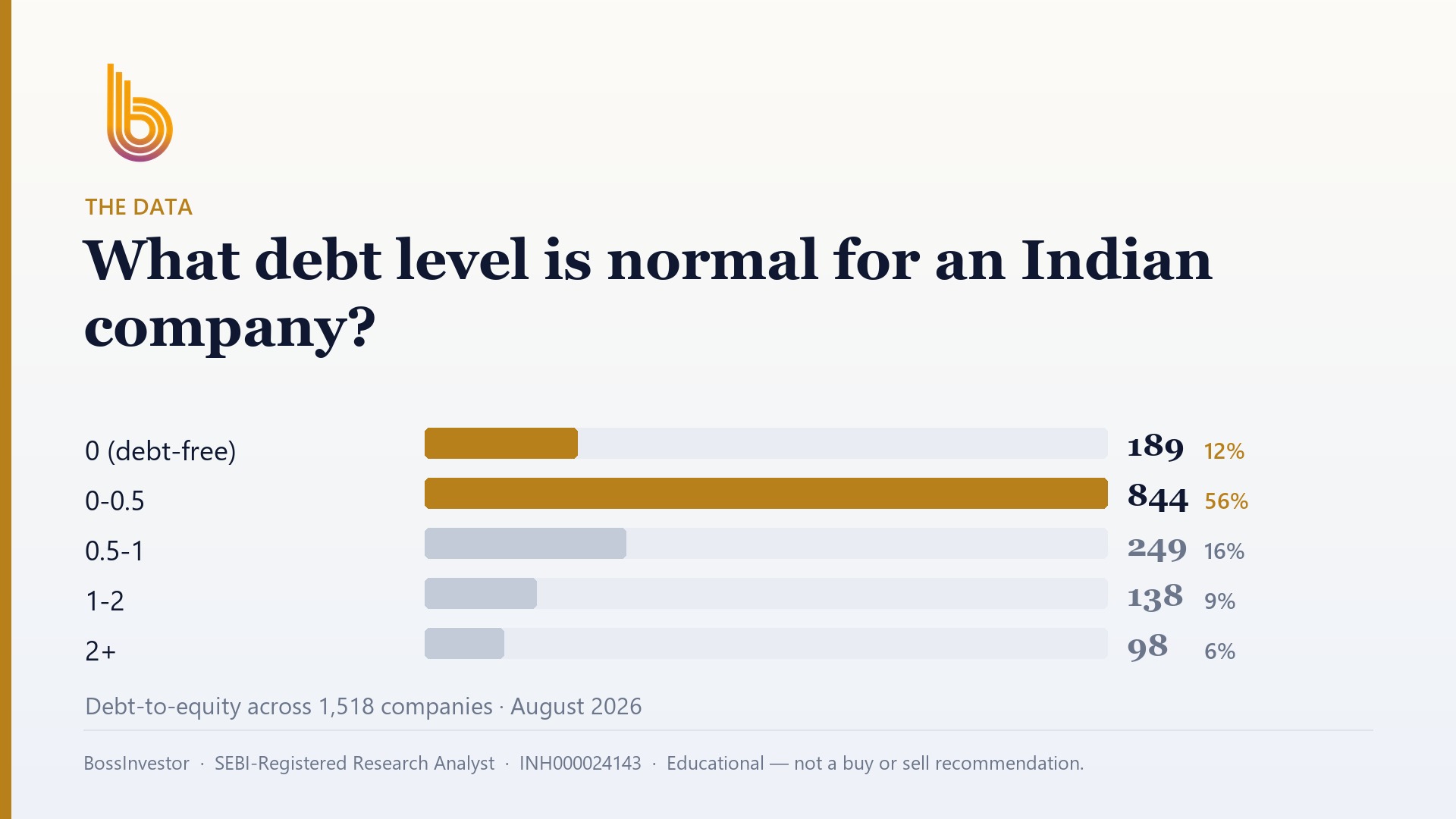
What is the quickest way to tell if an Indian listed company is carrying too much debt?
Check four numbers from the company's consolidated filings on NSE or BSE: debt-to-equity (below 1 is comfortable for most non-financial firms), interest coverage (operating profit at least 3 times interest cost), total debt against yearly operating profit, and whether borrowings are rising faster than profits. Two of these failing together is the real warning.
Key Takeaways
- Debt is not the problem; debt the business cannot service out of its own cash flow is.
- Debt-to-equity below 1 and interest coverage above 3 is the everyday comfort zone for a non-financial company.
- As of August 2026, 1,282 of 1,518 listed Indian companies with full-year fundamentals — 84.5% — had debt-to-equity below 1.
- Always use consolidated numbers; debt often sits in subsidiaries, not in the parent.
- A profitable company with negative cash from operations is a debt problem waiting to be announced.
- Never apply a flat debt-to-equity rule to banks and NBFCs — borrowing is their raw material.
What does 'too much debt' actually mean for a listed company?
Debt by itself is not a sin. A cement company borrows to build a plant, runs the plant, and earns more from it than the interest it pays the bank. In India, interest is deducted before tax is calculated, so borrowing cheaply and earning more than the cost of it genuinely makes shareholders richer. That is the whole point of a balance sheet.
Debt becomes dangerous when repaying it depends on something the company does not control — a commodity price, a government order, a good monsoon, or a fresh loan to repay the old one. So 'too much debt' is never a single number. It is a relationship between three things: how much is owed, how much the business earns before interest, and how much cash actually reaches the bank account each year. A steel or infrastructure company can carry far more debt than an IT services firm whose only assets are laptops and people. Judge the debt against the business it is sitting on, not against a rule you read once on a forum.
Which numbers do I need, and where do I find them on NSE or BSE?
You need six figures, all of them free. From the balance sheet: total borrowings (long-term plus short-term, and do not forget the current maturities of long-term debt), shareholders' equity (share capital plus reserves), and cash plus liquid investments. From the profit and loss statement: operating profit and finance cost. From the cash flow statement: net cash from operating activities.
Every listed company files these with the exchanges. Go to the NSE or BSE website, search the company, and open Financial Results for the quarterly numbers and the Annual Report for the full set with notes. Screening websites are fine for a first pass, but the notes to accounts only exist in the annual report, and that is where the uncomfortable details live.
One rule that saves people a lot of money: always use consolidated numbers, not standalone. A parent company can look almost debt-free while three subsidiaries carry the borrowings. Consolidated statements add the subsidiaries back in. If a company's standalone and consolidated debt figures are very different, that gap is itself worth understanding before you invest a rupee.
What is a safe debt-to-equity ratio for an Indian stock?
Debt-to-equity is total borrowings divided by shareholders' equity. It answers a simple question: for every rupee the owners have put in, how many rupees has the company borrowed? An illustrative example: if equity is ₹500 crore and total borrowings are ₹900 crore, debt-to-equity is 1.8 — the lenders have put in almost twice what the owners have.
As a working rule for non-financial companies, below 1 is comfortable, 1 to 2 needs a good reason and steady cash flows, and above 2 means the lenders, not the shareholders, effectively control the company's future. Anything above 3 should require you to prove to yourself why it is safe rather than assume it is.
Here is the useful context. In our own universe, as of August 2026, of 1,518 listed Indian companies with full-year fundamentals (out of 1,852 tracked), 1,282 — that is 84.5% — carried debt-to-equity below 1. Low debt is the normal state of a listed Indian company, not an achievement. When you find one above 2, you are looking at the minority, and you should ask why. Note the exception: banks and NBFCs are unfairly penalised by a flat debt-to-equity rule, because borrowing money is literally their business model.
How do I check whether the company can actually pay the interest?
This is the check most retail investors skip, and it matters more than the ratio above. Interest coverage is operating profit divided by finance cost. Illustrative figures: if operating profit is ₹240 crore and the interest bill is ₹80 crore, coverage is 3 times — the company earns three rupees of operating profit for every rupee of interest it owes.
Above 3 is comfortable. Between 2 and 3, there is no room for a bad year. Below 1.5, a single weak quarter or a rate increase starts to hurt. Below 1, the company is not earning enough to pay its interest and is surviving on refinancing, asset sales or promoter support.
Then do the second version of this test: total borrowings divided by one year's operating profit. This tells you how many years of full operating profit it would take to clear the debt. Under 3 years is comfortable for most businesses; beyond 5, the debt is no longer being repaid from operations, it is being rolled over. Look at both numbers for five years, not one, and specifically at the worst year in that stretch. Debt does not kill companies in good years.
Why can a company with low debt-to-equity still be in trouble?
Because equity can be flattered. If a large slice of shareholders' equity is goodwill from an old acquisition or a revalued property, the denominator is soft and the ratio looks better than the reality. Strip out goodwill mentally and see how the ratio changes.
There are three more traps. First, short-term borrowings. A company can keep debt low on paper by using working capital loans that get rolled over every few months — cheap until the day a bank refuses to roll them. Look at how much of the total debt matures within twelve months. Second, cash flow. A company can report healthy profits while cash from operations is negative, which usually means the profit is stuck in receivables or inventory. Profit pays no interest; cash does. Third, obligations that are not called debt: lease liabilities, guarantees given for group companies, and contingent liabilities disclosed in the notes to accounts.
Finally, check the shareholding pattern filed with the exchanges for promoter shares pledged. The company's own books can be clean while the promoter has borrowed heavily against their stake. If the share price falls, forced selling follows, and the stock falls further for reasons that have nothing to do with the business.
How should I judge debt for a bank or an NBFC?
Do not use debt-to-equity at all. A bank takes deposits and an NBFC borrows from banks and markets, then lends that money out at a higher rate. Borrowing is the raw material, so a debt-to-equity of 6 or 8 can be perfectly ordinary. Any screen that filters out high debt — including the 84.5% figure quoted above — will unfairly reject good lenders.
For a lender, look at different things. Capital adequacy ratio tells you how much cushion sits behind the loan book, and the RBI sets the minimum. Gross and net non-performing assets tell you how much of the lending has gone bad, and the trend over eight quarters matters more than any single number. Provision coverage tells you how much has already been set aside against those bad loans. The gap between what it earns on loans and what it pays for funds tells you whether the model works.
One more thing specific to NBFCs: check whether short-term borrowings are funding long-term loans. That mismatch is what turns a liquidity scare into a collapse, and India has watched it happen more than once.
What warning signs appear before the debt actually breaks a company?
Debt trouble is slow and it is announced in advance, in small print. Watch for borrowings rising while sales stay flat — that means the company is borrowing to run, not to grow. Watch for the interest cost growing faster than operating profit for several quarters in a row. Watch for a credit rating action from CRISIL, ICRA or CARE: a downgrade, or even a shift to 'rating watch with negative implications', is a professional team telling you the repayment ability has weakened.
Then the governance signals. An auditor's qualification or an emphasis of matter about the company's ability to continue operating is the loudest signal in any annual report. A sudden auditor or CFO resignation is another. Repeated fundraising through rights issues or QIPs where the stated purpose is 'repayment of borrowings' means shareholders are being asked to pay the lenders. Delayed results filings, rising pledged promoter shares, and one-time asset sales propping up profits all belong on the same list.
None of these is proof on its own. Two or three together, in the same company, in the same year, is a pattern — and by the time it becomes news, the price has usually already moved.
How do I run this whole debt check in ten minutes?
Open the latest annual report and take the consolidated figures. One: calculate debt-to-equity and note whether it is under 1, between 1 and 2, or above 2. Two: calculate interest coverage and confirm it is above 3. Three: divide total borrowings by one year's operating profit and check it is under 3 years. Four: confirm cash from operations has been positive in at least four of the last five years.
Then spend the last four minutes on the trend and the notes. Put five years of borrowings side by side. Are they rising, flat or falling, and is sales growth keeping pace? Read the contingent liabilities note, the maturity profile of debt, and any auditor comment. Check the shareholding pattern for pledged promoter shares.
Remember that debt is only one of three quality tests. In our universe, as of August 2026, only 22.0% of the 1,518 companies with full-year fundamentals cleared return on equity above 15%, return on capital employed above 15%, and debt-to-equity below 1 at the same time. Low debt with poor returns is not safety — it is just a slow business that has not borrowed yet.
Click Here – See BossInvestor's Data-Driven Stock Screens
Conclusion
Judging debt is not about memorising one ratio. It is about asking whether the company's own cash flow can service what it owes, in a bad year, without help from a bank or a promoter. Run the four numbers on consolidated figures, look at five years rather than one quarter, and read the notes where the uncomfortable details are disclosed. If you would rather see which companies in the Indian market currently clear these tests together, that screening — and the actual call on any single stock — sits behind KYC in the BossInvestor app.
BossInvestor is a SEBI Registered Research Analyst (INH000024143). This article is for educational and informational purposes only. It explains a method and is not investment advice, nor a recommendation to buy, sell or hold any security. Market-wide figures are computed from our universe as of August 2026; past metrics do not guarantee future results. Always do your own research or consult a registered adviser before investing.
Frequently Asked Questions
Is zero debt always better for a company?
No. A company with zero debt may simply be avoiding growth, or may not have opportunities worth funding. Since interest is deductible before tax in India, cheap borrowing that earns more than it costs genuinely benefits shareholders. What matters is whether the returns on capital comfortably exceed the cost of borrowing, and whether operating cash flow covers interest several times over. Zero debt with weak returns is not safety; it is a business going nowhere quietly.
Should I use standalone or consolidated numbers to check debt?
Always consolidated. Standalone figures cover only the parent company, and borrowings are frequently held in subsidiaries, joint ventures or special purpose vehicles created for specific projects. A parent can look nearly debt-free while the group carries heavy borrowings. Consolidated statements combine all of it. If you notice a wide gap between the standalone and consolidated debt figures, treat that gap as a question to answer before investing, not a detail to ignore.
What interest coverage ratio is considered dangerous?
Below 1.5 is fragile and below 1 is genuinely dangerous, because the company is not earning enough operating profit to cover its interest bill and must rely on refinancing, asset sales or promoter support to survive. Between 2 and 3 there is no cushion for a weak year. Above 3 is comfortable for most businesses. Check the ratio across five years and pay attention to the worst year, since debt rarely causes trouble during good years.
How many Indian listed companies actually have low debt?
In our own universe, as of August 2026, 1,282 of the 1,518 listed Indian companies with full-year fundamentals — 84.5% — had debt-to-equity below 1. So low debt is the normal condition for a listed Indian company rather than a rare virtue. A heavily indebted company is the exception and deserves a specific explanation. One caveat: this screen unfairly rejects banks and NBFCs, because borrowing is the core of how lending businesses operate.
Related Blogs
How to Analyse a Stock Before Buying: A 10-Point Checklist
Published: Mon Sep 07 2026Read more…

How to Calculate Your Financial Freedom Number and Achieve It
Published: Tue May 20 2025Read more…
 (1).jpg)
From Signal to Strategy: The Moving Averages
Published: Tue May 20 2025Read more…

Market Share: The Silent Signal of Competitive Power and Investment Opportunity
Published: Wed May 14 2025Read more…