How to check promoter and management quality
Most retail investors judge promoters by interviews and news headlines. That is the slowest and least reliable way. This page shows you the paper trail every listed Indian company is legally required to publish, and exactly what to look for in it.

BOSSINVESTOR
Mon Sep 07 2026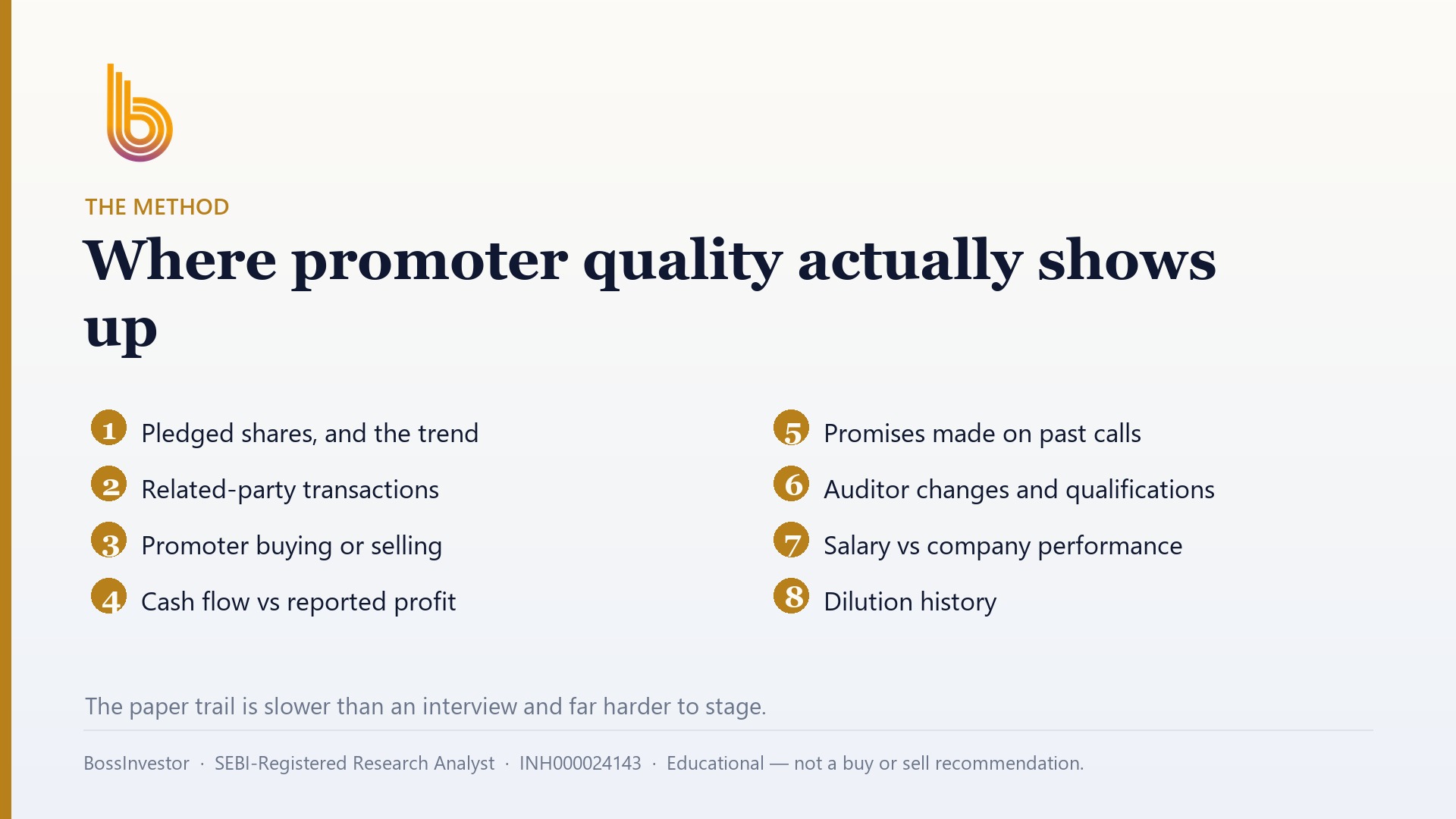
What is the fastest way to judge a promoter from public filings?
Check promoter and management quality using public filings, not opinions. Read four things: promoter shareholding and pledge percentage in the quarterly BSE/NSE filing, related-party transactions and auditor remarks in the annual report, cash flow from operations against reported profit, and whether past guidance was met. Weak numbers plus vague answers mean walk away.
Key Takeaways
- Promoter quality is a paper trail, not a personality. Read filings, not interviews.
- Pledged promoter shares are a warning light — check the percentage every quarter.
- If profit rises but cash flow from operations does not, stop and ask why.
- Related-party transactions are where money quietly leaves a minority shareholder's pocket.
- An auditor resigning mid-term is one of the loudest signals in Indian markets.
- As of August 2026, only 22.0% of 1,518 Indian companies with full-year fundamentals clear a basic quality bar.
What does 'promoter quality' actually mean for a minority shareholder?
In an Indian listed company, the promoter is the family or group that controls the business. You, buying 50 shares on the NSE, are a minority shareholder. You have almost no ability to change anything. So the promoter's honesty is not a soft, feel-good issue. It is the single largest risk you cannot diversify away inside one stock.
Promoter quality means two separate things. First, competence: can they run the business and allocate money well? Second, and more important, integrity: when the company makes profit, does that profit reach you as a shareholder, or does it get quietly routed somewhere else? A brilliant operator who treats the listed entity as a personal ATM is more dangerous to you than an average operator who is honest.
The good news is that both show up in numbers and documents, over time. A promoter can give a confident TV interview. It is much harder to fake five years of cash flow statements, dividend history, pledge disclosures and related-party notes. That is where you should be looking.
Where do I find promoter shareholding and pledge data for free?
Every listed company files a shareholding pattern with BSE and NSE within 21 days of each quarter ending. Go to the exchange website, search the company, and open the Shareholding Pattern section. It is free and it is the primary source — not a screener, not a blog. The same document sits under Investor Relations on the company's own website.
Look at three columns. Promoter and promoter group holding as a percentage. Number of shares pledged or otherwise encumbered. And the public shareholding split — how much is with mutual funds, insurance companies and FIIs versus individual retail investors. Write these down for the last eight quarters. You want the trend, not one snapshot.
Also open the annual report, which is on the same Investor Relations page and on BSE. The sections that matter are the auditor's report, the notes on related-party transactions, the corporate governance report, and the managerial remuneration disclosure. Nobody reads these. That is precisely why reading them gives you an edge.
What does a falling promoter stake or a high pledge tell me?
Pledging means the promoter has taken a loan against their own shares. If the share price falls, the lender can sell those shares in the open market. That selling pushes the price down further, which triggers more selling. Indian markets have seen this loop destroy prices in weeks. A pledge above roughly 25% of promoter holding deserves a hard question. Above 50%, most careful investors simply move on.
A steadily falling promoter stake is a different signal, and you must read the reason before you react. Some reductions are healthy and legally required — a company meeting the 25% minimum public shareholding rule, or a promoter selling to a strategic partner. Others are the family quietly stepping back. Check the disclosure filed with the exchange under SEBI's insider trading rules; the reason is usually stated.
Rising promoter stake through open-market purchases is a genuinely useful positive. The people with the most information are putting their own rupees in at the current price. It is not a guarantee, but it is honest evidence, and it costs them real money to fake.
How do I check whether the reported profit is real cash?
Profit is an opinion. Cash is a fact. Open the cash flow statement in the annual report and find Cash Flow from Operations. Compare it with net profit for the same year. Do this for five years, not one — a single bad year can be a genuine working capital cycle.
Here is an illustrative example with made-up figures. Suppose a company reports net profit of ₹100 crore in each of five years, so ₹500 crore in total. But cumulative cash flow from operations over those five years is only ₹120 crore. That gap means the profit exists mostly on paper — usually stuck in receivables customers have not paid, or inventory nobody bought. A high-quality management team closes that gap. A weak one keeps announcing profit and keeps raising debt to pay the electricity bill.
Also check receivable days and inventory days over the same five years. If sales grow 20% but receivables grow 60%, the company may be booking sales to customers who cannot pay. Ask that question before the auditor does.
How do I read related-party transactions without an accounting degree?
Related-party transactions are deals between the listed company and entities connected to the promoter — a family-owned supplier, a private company that leases the factory, a loan given to a group firm. Some are completely normal. Many Indian groups genuinely have shared logistics or shared brands. The problem is the ones that are not normal.
Go to the notes in the annual report, find the related-party section, and add up the rupee value of transactions with promoter-linked entities. Then compare that total against revenue and against profit. If a company earns ₹200 crore in profit and moves ₹300 crore through promoter-linked entities every year, you are no longer investing in a business — you are trusting a family's internal accounting.
The specific patterns worth fearing: interest-free or cheap loans and advances to group companies, corporate guarantees given for private group entities, buying raw material from a promoter firm at prices you cannot verify, and royalty or brand fees paid to the promoter family. SEBI now requires shareholder approval for material related-party transactions, so also check whether such resolutions keep appearing in the AGM notice year after year.
Is the management paying itself too much?
The annual report must disclose managerial remuneration, including the ratio of each director's pay to the median employee's pay. This is one of the fastest quality checks available and it takes two minutes.
Compare total promoter-director pay against net profit. Take these illustrative numbers: a company with ₹40 crore net profit paying ₹12 crore across three promoter-directors is handing 30% of shareholder profit to one family. Compare that with a similarly sized company paying ₹3 crore. Neither number is automatically right, but the first one demands an explanation you should be able to find in the report.
Then check the direction over five years. Pay that rises smoothly while profit falls is a governance signal, not an HR detail. Also look at whether dividends grew alongside promoter pay. A promoter who raises their own salary in a weak year but skips the dividend has told you exactly where you rank.
What do auditor changes and resignations really signal?
An auditor resigning before their term ends is among the most serious signals in Indian markets. Auditors rarely walk away from a paying client. When they do, and the resignation letter mentions incomplete information, unavailable records, or an inability to verify balances, treat it as a full stop rather than a detail to research further.
Even without a resignation, read the auditor's opinion in the annual report. A clean opinion is standard. A qualified opinion, an emphasis of matter, or an adverse opinion means the auditor is publicly flagging something. Read exactly what they flagged, in their words. It is usually one short paragraph, and it is written plainly.
Add three more checks from the same document. Frequent CFO changes — three CFOs in four years is a pattern, not a coincidence. Delayed results filings with the exchanges. And the composition of the board: are the independent directors genuinely independent, or are they long-standing family associates who have sat there for fifteen years?
How do I check if management actually did what it promised?
This is the check that separates careful investors from everyone else, and it costs nothing but time. Pull up the earnings call transcripts and management commentary from three years ago. Write down every specific promise: a capacity expansion, a margin target, a debt reduction plan, a new plant coming online by a stated quarter.
Now check what actually happened. Did the plant get commissioned on time? Did debt actually come down? Did the margin reach the number they promised, or did the target quietly get restated as ambition? Management teams that consistently deliver what they say tend to keep doing it. Teams that miss and then stop mentioning the old target have told you how much their words are worth.
Pay attention to how they handle a bad quarter on the call. Honest management explains what went wrong and what they are changing. Weak management blames the monsoon, the government, the dollar, and the industry cycle — never a decision they made. Listen for who takes responsibility.
How many Indian companies actually pass a basic quality screen?
Good governance usually leaves a financial fingerprint: decent returns on capital and controlled debt, sustained over years. So it helps to know how rare that is. Across our universe of 1,852 listed Indian companies as of August 2026, 1,518 had full-year fundamentals available. Of those, only 22.0% — 334 companies — cleared a basic quality bar of return on equity above 15%, return on capital employed above 15%, and debt-to-equity below 1, all at the same time.
Add a simple valuation filter of PE under 40 and you are left with 15.9%, or 241 companies. For context, the median PE across that same set was 24.0 in August 2026. So roughly four out of five listed Indian companies fail a screen that most investors would consider the bare minimum before they even open the annual report.
One important caveat. A flat debt-to-equity rule unfairly punishes banks and NBFCs, because borrowing is literally their business model. For lenders, judge management on asset quality, provisioning honesty and capital adequacy instead — and treat every sudden change in how bad loans are recognised as a governance question, not an accounting one.
Use the screen to shorten your list, never to finish your work. A company can clear all three ratios and still be run by a promoter who is routing profit through a cousin's trading firm. The numbers get you to a shortlist of a few hundred. The filings get you to the ten you can actually hold.
Click Here – See BossInvestor's Data-Driven Stock Screens
Conclusion
Promoter and management quality is not a feeling you develop from watching interviews. It is a checklist you run: shareholding and pledge trend, cash flow versus profit, related-party value, remuneration, auditor language, and promises kept. Run it on five years of filings before you buy, and re-run the shareholding and pledge check every quarter after. If you would rather see this method already applied to specific names, that work sits behind KYC in our app — but the method above is yours to use for free, on any stock on the NSE or BSE.
BossInvestor is a SEBI Registered Research Analyst (INH000024143). This article is for educational and informational purposes only. It explains a method and is not investment advice, nor a recommendation to buy, sell or hold any security. Market-wide figures are computed from our universe as of August 2026; past metrics do not guarantee future results. Always do your own research or consult a registered adviser before investing.
Frequently Asked Questions
Is a high promoter holding always a good sign?
Not always. High promoter holding means their money is aligned with yours, which is genuinely useful. But it also means they control every decision and minority shareholders cannot push back. What matters more is the trend and the quality of what they do with that control. A promoter holding 70% who pays fair dividends and keeps related-party deals small is very different from one holding 70% who runs everything through family entities.
How often should I re-check promoter quality after buying?
Check shareholding pattern and pledge percentage every quarter, within about a month of quarter-end when the exchange filing appears. It takes five minutes. Read the full annual report once a year, focusing on the auditor's opinion, related-party notes and remuneration. Check any special announcements immediately — an auditor resignation, a CFO exit, or a sudden pledge increase deserves attention the same week, not at your next annual review.
What is the single biggest red flag for promoter quality?
An auditor resigning mid-term while citing lack of information or inability to verify records. Auditors do not walk away from fee-paying clients casually, and by the time they do, the problem is usually large and already known internally. Close behind it: a large gap between reported profit and cash flow from operations sustained over several years, combined with rising related-party transactions. Individually those are questions; together they are an answer.
Do these checks work for small-cap and micro-cap companies?
They matter more there, not less. Large caps are watched by analysts, institutions and the financial press, so governance problems surface faster. Small and micro caps often have thin institutional ownership, less scrutiny and lower liquidity, which means you may not be able to exit quickly when something breaks. The filings are legally required for every listed company regardless of size, so the same checklist applies — just apply it more strictly.
Can a company with a weak promoter still make me money?
Sometimes, for a while, especially in a strong bull market when everything rises. The problem is that you cannot know when the story ends, and governance failures usually reveal themselves suddenly rather than gradually. When they do, the fall is fast and often accompanied by circuit limits that stop you from selling at all. Over a full market cycle, avoiding a handful of these outcomes typically does more for your returns than picking a few extra winners.
Related Blogs
How to Analyse a Stock Before Buying: A 10-Point Checklist
Published: Mon Sep 07 2026Read more…

How to Calculate Your Financial Freedom Number and Achieve It
Published: Tue May 20 2025Read more…
 (1).jpg)
From Signal to Strategy: The Moving Averages
Published: Tue May 20 2025Read more…

Market Share: The Silent Signal of Competitive Power and Investment Opportunity
Published: Wed May 14 2025Read more…