How to identify a good company to invest in
Most retail investors buy a stock price, not a business. This page walks you through the exact order of checks — the business, the returns on capital, the debt, the cash flow, the promoters, and finally the price — using plain language and Indian numbers. By the end you will have a checklist you can run on any NSE or BSE listed company in about forty minutes.

BOSSINVESTOR
Mon Sep 07 2026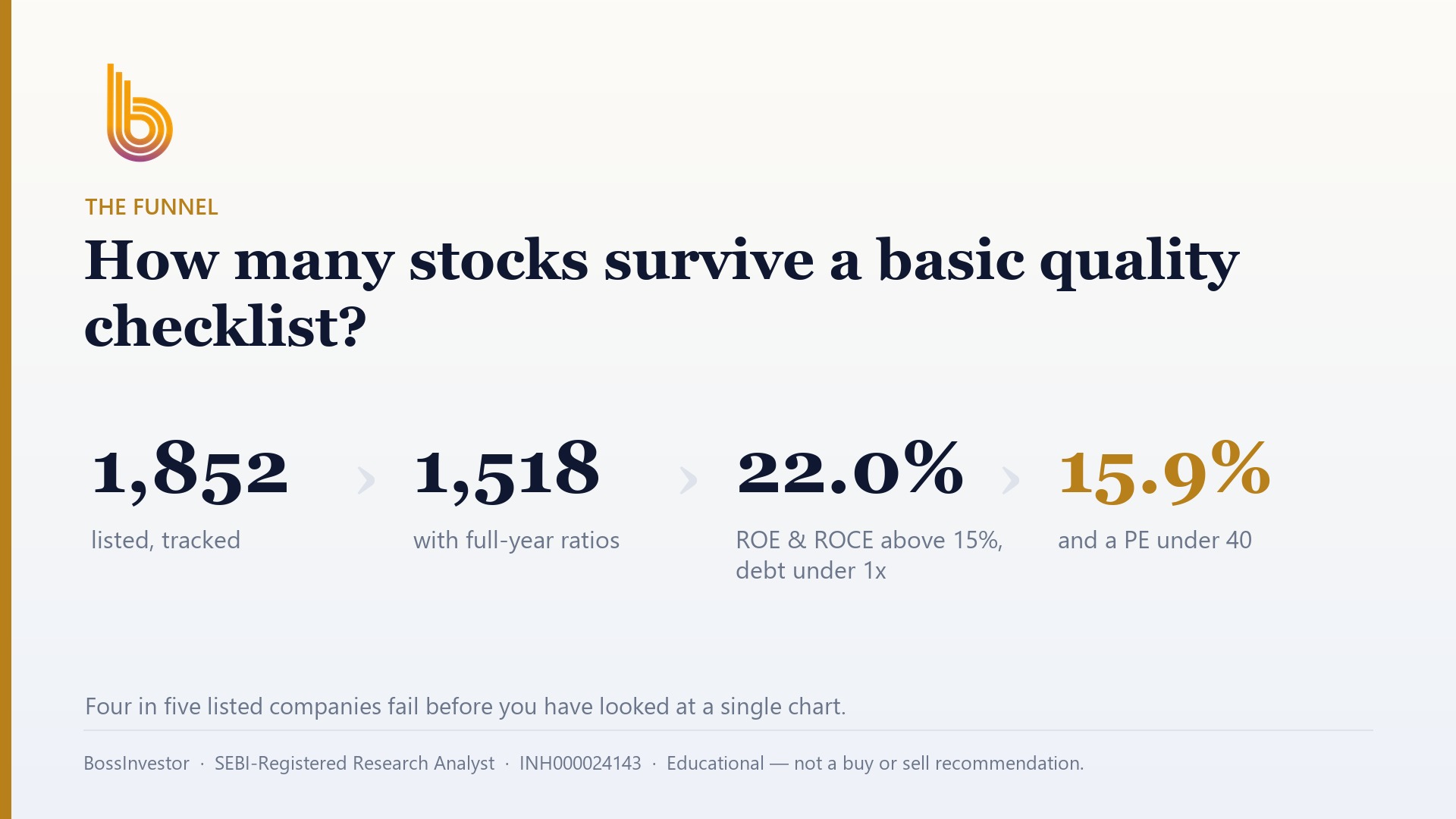
What separates a genuinely good listed company from an ordinary one?
Start with the business, then the numbers. A good company earns a high return on the money it uses, funds growth without heavy debt, converts profit into real cash, and is run by honest promoters. Of 1,518 Indian companies with full-year fundamentals, only 22.0% clear that bar (August 2026).
Key Takeaways
- Understand what the company sells and why customers keep paying before you look at a single ratio.
- ROE and ROCE above 15% tell you the business earns well on the money it uses.
- Only 22.0% of 1,518 Indian companies with full-year fundamentals clear ROE, ROCE and debt together (August 2026).
- Profit without matching cash from operations is the single most common warning sign.
- Check promoter holding, pledged shares and auditor changes — governance beats growth.
- Price still matters: median PE across our universe is 24.0, and quality plus a valuation check leaves just 15.9%.
What actually makes a company 'good' — the business or the numbers?
The business comes first. Numbers are the scoreboard; the business is the game. Before you open a single ratio, answer three questions in your own words: What does this company sell? Who pays for it, and why do they keep coming back? What stops a rival with deep pockets from taking that customer tomorrow? If you cannot answer all three in two plain sentences, you are not investing. You are guessing with a broker app open.
Take neutral examples of how Indian businesses actually win. A cement plant sells an identical grey powder, so it wins on where the plant sits and what freight costs to the nearest market. A paint company wins because fifty thousand small dealers stock its tins and the painter asks for it by name. A software services firm wins because ripping it out of a client's systems is painful and expensive. These are three completely different reasons to survive, and each one shows up differently in the accounts.
Only after you have the story do the numbers earn their place. Their job is to confirm or destroy what you just told yourself. A company that says it has a strong brand but earns a thin return on its capital does not have a strong brand. It has a marketing department.
Which financial ratios should I check first, and what do they actually mean?
Four checks cover most of the ground. Return on equity, or ROE, asks how much profit the company makes on the shareholders' money. Return on capital employed, or ROCE, asks the tougher version: how much operating profit it makes on all the money it uses, including borrowed money. Debt-to-equity tells you how much of the business is funded by lenders. And a five to ten year record of sales and profit growth tells you whether any of this is repeatable or was a one-good-year accident.
Here is an illustrative example, with made-up round figures used only to show the arithmetic. Suppose a company uses ₹100 crore of total capital — ₹70 crore of shareholders' money and ₹30 crore of loans — and earns ₹20 crore of operating profit for the year. That is a 20% ROCE. Now suppose a second company earns the same ₹20 crore but needed ₹400 crore of capital to do it. That is 5%. Both report a profit. Only one of them is a good business, because the second one is barely beating a fixed deposit while carrying all the risk of running a factory.
Add one more habit: look at the operating margin over five years, not one. A margin that grinds slowly upward usually means pricing power. A margin that swings violently means the company is a passenger, and something outside its control — commodity prices, a government tender cycle, the rupee — is driving.
How many Indian listed companies actually pass a basic quality check?
Far fewer than you would think, and this is the number that should change how you shop. Across our universe of 1,852 listed Indian companies as of August 2026, 1,518 had full-year fundamentals available. Of those, 458 companies (30.2%) had ROE above 15%. Separately, 464 companies (30.6%) had ROCE above 15%. And 1,282 companies (84.5%) had debt-to-equity below 1.
The interesting part is what happens when you insist on all three at once. Only 334 companies — 22.0% of the 1,518 — clear ROE above 15%, ROCE above 15% and debt-to-equity below 1 at the same time (August 2026). Roughly four out of five listed Indian companies fail a bar that most investors would describe as merely reasonable. This is why hunting for a good company feels hard. It is hard, because they are rare.
One honest caveat before you run this screen yourself. A flat debt-to-equity rule is unfair to banks and NBFCs, because borrowing is literally their business model. A well-run bank will look terrible on that filter and a badly-run one will too. For lenders, look instead at asset quality, provisioning and capital adequacy, and judge them on their own terms rather than throwing them out on a ratio built for manufacturers.
How do I check whether the reported profit is real cash?
This is the check that separates careful investors from the rest, and it takes ten minutes. Open the cash flow statement in the annual report. Compare cash generated from operations with net profit, for each of the last five to seven years, and add both columns up. If a company reported, say, ₹500 crore of cumulative profit and generated ₹450 crore of cumulative operating cash, that is healthy. If it reported ₹500 crore of profit and generated ₹80 crore of cash, the profit is sitting somewhere other than the bank account. These figures are illustrative, used only to show the comparison.
When the cash is missing, find out where it went. Usually it is trapped in receivables — money customers owe but have not paid — or in inventory piling up in warehouses. A quick test: if sales grew 20% but receivables grew 60%, the company may be booking sales it will struggle to collect. Some Indian companies do this near the year end to make the annual number look good, and it unwinds in the next two quarters.
The last piece is what the company does with the cash it does generate. Money spent on new plants that later earn a good return is excellent. Money that quietly leaves through 'loans and advances to related parties' or an unexplained acquisition in an unrelated business is a reason to close the tab and move on.
How do I judge the promoters and management of an Indian company?
In India, governance is not a soft factor. It is often the whole investment. Start with the quarterly shareholding pattern filed with NSE and BSE, which is free and public. Is promoter holding stable, rising, or quietly sliding down quarter after quarter? A steady drip of promoter selling, especially in a small company, deserves a real explanation.
Then check pledged shares. Promoters who have pledged a large chunk of their holding to raise personal loans have handed a lever to their lenders, and a falling stock price can force sales that crush the price further. Next, read the related party transactions note in the annual report — every rupee the listed company pays to entities the promoter family also owns. A handful of routine items is normal. Pages of them, growing every year, is not.
Three more signals, all quick. Did the statutory auditor resign mid-term, and did the exit letter give a vague reason? Are contingent liabilities large relative to net worth? And does management guidance from three years ago match what actually happened? A promoter who missed a target and said so plainly is worth far more than one who has never once been wrong in a concall.
Does the price I pay matter if the company is genuinely good?
Yes, and this is where good businesses turn into bad investments. A wonderful company bought at an absurd price can go sideways for five years while the earnings catch up to what you already paid. Across our universe in August 2026, 988 companies (65.1%) traded at a PE between 0 and 40, and the median PE was 24.0. That median is your rough sense of what the middle of the Indian market costs.
Now stack the filters. Add that PE-under-40 check on top of the quality bar and you are left with 241 companies — 15.9% of the 1,518 with full fundamentals (August 2026). Roughly one in six listed Indian companies is both decently run and not obviously expensive. That is your realistic hunting ground, and it is far smaller than the list of stocks being discussed on your feed today.
Use PE as a starting question, never as the answer. A low PE on a cyclical business — a metals or sugar company at the top of its cycle — is often a trap, because the E is about to fall. A high PE can be justified if the company genuinely reinvests at high returns for years. The right question is not 'is 30 too much', it is 'what growth and what returns does this price already assume, and is that assumption sane?'
What are the red flags that should make me walk away immediately?
Some findings are not a negotiation. Walk away when the auditor resigns without a clear reason, when a large share of promoter holding is pledged, when related party transactions keep growing, or when the company raises fresh equity every couple of years without the profit ever rising to match. Repeated dilution means existing shareholders are funding losses and calling it growth.
Watch for profit that comes from the wrong place. If the operating business is flat but net profit jumped because of 'other income' — treasury gains, a one-off land sale, a written-back provision — you are looking at an accounting event, not a better business. The same applies to a company that changes its stated line of business every few years to whatever is currently fashionable on the exchanges.
Finally, be careful about how the story reached you. A thinly traded small or SME-platform stock rising fast on messages, videos and forwarded screenshots is the classic setup where you are the exit for someone who bought earlier and cheaper. If the loudest thing about a company is the noise around it rather than anything in its filings, that is the finding.
How do I turn all this into a checklist I can actually use every time?
Run the checks in this order, because the order saves you time: business first, quality second, cash third, governance fourth, price last. Most candidates die in the first three steps, and dying early is the point — you want to spend your effort on the few that survive, not on writing a beautiful valuation model for a company you should never have opened.
Write the checklist down on one page and refuse to skip lines. Can I explain the business in two sentences? Is ROE and ROCE above 15% for most of the last five years? Is debt-to-equity comfortable, judged fairly for the industry? Did operating cash roughly track profit over five years? Is promoter holding stable, unpledged and clean on related party dealings? Is the price reasonable against what the business can plausibly earn? Six answers. Any 'no' you cannot explain is a pass, not a discussion.
Then treat the decision like a decision, not a reflex. Size the position so that being wrong costs you sleep, not your goals. Give the thesis a real holding period — holding beyond a year also moves the gain into the lower long-term capital gains rate rather than the higher short-term one — and revisit the same six questions each time results are filed. You are not re-checking the price. You are re-checking whether the reasons you bought are still true.
Click Here – See BossInvestor's Data-Driven Stock Screens
Conclusion
Identifying a good company is not a talent, it is a sequence: understand the business, demand high returns on capital, insist the profit shows up as cash, verify the people, and only then argue about price. The August 2026 numbers say roughly one in six listed Indian companies passes both a quality and a valuation check, so most of your work is saying no quickly. Run this checklist honestly and you will lose far fewer rupees to stories. If you would rather see which names currently clear these filters in our tracked universe, that research sits behind KYC inside the BossInvestor app.
BossInvestor is a SEBI Registered Research Analyst (INH000024143). This article is for educational and informational purposes only. It explains a method and is not investment advice, nor a recommendation to buy, sell or hold any security. Market-wide figures are computed from our universe as of August 2026; past metrics do not guarantee future results. Always do your own research or consult a registered adviser before investing.
Frequently Asked Questions
What is a good ROE and ROCE for an Indian company?
As a starting bar, ROE and ROCE above 15% sustained over five years is a reasonable definition of a business that earns well on the money it uses. In our universe as of August 2026, 458 of 1,518 companies (30.2%) had ROE above 15% and 464 (30.6%) had ROCE above 15%. Judge consistency, not one good year, and remember capital-heavy sectors and lenders need to be assessed on different terms.
How much debt is too much for a company I am considering?
For most manufacturing and services companies, debt-to-equity below 1 is a comfortable starting rule, and 1,282 of 1,518 companies (84.5%) cleared it in August 2026. More useful than the ratio alone is whether operating profit comfortably covers interest, and whether debt is falling as profits grow. Banks and NBFCs are the exception — borrowing is their business model, so judge them on asset quality, provisioning and capital adequacy instead.
Is a low PE ratio always a sign of a cheap stock?
No. A low PE often means the market expects earnings to fall, which is common in cyclical businesses like metals, sugar or commodity chemicals at the top of their cycle. The median PE in our universe was 24.0 in August 2026, so treat that as context rather than a target. Ask what growth and return on capital the current price assumes, and whether those assumptions are realistic for this specific business.
How long does it take to check one company properly?
About forty minutes to an hour for a first pass, once you have done a few. Ten minutes to understand the business, ten on the ratio history, ten comparing five years of profit against operating cash flow, ten on the shareholding pattern, related party notes and auditor history, and the rest on price. Most companies fail within the first twenty minutes, which is exactly what a good checklist is supposed to do.
Where do I find this data for NSE and BSE listed companies for free?
Annual reports and quarterly results are published on the company's own website and on the NSE and BSE filing pages, at no cost. The shareholding pattern, pledged share disclosure, auditor changes and related party notes all live there. Free screener websites are useful for a first sort on ratios, but always open the actual annual report before committing rupees, because the footnotes carry the information the summary tables leave out.
Related Blogs
How to Analyse a Stock Before Buying: A 10-Point Checklist
Published: Mon Sep 07 2026Read more…

How to Calculate Your Financial Freedom Number and Achieve It
Published: Tue May 20 2025Read more…
 (1).jpg)
From Signal to Strategy: The Moving Averages
Published: Tue May 20 2025Read more…

Market Share: The Silent Signal of Competitive Power and Investment Opportunity
Published: Wed May 14 2025Read more…