How to pick stocks for long term investment in India
Most people pick stocks from tips, then hold them for years hoping the loss comes back. This page gives you the opposite: a repeatable filter you can run yourself on any NSE or BSE listed company, in the order that actually matters. Business quality first, price second, patience third.

BOSSINVESTOR
Mon Sep 07 2026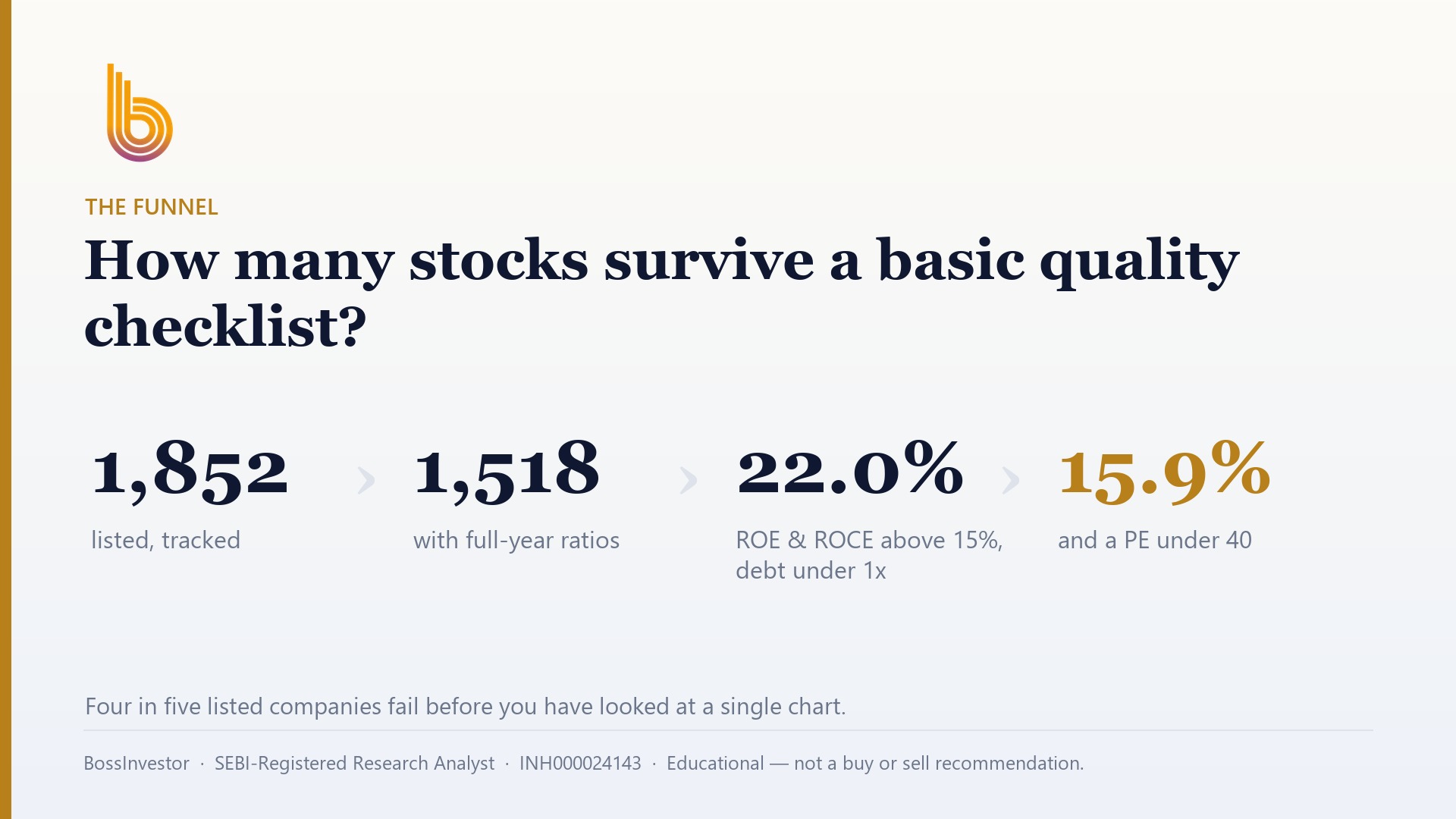
What is the right way to choose long-term stocks in the Indian market?
Pick long-term stocks by judging business quality first and price second. Look for ROE and ROCE above 15%, debt-to-equity below 1, a promoter you can trust and a growth runway of ten years or more, then pay a sensible PE. In our universe of 1,518 Indian companies with full-year fundamentals, only 22.0% clear that quality bar as of August 2026.
Key Takeaways
- Quality first, price second. A cheap bad business stays a bad business.
- ROE above 15%, ROCE above 15% and debt-to-equity below 1 is the basic quality bar.
- Only 22.0% of the 1,518 Indian companies with full-year fundamentals clear all three at once (August 2026).
- Add a PE-under-40 check and the list shrinks to 15.9%. Median PE across the universe is 24.0.
- Never apply a flat debt rule to banks and NBFCs. Borrowing is their business.
- Buy in tranches, hold 5-10 years, and sell only when the business breaks, not when the price wobbles.
What does "long term" actually mean for an Indian stock?
Long term is not one year. One year is a tax definition. For a business, one year is barely a full cycle of monsoons, GST filings and festival demand. When we say long term we mean five to ten years, long enough for profits to compound and for a bad quarter to stop mattering.
This matters because it changes what you look at. If you plan to hold for a decade, the daily chart is noise. What decides your return is how much profit the company earns on the money it puts to work, and whether it can keep putting more money to work at the same rate. Everything below is built around that one idea.
It also changes what you can ignore. You do not need to predict the Nifty. You do not need to time the RBI. You need to be right about roughly ten businesses over roughly ten years, and to not sell them in a panic in year three.
How do I narrow down 1,800 listed companies to a shortlist I can actually read?
Start by accepting that most listed companies are not investable for you. As of August 2026 our universe covers 1,852 listed Indian companies, of which 1,518 have full-year fundamentals we can score. That is your starting pool. The job of a screen is not to find winners. It is to throw away the obvious losers so your reading time goes to the survivors.
Run three filters in this order. First, is the business good? Second, is the balance sheet safe? Third, is the price sane? Do not reverse the order. If you sort by cheapest PE first, you will spend your evenings reading about companies that are cheap for a reason.
A screener on any Indian data platform can do this in a minute. What it cannot do is the next step, which is reading five years of annual reports and deciding whether the numbers were earned honestly. The screen buys you the time to do that reading.
Which numbers tell me the underlying business is genuinely good?
Two numbers do most of the work. Return on equity (ROE) tells you what the company earns on shareholder money. Return on capital employed (ROCE) tells you what it earns on all the money it uses, including borrowed money. Above 15% on both, sustained for five years, means the business earns more than it costs to fund. Below 10%, it is quietly destroying value even while reporting a profit.
Look at the five-year trend, not one year. A single good year can come from an asset sale or a one-off order. Five straight years above 15% usually means something real is protecting the company from competition, whether that is a brand, a distribution network, a licence or a cost advantage.
How rare is this? In our universe as of August 2026, 458 companies (30.2%) had ROE above 15% and 464 (30.6%) had ROCE above 15%. Roughly seven out of ten listed Indian companies fail one of the two simplest tests of a good business. That is why picking randomly from a tip feels like gambling. It is.
How much debt is too much, and why do banks break the rule?
Debt is what turns a bad year into a permanent loss. A company with no debt can survive a demand collapse; a company with heavy debt has to keep paying interest whether customers show up or not. The simple screen is debt-to-equity below 1, which means the company owes less than the owners have put in. Also check that operating profit covers interest several times over.
This filter is generous. In our universe, 1,282 companies (84.5%) had debt-to-equity below 1 as of August 2026. Most listed Indian companies are not over-leveraged. So when a company fails this one, treat it as a loud signal, not a rounding error, and go read why the borrowing happened.
One important exception: never apply a flat debt-to-equity rule to banks, NBFCs or housing finance companies. Borrowing money and lending it out is literally their business model, so the ratio penalises them unfairly. For lenders, look instead at capital adequacy, gross and net NPAs, provision coverage and the cost of funds. Different business, different scorecard.
What price should I be willing to pay for a good business?
A great company bought at a silly price is still a bad investment. The price-to-earnings ratio is the crude first check: it tells you how many rupees you are paying for one rupee of annual profit. As of August 2026, the median PE across our universe is 24.0. That is your anchor for what "normal" looks like in this market.
Compare a company's PE to its own five-year history and to its direct competitors, not to the market as a whole. A stable consumer business at 45 times earnings may be normal for that sector; a cyclical commodity producer at 8 times may be expensive, because it is at the top of its cycle and those earnings are about to fall.
Here is where the funnel bites. Companies clearing the full quality bar of ROE above 15%, ROCE above 15% and debt-to-equity below 1 at the same time number 334, which is 22.0% of the 1,518 with fundamentals. Add a valuation check of PE under 40 and you are left with 241 companies, or 15.9%, as of August 2026. Fewer than one in six. That is your realistic hunting ground.
How do I judge whether the growth can last another ten years?
Ratios tell you what happened. The runway tells you what can happen next. Ask a plain question: in ten years, can this company sell meaningfully more than it does today, and to whom? If a paint company sells to 60% of Indian districts, the remaining 40% is a runway. If a company already owns 80% of a shrinking market, the ratios can look beautiful while the future quietly shuts.
Check three things. Is the industry itself growing, driven by something durable like rising incomes, formalisation or replacement demand? Is the company gaining share within it, visible in revenue growing faster than the sector? And can it fund that growth from its own cash flow rather than repeated share issues that dilute you?
Then look for the moat in plain words. Why can a well-funded rival not copy this in three years? If your honest answer is "they could," the high ROCE will not survive the decade, and neither will your return. Write the answer down in one sentence before you buy. If you cannot, you do not understand the business yet.
What should I check about the promoter and the accounts before I invest?
Good numbers can be manufactured. Before you trust a screen result, read the last five annual reports, especially the auditor's report and the related-party transactions note. You are looking for money moving between the listed company and entities the promoter family controls, for auditors resigning suddenly, and for frequent changes in accounting policy that flatter profit.
Then check whether profit turns into cash. Compare five years of cumulative net profit with cumulative cash from operations. If profits keep rising but cash does not follow, the money is probably sitting in receivables or inventory. That gap is the single most common early warning of trouble in Indian small and mid caps.
Finally, check promoter behaviour on the exchange filings. High pledged shareholding means the promoter has borrowed against the stock, which can force selling in a fall. Steady promoter holding, low pledging and dividends that actually get paid are boring signals, and boring is what you want for a ten-year holding.
How many stocks should I hold and how should I buy them?
Between 12 and 20 stocks is enough for most retail investors. Fewer than eight and one fraud wipes out years of gains. More than 25 and you cannot track them, so you are effectively paying yourself to run a worse index fund. Cap any single position at around 8-10% of the portfolio at cost, and spread across at least four or five unrelated sectors.
Buy in tranches, not in one click. Here is an illustrative example, using made-up figures purely to show the mechanics: if you have decided to put ₹2,00,000 into one qualifying company, you might deploy ₹50,000 now and the rest in three further instalments over nine to twelve months, adding more only if the quarterly results keep confirming your thesis. This is illustrative, not a recommendation on any stock.
Keep a one-page note for each holding: why you bought, what would prove you wrong, and what you expect the business to look like in five years. Re-read it every year when the annual report lands. That note is what stops you from selling a good business during a bad quarter.
When should I sell, and what tax will I pay in India?
Sell for business reasons, not price reasons. The three honest triggers are: the thesis broke (ROCE has fallen for several years and is not recovering, or the moat is gone), the management lost your trust (governance red flags, aggressive accounting, heavy pledging), or the valuation went absurd relative to any realistic growth. A 20% fall on no news is not a trigger. It is Tuesday.
On tax, Indian listed equity is treated kindly if you hold on. Gains on shares held for more than 12 months are long-term and taxed at 12.5%, with the first ₹1.25 lakh of such gains in a financial year exempt. Sell before 12 months and the gain is short-term at 20%. Add STT, stamp duty and brokerage on every trade. Churning is expensive twice over, once in tax and once in mistakes.
Rebalance once a year, not once a week. If one winner has grown to a quarter of your portfolio, trimming it back toward your cap is risk management, not disloyalty. And keep some cash. Falls in the Indian market arrive without an invitation, and cash is what turns them from a threat into an opportunity.
Click Here – See BossInvestor's Data-Driven Stock Screens
Conclusion
Picking long-term stocks in India is less about finding a secret and more about applying an unglamorous filter, in order, every single time: is the business good, is the balance sheet safe, is the price sane, and can I trust the people running it. The August 2026 numbers show why discipline pays. Out of 1,518 companies with full-year fundamentals, only 22.0% clear the basic quality bar and 15.9% survive a valuation check too. If you want to see which names are currently clearing these filters in our research, that sits behind KYC in the BossInvestor app.
BossInvestor is a SEBI Registered Research Analyst (INH000024143). This article is for educational and informational purposes only. It explains a method and is not investment advice, nor a recommendation to buy, sell or hold any security. Market-wide figures are computed from our universe as of August 2026; past metrics do not guarantee future results. Always do your own research or consult a registered adviser before investing.
Frequently Asked Questions
Is a low PE ratio always a good sign for a long-term stock?
No. A low PE often means the market expects profits to fall, which is common in cyclical businesses at the top of their cycle and in companies with governance problems. Always ask why it is cheap before assuming it is a bargain. Use PE only after the business has already passed quality checks on ROE, ROCE and debt. For context, the median PE across our universe of listed Indian companies is 24.0 as of August 2026.
How many years of financial data should I look at before buying?
At least five years, and ten if the company has been listed that long. One or two years can be flattered by a strong cycle, a one-off asset sale or an unusually low base. Five years covers enough ups and downs to show whether high returns are structural or lucky. Read the annual reports, not just the ratio table: the notes on related-party transactions, auditor comments and cash flow tell you things a screener cannot.
Can I use the same checklist for banking and NBFC stocks?
Not entirely. The quality and valuation logic still applies, but a flat debt-to-equity rule unfairly penalises lenders because borrowing money to lend it out is their actual business model. For banks and NBFCs, look at capital adequacy, gross and net NPAs, provision coverage ratio, cost of funds and net interest margin instead. Return on assets is often more informative than ROE, because ROE can be inflated purely by higher leverage.
How many stocks should a beginner hold for the long term in India?
Around 12 to 20 for most retail investors, spread over at least four or five unrelated sectors, with no single stock above roughly 8-10% of the portfolio at cost. Fewer holdings and one accounting fraud can undo years of gains. Many more and you cannot realistically track results, filings and annual reports for each. Beginners can also hold an index fund as the core and build a direct-equity satellite around it while learning.
What tax do I pay on long-term stock gains in India?
For listed equity shares held more than 12 months, gains are long-term and taxed at 12.5%, with the first ₹1.25 lakh of such gains in a financial year exempt. Sell within 12 months and the gain is short-term, taxed at 20%. Securities transaction tax, stamp duty and brokerage apply on transactions as well. Frequent trading raises your tax bill and your error rate at the same time, which is one more argument for holding good businesses longer.
How rare is it for an Indian company to pass a strict quality screen?
Rarer than most people expect. As of August 2026, our universe covers 1,852 listed Indian companies, of which 1,518 have full-year fundamentals. Only 334 of them, or 22.0%, simultaneously show ROE above 15%, ROCE above 15% and debt-to-equity below 1. Add a valuation filter of PE under 40 and just 241 companies remain, which is 15.9%. That is fewer than one in six, and it is why a screen matters more than a tip.
Related Blogs
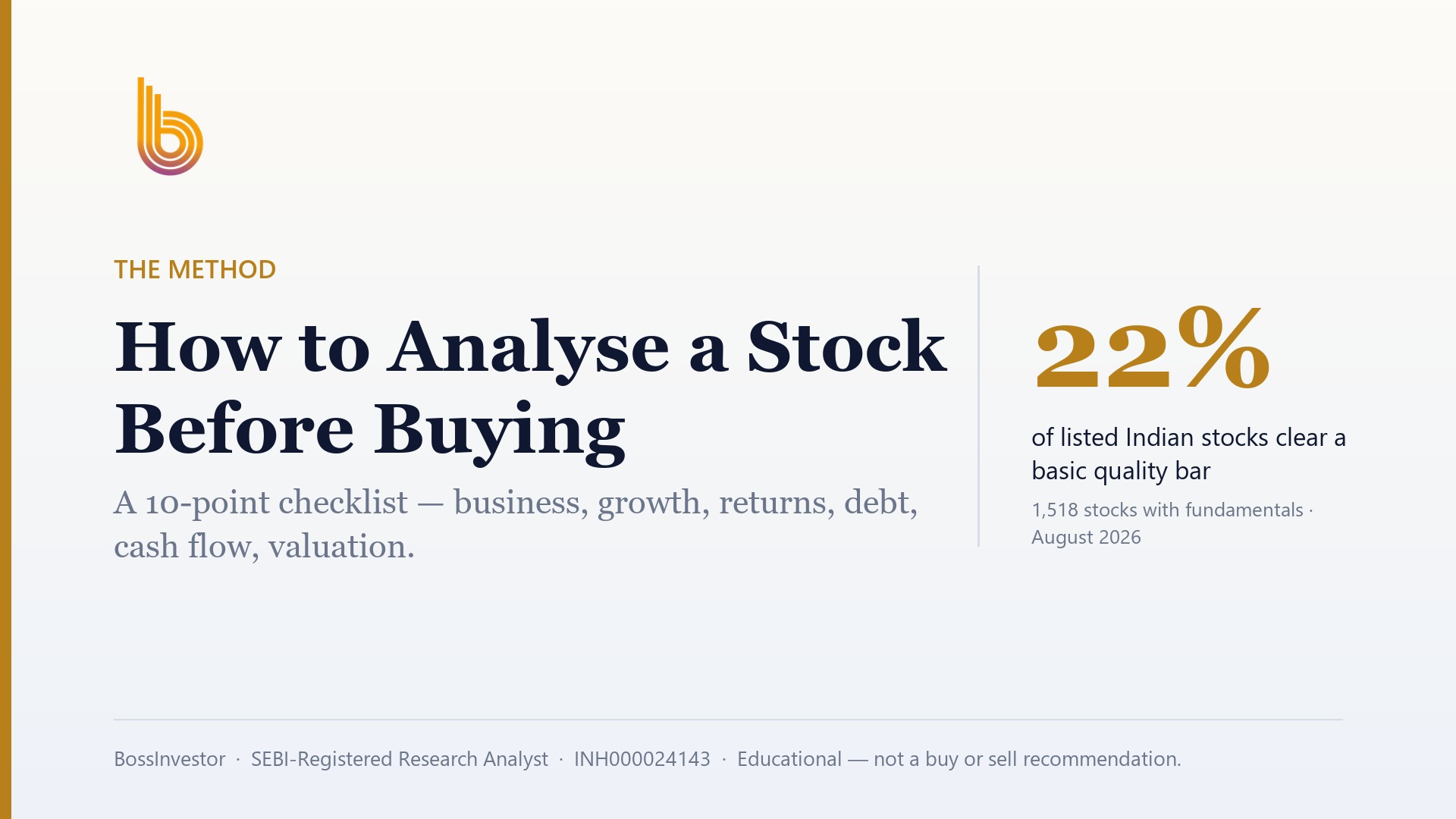
How to Analyse a Stock Before Buying: A 10-Point Checklist
Published: Mon Sep 07 2026Read more…

How to Calculate Your Financial Freedom Number and Achieve It
Published: Tue May 20 2025Read more…
 (1).jpg)
From Signal to Strategy: The Moving Averages
Published: Tue May 20 2025Read more…

Market Share: The Silent Signal of Competitive Power and Investment Opportunity
Published: Wed May 14 2025Read more…