How to read a concall or earnings call transcript
Most retail investors either skip the concall transcript or read all 40 pages and remember nothing. This page gives you a repeatable reading order, the exact things to underline, the phrases that should slow you down, and a way to keep notes so that next quarter's transcript actually tells you something.

BOSSINVESTOR
Mon Sep 07 2026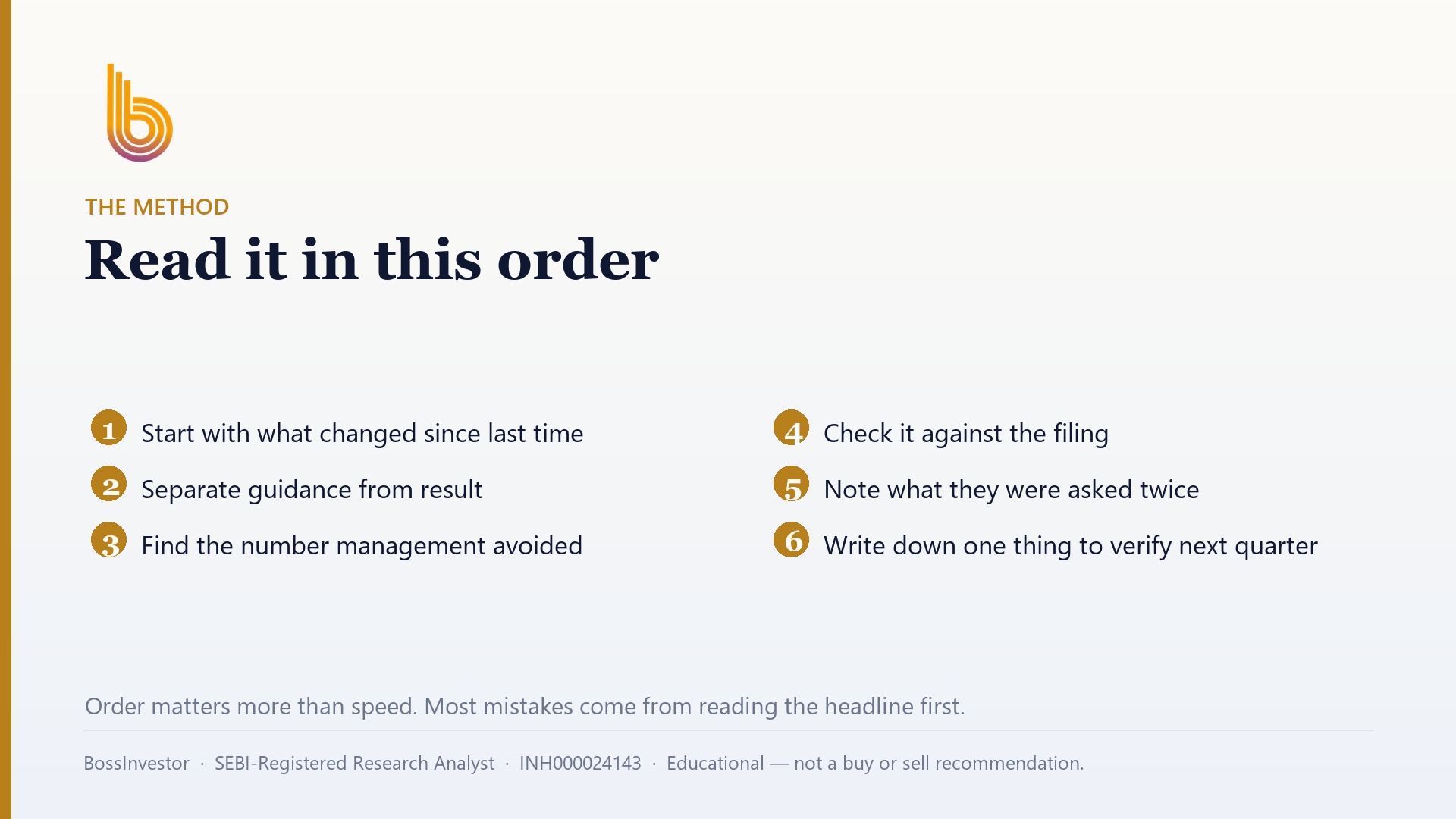
What is the right way for an Indian investor to read an earnings call transcript?
Read a concall transcript in four passes: management's opening remarks for guidance and reasons, the analyst Q&A for what gets pushed back on, the questions management dodges, and last quarter's transcript to check whether promises were kept. Note the numbers, promises and excuses in one file. Repeat every quarter for the same company.
Key Takeaways
- The Q&A section carries more information than the management speech — read it first if you are short on time.
- A dodged question is data. Note who asked it and whether it comes back next quarter.
- Always read the previous transcript alongside the new one; promises only become evidence over time.
- Underline three things: numbers, promises with a date, and excuses.
- Transcripts explain the 'why' behind ratios — as of August 2026, only 22.0% of 1,518 Indian companies with full-year fundamentals clear ROE above 15%, ROCE above 15% and debt-to-equity below 1 together.
- Keep a one-page note per company per quarter. The file, not the transcript, is the asset.
What exactly is a concall transcript, and where do I get it free?
A concall is the conference call a listed company holds after it declares quarterly results. Management reads out a short opening statement, then takes questions from analysts and fund managers for forty minutes or so. The transcript is the typed-out record of that call, word for word, including the awkward pauses and the deflections.
In India you never have to pay for it. Every listed company must file the transcript with NSE and BSE within five working days of the call, under SEBI's disclosure rules. Go to the company's page on nseindia.com or bseindia.com and look under corporate announcements, or go straight to the investor relations tab on the company website, where it usually sits next to the results PDF and the investor presentation. The audio recording is often there too.
Download it as a PDF and keep it. You will need the old ones later, and company websites have a habit of quietly dropping files older than three or four years.
Why bother with the transcript when I already have the results and the PPT?
The results filing tells you what happened. The investor presentation tells you what the company wants you to feel about what happened. The transcript is the only one of the three where somebody outside the company gets to ask an uncomfortable question and management has to answer it live, without a design team smoothing the edges.
Think of it this way. The numbers give you the score. The transcript gives you the reasons — why margin fell 200 basis points, whether the new plant is running late, whether that big order is actually signed or still 'in advanced discussions'. Reasons are what let you judge whether a bad quarter is a bump or the start of a slide.
This matters because good numbers are rarer than most people assume. Across our own universe, as of August 2026, of 1,518 listed Indian companies with full-year fundamentals, only 22.0% clear a basic quality bar of ROE above 15%, ROCE above 15% and debt-to-equity below 1 at the same time. Add a valuation check of PE under 40 and you are down to 15.9%. Screens narrow the field to a few hundred names. The transcript is how you separate the ones with a real reason for those numbers from the ones having a lucky year.
In what order should I read a 40-page transcript?
Do not read it top to bottom on the first pass. Use four passes, and give the whole thing about thirty minutes.
Pass one: the opening remarks, skimming. You are looking only for numbers and forward statements — capacity added, order book, guidance for the year, any target date. Underline them. Pass two: jump to the Q&A and read every question first, ignoring the answers. The questions tell you what professional analysts are worried about, and their worry list is usually better than yours. Pass three: go back and read the answers to the three or four questions that got asked more than once by different people. Repetition means the first answer did not satisfy the room.
Pass four is the one almost nobody does. Open last quarter's transcript side by side and check the promises. Did the plant commission on time? Did receivables come down like they said? This fourth pass is where the actual edge is, because it costs an hour and most people will not spend it.
What should I underline in the management opening remarks?
Three categories, and nothing else. Numbers, promises with a date attached, and excuses.
Numbers are anything you can verify later — volumes in tonnes, realisation per unit, order book in crores, capacity utilisation in percent, planned capex in rupees. Promises with a date are sentences like 'we expect the Gujarat unit to be commercial by Q3' or 'we are targeting 18% EBITDA margin for the full year'. Write them down with the quarter they were made in. Excuses are the reasons given for anything that went wrong: monsoon, freight rates, a customer pushing an order, election-related slowdown, raw material prices.
The excuse column is the sneaky one. Any single excuse is usually fair — Indian businesses genuinely do get hit by monsoons and freight. But when the same excuse appears three quarters running, it has stopped being an excuse and become the business model. A company that blames unseasonal rain every single year is a company with a weather-dependent business, and it should be valued as one.
Which analyst questions in the Q&A actually matter?
Rank the questions by who is asking and how hard they push. A question from a large institutional analyst who covers the sector full time is worth more than a general question about industry outlook. A follow-up question is worth more than a first question, because a follow-up means the analyst was not convinced.
Watch for the moment an analyst rephrases. 'Just to come back on the margin — are you saying the 200 basis point drop is entirely raw material, or is there a pricing element?' That rephrasing is the analyst boxing management in. Read management's answer to that one very carefully, twice.
Also read the last few questions on the call. Small investors and smaller broking firms often get the tail end of the queue, and their questions are sometimes blunt in a way institutional questions are not — about promoter pledging, related party transactions, or why a subsidiary keeps needing money. The answers there are often the most revealing part of the whole document.
What phrases in a concall should make me slow down?
Certain language patterns show up again and again before things go wrong. Learn to notice them without treating any single one as proof.
First, the non-answer: 'we don't guide on that', 'directionally we are positive', 'I would not like to comment on a specific number'. Sometimes this is genuine regulatory caution. But if a company gave a specific number last quarter and refuses to now, the refusal itself is the information. Second, the shift in metric. If a company reported volume growth for eight quarters and suddenly starts talking only about value growth, volumes probably fell. Third, blaming the base: 'last year was an exceptional quarter'. Check whether that is true — you have the old transcript. Fourth, sudden vocabulary changes, where a business quietly restyles itself into whatever theme the market is paying for that year.
Also count who speaks. If the CFO answers every financial question crisply and the promoter takes over whenever anyone asks about capital allocation or related parties, that is worth noting in your file.
How do I check whether management kept its last promise?
Build a promise tracker. One row per promise, four columns: what was said, which quarter it was said in, the deadline given, and what actually happened. A plain spreadsheet is enough.
Here is an illustrative example, using made-up figures purely to show the method. Suppose in the July 2025 call management says a new line will start commercial production by December 2025 and add roughly ₹120 crore of annual revenue. In the January 2026 call they say commissioning is 'in the final stages'. In the April 2026 call they say it started in March. That is one quarter of slippage on a small project — a yellow flag, not a red one. But if the same company slipped its previous two projects by two quarters each, you now have a documented pattern of over-promising, and you should mentally discount every future timeline they give you.
Over two or three years this tracker becomes something you cannot buy: a record of how honest a particular management team is about its own timelines. Companies with a clean tracker deserve more benefit of the doubt during a bad quarter. Companies with a messy one deserve less, no matter how good the current numbers look.
How does a transcript connect back to the ratios on a screener?
Screens give you the what; transcripts give you the why, and the why decides whether the what continues. Suppose a company shows ROCE above 15%. The transcript tells you whether that came from a genuine pricing advantage, from a one-off government incentive, or from running old, fully depreciated plants that will need replacing.
Same with debt. A falling debt-to-equity ratio looks good on a screen, but the call will tell you whether debt fell because of real cash generation or because the company sold an asset. One repeats, the other does not. A word of caution here: as of August 2026, 84.5% of companies in our universe with fundamentals show debt-to-equity below 1, but a flat debt rule unfairly penalises banks and NBFCs, where borrowing is the business model itself. For a lender, read the transcript for asset quality, slippages, cost of funds and credit cost guidance instead.
And keep valuation in the frame while you read. Median PE across the universe is 24.0 as of August 2026. A brilliant concall does not make an expensive stock cheap. It just tells you whether the price you are being asked to pay is attached to a business that can actually deliver.
How many transcripts should I read, and how should I keep notes?
Depth beats breadth. Reading four quarters of one company teaches you more than reading one quarter each of twelve companies. Pick five to eight businesses you genuinely want to own for years, and read every call for those. If you also want sector context, read the calls of two or three competitors in the same industry — management teams contradict each other, and the contradictions are useful.
Keep one page per company per quarter, in a plain document. Five headings: numbers I can verify, promises with deadlines, excuses given, questions dodged, and what would make me change my mind. That last heading is the important one. Write down in advance what would break your view — a second quarter of falling volumes, receivables crossing a certain number of days, another delay on the same project.
Reading takes thirty minutes; the note takes ten. Do this for eight quarters and you will know a company better than most people who own it, including the ones who bought it on a WhatsApp tip.
Click Here – See BossInvestor's Data-Driven Stock Screens
Conclusion
A transcript is not homework, it is a memory. Four passes, three things underlined, one page of notes per quarter, and the previous transcript open beside the new one. Do it for a handful of companies and the pattern of a management team — honest, cautious, or promotional — becomes visible long before it shows up in the price. When you want the research and the actual call on a specific stock, that sits behind KYC inside our app, where SEBI rules require it to.
BossInvestor is a SEBI Registered Research Analyst (INH000024143). This article is for educational and informational purposes only. It explains a method and is not investment advice, nor a recommendation to buy, sell or hold any security. Market-wide figures are computed from our universe as of August 2026; past metrics do not guarantee future results. Always do your own research or consult a registered adviser before investing.
Frequently Asked Questions
Is the concall transcript available for every listed Indian company?
Most, but not all. SEBI requires the top listed entities by market capitalisation to hold and disclose earnings calls, and many mid and smallcap companies do it voluntarily to attract investors. If a company you own has never held a concall or does not publish a transcript, treat that silence as information about how it views minority shareholders. You can still read the results filing and the annual report, but you lose the one document where outsiders get to ask questions.
Should I read the transcript or listen to the audio recording?
Read the transcript first. It is faster, searchable, and you can jump straight to the Q&A section. Audio is worth using selectively: when an answer in the transcript reads evasive, listening to that specific stretch tells you about tone, hesitation and whether the room went quiet. Most investor relations pages host both. A practical routine is to read the full transcript, mark two or three answers, and listen only to those minutes.
How long after results is the transcript published?
Indian listed companies must file the transcript with the stock exchanges within five working days of the earnings call, and many post it within two or three days. The audio recording usually appears sooner, often within twenty-four hours. Because the price often moves on results day itself, the transcript is rarely a trading tool. Its value is cumulative — it helps you decide whether to keep holding, add over time, or exit, not what to do in the first hour.
What if I do not understand the technical terms analysts use?
Keep a running glossary of the ten or fifteen terms specific to that industry, and look up one or two per call. Cement calls run on realisation per tonne and clinker utilisation; IT calls on deal wins, utilisation and attrition; lending calls on net interest margin, slippages and credit cost. After three or four transcripts of the same company, the vocabulary stops being a barrier. Do not skip a question just because it uses a term you do not know — that is often the important one.
Can reading transcripts replace looking at financial ratios?
No. They answer different questions and you need both. Ratios tell you whether a business earns well on the capital it uses and whether it is over-borrowed; the transcript tells you why, and whether that is likely to continue. As of August 2026, only 15.9% of the 1,518 Indian companies with full-year fundamentals in our universe clear ROE above 15%, ROCE above 15%, debt-to-equity below 1 and PE under 40 together. Use screens to shortlist, transcripts to decide.
Do transcripts help with tax planning or holding period decisions?
Indirectly, and that is enough to matter. In India, listed equity held over twelve months is taxed as long-term capital gains, and shorter holdings at the higher short-term rate. Reading calls builds the conviction to hold through a weak quarter rather than selling on a headline, which often means fewer taxable exits and lower brokerage costs. The transcript will not tell you your tax liability, but it makes it far less likely you sell a good business for a bad reason.
Related Blogs
How to Analyse a Stock Before Buying: A 10-Point Checklist
Published: Mon Sep 07 2026Read more…

How to Calculate Your Financial Freedom Number and Achieve It
Published: Tue May 20 2025Read more…
 (1).jpg)
From Signal to Strategy: The Moving Averages
Published: Tue May 20 2025Read more…

Market Share: The Silent Signal of Competitive Power and Investment Opportunity
Published: Wed May 14 2025Read more…