How to read an annual report and what to look for
An annual report runs 200 to 400 pages, and almost nobody reads it front to back. This page gives you a reading order that takes about ninety minutes, the six numbers you should pull out, and the warning signs that appear in the boring pages nobody opens.

BOSSINVESTOR
Mon Sep 07 2026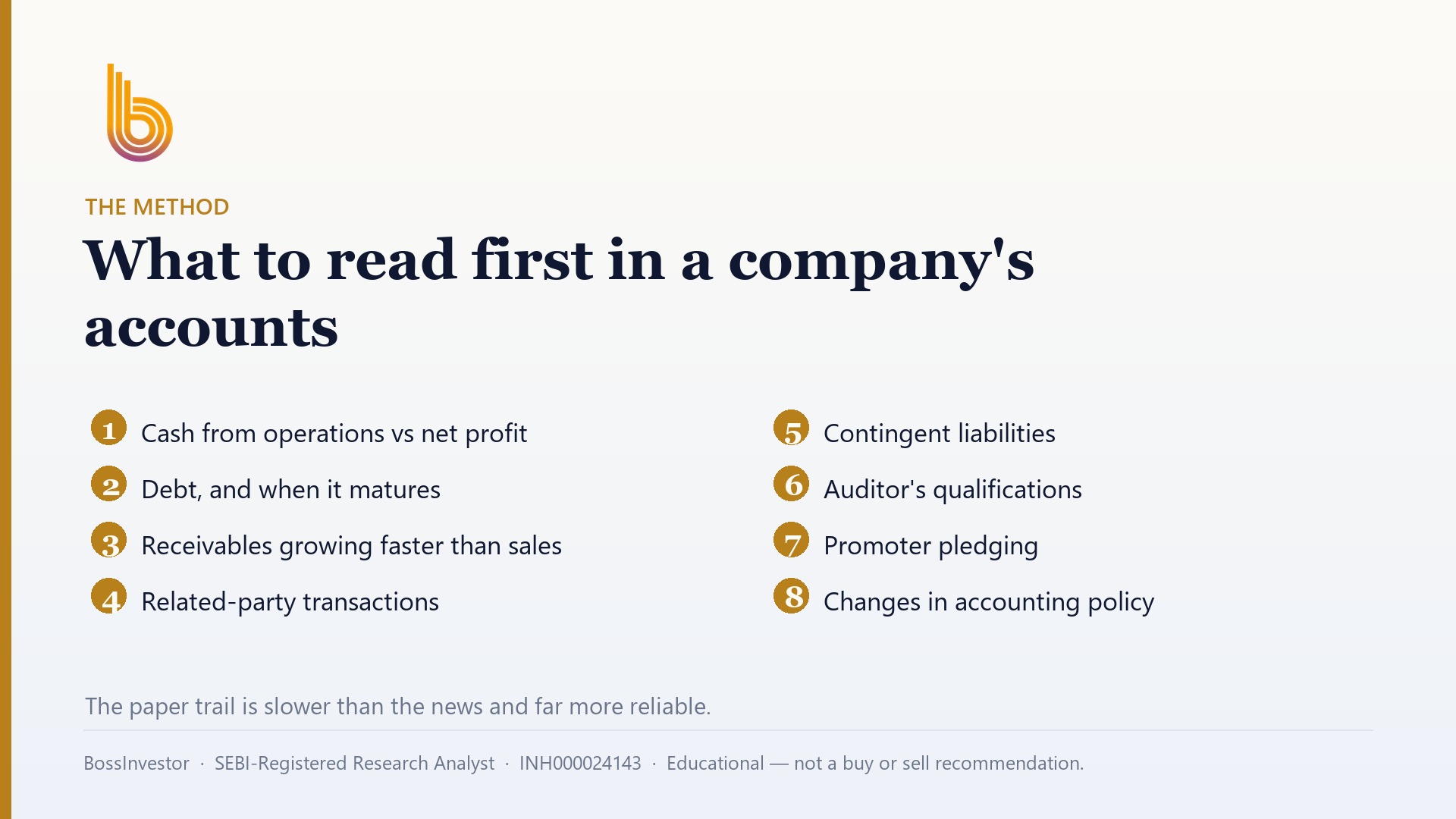
What is the right way for a retail investor in India to read a company's annual report?
Read an annual report backwards. Start with the auditor's report and the notes to accounts, then the cash flow statement, then the balance sheet, and only then the chairman's letter. You are checking three things: does profit turn into cash, is debt manageable, and is the promoter honest with minority shareholders.
Key Takeaways
- The glossy front pages are marketing; the truth is in the notes and the auditor's report at the back.
- Five years of cash from operations versus five years of net profit is the single most useful comparison you can make.
- Related party transactions tell you whether the promoter treats the listed company as his own pocket.
- As of August 2026, only 22.0% of 1518 Indian companies with full-year fundamentals clear a basic quality bar at the same time.
- Read the same three sections across five years — one year alone tells you almost nothing.
- A great report is a reason to study a company, never a reason to buy it at any price.
Where do I get an Indian company's annual report for free?
Three places, all free. The company's own website has an Investor Relations or Shareholder Information tab, and the annual reports usually sit there as PDFs going back ten years or more. The BSE website lets you search a company and open its Financials or Annual Reports section. The NSE website has the same under Corporate Information. SEBI's listing rules require every listed company to file the report and keep it accessible, so if you cannot find it, that itself is a small mark against the company.
Download five years at once, not one. A single annual report is a photograph. Five reports side by side are a film, and the film is what tells you whether margins are really expanding or whether one good year is being sold to you as a trend. Keep them in one folder named after the company.
Also grab the AGM notice, which is often attached at the end. It contains the resolutions the board wants passed — director reappointments, salary hikes, related party approvals, fresh borrowing limits. Shareholders skip it and then complain later about decisions they were literally asked to vote on.
Which pages should I read first, and in what order?
Read it backwards. The first forty pages are designed by an advertising agency: sunrise photographs, a chairman explaining that the year was challenging but the future is bright, and a page of awards. None of it is audited. Skip it on the first pass.
Here is the order that works. One, the Independent Auditor's Report. Two, the Notes to Accounts, especially related party transactions and contingent liabilities. Three, the Cash Flow Statement. Four, the Balance Sheet. Five, the Profit and Loss Statement. Six, the Management Discussion and Analysis. Seven, and only now, the chairman's letter — which you read as a claim to be tested against the six things you already know.
This order works because it front-loads the parts that are hard to dress up. An auditor's qualification is a legal statement. A related party transaction is a disclosed fact. Cash in the bank either moved or it did not. Narrative is easy to write; those three are not. Ninety minutes for a first pass is normal, and it gets faster as you build the habit.
What should I look for in the profit and loss statement?
Pull five numbers for five years and put them in a spreadsheet: revenue, operating profit, other income, interest cost, and net profit. Then look at the shape rather than the level. Is revenue growing faster than the industry or slower? Is operating margin steady, widening, or quietly slipping while headline profit rises?
Watch other income carefully. It covers interest on deposits, dividends, treasury gains and one-off sales of land or a subsidiary. If a company's net profit grew 30% but operating profit was flat, the growth came from somewhere that will not repeat. To take an illustrative example only, if a company reports operating profit of Rs 100 crore and net profit of Rs 90 crore, but Rs 35 crore of that came from selling a plot of land, then the business actually earned far less than the headline suggests.
Two more checks. Compare interest cost with operating profit: if interest eats more than a quarter of operating profit, the lenders are ahead of you in the queue. And look at the effective tax rate. A company paying far below the Indian statutory rate year after year should have an explanation in the notes — a tax holiday, brought-forward losses, an SEZ unit. If there is no explanation, that is your question for the AGM.
How do I check whether the balance sheet is safe?
Start with borrowings against net worth. Debt-to-equity below 1 means the owners have more skin in the game than the lenders do. Across our universe as of August 2026, 1282 of 1518 companies with full-year fundamentals, or 84.5%, have debt-to-equity below 1 — so a low-debt balance sheet is common in India and is not, by itself, something special. One important caveat: this flat rule unfairly penalises banks and NBFCs, because borrowing is literally their business model. For lenders, look at capital adequacy, gross and net NPAs, and provision coverage instead.
Next, receivables and inventory. Divide trade receivables by annual revenue and multiply by 365 to get roughly how many days the company waits to be paid. Do the same for inventory. If receivable days climb from 45 to 90 over four years while revenue grows, the company may be booking sales it has not yet collected. That is the most common way an Indian small-cap starts looking better than it is.
Finally, the two items that sit outside the main statements. Contingent liabilities — disputed tax demands, guarantees given for group companies — are real risks that are not on the balance sheet. And check the promoter shareholding pattern for pledged shares. A promoter who has pledged a large slice of his holding to raise personal loans has a problem that can become your problem in a falling market.
Why does the cash flow statement matter more than reported profit?
Profit is an opinion shaped by accounting choices. Cash is a fact. The cash flow statement has three sections — operating, investing, financing — and the first one is where you live. Cash from operations tells you how much money the actual business generated after paying for its own working capital.
Do this: add up five years of net profit, add up five years of cash from operations, and compare the two totals. In a healthy business the cash figure should be close to, or larger than, the profit figure, because depreciation is a non-cash charge that gets added back. If profit is much larger than cash year after year, the money is stuck somewhere — usually in receivables, inventory, or loans to related parties — and you should find out where in the notes.
Then look at investing. Heavy, continuous capital spending is not automatically bad; it can mean a company building capacity ahead of demand. But if a business has spent thousands of crores over a decade and operating cash flow has barely moved, the spending is not earning its keep. In the financing section, notice whether dividends and buybacks are funded by operations or by fresh borrowing. The second one is a treadmill.
What do the notes to accounts and related party transactions actually reveal?
The notes are where the accountants had to write down things they would rather not headline. Read the related party transactions note in full. It lists every rupee that moved between the listed company and entities controlled by the promoter and his family — sales, purchases, rent, loans, guarantees, consultancy fees. Small amounts are normal in Indian group structures. Large and growing amounts, especially loans or advances to promoter-linked entities, mean the money you invested is funding something you do not own.
Also check managerial remuneration against net profit. A promoter-director drawing a salary that keeps rising while profit falls is telling you where his priorities sit. Look at auditor remuneration too, and specifically whether the audit firm earns large non-audit fees from the same company — that weakens the independence you are relying on.
Two more notes reward attention. Capital work-in-progress that stays on the books for years without becoming a working asset can be a place where costs are parked instead of expensed. And any change in accounting policy — the way revenue is recognised, the way depreciation is calculated, the way an inventory is valued — deserves a moment of suspicion, because a policy change is the cheapest way to move profit from one year to another.
How do I read the auditor's report and the governance section?
The auditor's report is one to four pages and is the most legally consequential text in the entire document. You want to see an unmodified opinion, which means the auditor is satisfied. Anything else deserves attention: a qualified opinion means the auditor disagrees with something specific, an emphasis of matter flags something important the auditor wants you to notice, and a disclaimer of opinion means the auditor could not get enough evidence to form a view at all.
Under the Key Audit Matters heading, the auditor lists what he found hardest to verify — usually revenue recognition, provisioning, or valuation of an acquisition. That is a free map of where the accounting risk sits. The CARO annexure that follows is a checklist of statutory matters, including whether the company has been regular in paying its statutory dues and whether any fraud was reported. Read the exceptions, not the clean lines.
Then the governance report. Note the number of genuinely independent directors and how often they attended. Note auditor changes: an audit firm resigning mid-term at a small or mid-cap company is one of the loudest signals available in Indian markets, and it is always disclosed to the exchanges. Note whether the same family holds the chairman and managing director roles with no counterweight on the board.
How do the numbers I extract turn into a judgement about quality?
Once you have read the report, you should be able to compute four things: return on equity, return on capital employed, debt-to-equity, and — using the current market price from NSE or BSE — the price-to-earnings ratio. Return on equity tells you what the business earns on shareholder money. Return on capital employed tells you what it earns on all the money it uses, including debt, which is why it is the harder and more honest test.
Here is how rare a genuinely good business is. Across our universe of 1852 listed Indian companies as of August 2026, 1518 have full-year fundamentals. Of those, 458 companies (30.2%) have ROE above 15% and 464 (30.6%) have ROCE above 15%. But only 334 companies, or 22.0%, clear all three of ROE above 15%, ROCE above 15% and debt-to-equity below 1 at the same time. Add a valuation filter of PE under 40 and just 241 companies, or 15.9%, remain. Median PE across the universe is 24.0.
The point of those figures is calibration. Roughly four out of five listed Indian companies fail a basic quality test, so if the report you just read looks excellent, first suspect that you read it too kindly. And a company passing all three quality tests still tells you nothing about price. Quality is what you are buying; valuation is what you are paying. Both have to be answered before you act.
What red flags should make me put the annual report down and walk away?
Keep a short list and treat any single item on it as a full stop rather than a discount. A qualified opinion or an auditor resigning mid-term. Cash from operations far below net profit for three years or more. Large or rising loans and advances to promoter-controlled entities. Receivable days rising sharply while management calls demand strong. A heavily pledged promoter stake. Frequent changes of auditor, chief financial officer or accounting policy. Contingent liabilities larger than net worth. Repeated equity raises with no visible improvement in operating cash.
Also watch the gap between narrative and numbers. If the chairman's letter uses the word transformation four times and the segment note shows the old business still contributing almost everything, the transformation is a plan, not a result. If the report celebrates order book size but revenue has been flat for three years, orders are not converting.
None of this requires an accounting degree. It requires reading the same six places in five consecutive reports and noticing what changed. Most retail losses in Indian small-caps come from companies whose annual reports were shouting for two years before the price fell — the reports simply went unread.
Click Here – See BossInvestor's Data-Driven Stock Screens
Conclusion
An annual report is not a document to admire; it is a document to interrogate. Read it backwards, compare five years of cash against five years of profit, read the related party note in full, and treat a clean auditor's opinion as the floor rather than the achievement. That method is yours to use on any company on NSE or BSE, for free, this weekend. If you would rather see which companies our research desk has already run this process on, that work sits inside the BossInvestor app after KYC.
BossInvestor is a SEBI Registered Research Analyst (INH000024143). This article is for educational and informational purposes only. It explains a method and is not investment advice, nor a recommendation to buy, sell or hold any security. Market-wide figures are computed from our universe as of August 2026; past metrics do not guarantee future results. Always do your own research or consult a registered adviser before investing.
Frequently Asked Questions
How long does it take to read one annual report properly?
About ninety minutes for a first pass if you follow the backwards order: auditor's report, notes, cash flow, balance sheet, profit and loss, then the narrative sections. Reading five years of the same company takes roughly half a day, because after the first report you already know the layout and are only looking for what changed. It gets much faster with practice — experienced readers scan a familiar company's report in under thirty minutes.
Should I read the standalone or the consolidated financial statements?
Consolidated, almost always. Standalone covers only the parent company; consolidated includes subsidiaries, joint ventures and associates, which is where Indian groups often park debt, losses or fresh capital spending. Read consolidated first, then glance at standalone to see how different the two are. A very large gap between them is itself information — it means most of the business, or most of the trouble, sits outside the parent entity you thought you were buying.
Is a company with zero debt automatically a safe investment?
No. As of August 2026, 84.5% of the 1518 Indian companies in our universe with full-year fundamentals already have debt-to-equity below 1, so low debt is ordinary rather than exceptional. A debt-free company can still have poor returns on capital, shrinking margins, or cash trapped in receivables. And the flat debt rule misjudges banks and NBFCs entirely, since borrowing is their business model — judge lenders on capital adequacy, gross and net NPAs, and provision coverage instead.
What is the difference between the annual report and quarterly results?
Quarterly results are a short, limited-review update with a few summary numbers and no detailed notes. The annual report is fully audited and contains the material that actually matters: the auditor's opinion, related party transactions, contingent liabilities, segment detail, shareholding and governance disclosures. Use quarterly results to track momentum between reports; use the annual report to decide whether you trust the company at all. One is a pulse check, the other is the diagnosis.
Can I rely on screener websites instead of reading the report myself?
Screeners are excellent for narrowing a list and terrible for the final decision. They compute ratios from filed data, so they will show you ROE, ROCE, debt and PE quickly. What they cannot show is a qualified audit opinion, a related party loan, a mid-year auditor resignation, or a change in revenue recognition policy. Use a screener to get from 1852 companies to a shortlist of ten, then read those ten annual reports properly.
Related Blogs
How to Analyse a Stock Before Buying: A 10-Point Checklist
Published: Mon Sep 07 2026Read more…

How to Calculate Your Financial Freedom Number and Achieve It
Published: Tue May 20 2025Read more…
 (1).jpg)
From Signal to Strategy: The Moving Averages
Published: Tue May 20 2025Read more…

Market Share: The Silent Signal of Competitive Power and Investment Opportunity
Published: Wed May 14 2025Read more…