How to use a stop loss in investing
Most investors do not lose money because they picked a bad stock. They lose because they had no plan for being wrong. This page explains, step by step, how to decide your exit before you buy, which order type actually works on the NSE and BSE, and how much of your capital any single mistake should be allowed to cost.

BOSSINVESTOR
Mon Sep 07 2026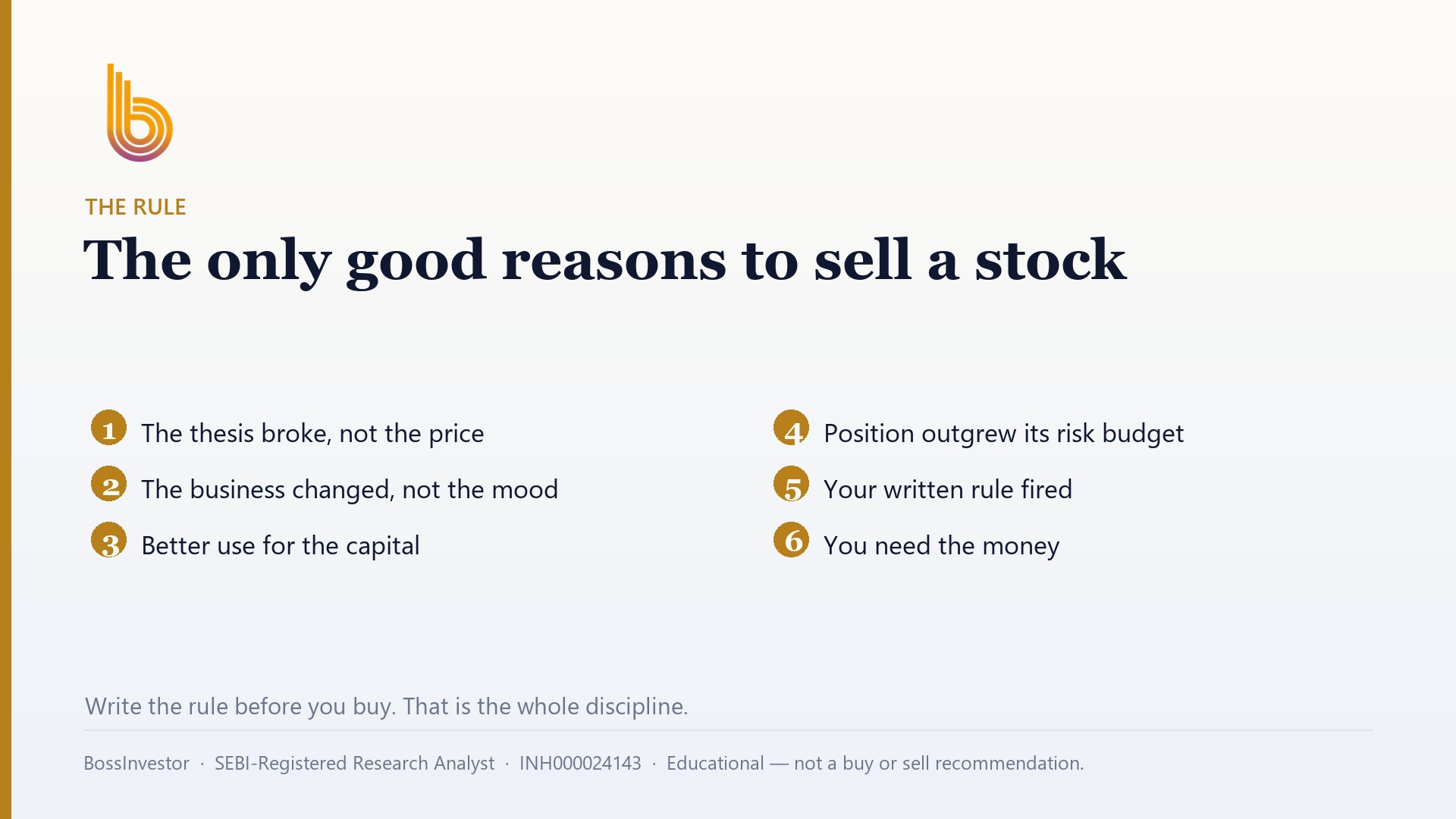
What is the right way to set and use a stop loss on Indian stocks?
A stop loss is a price you decide before you buy, at which you will sell and accept the loss. Place it where your reason for owning the stock is proven wrong, size the position so that loss costs 1-2% of your portfolio, and never widen it once the trade is live.
Key Takeaways
- Decide the exit price before you buy, not after the stock falls.
- The stop level should be where your reason for buying stops being true.
- Size the position so a stop-out costs 1-2% of your total portfolio, not 20%.
- Use SL-M or a GTT order at your broker if you cannot watch the screen.
- A stop loss protects capital; it does not make a weak business a good one.
- Widening a stop loss to avoid the pain is the single most expensive habit in investing.
What exactly is a stop loss, and how does it work on the NSE and BSE?
A stop loss is an exit price you fix in advance. If the stock trades down to that price, you sell, and the loss ends there. That is the whole idea. It is not a prediction, it is a limit on how much a single wrong decision is allowed to cost you.
Mechanically, on the NSE and BSE your broker lets you place a stop-loss order with a trigger price. The order sits dormant in the system. The moment the stock touches your trigger, the order goes live and becomes a sell order in the market. You do not have to be watching. That is the point.
One thing catches most new investors out: an ordinary intraday stop-loss order lapses at the end of the trading day. If you are holding for weeks or months, you either place a fresh order each morning or use your broker's GTT (Good Till Triggered) facility, which holds the instruction for a much longer period. Check what your specific broker supports, because the terms and the validity period differ between them.
Where should I place my stop loss below my buy price?
There are three honest answers, and you should pick one and stay consistent. The first is a fixed percentage: you decide that any position which falls, say, 10% or 15% below your purchase price is a mistake, and you exit. It is crude, but it is a rule, and a crude rule you follow beats a clever rule you abandon.
The second is a chart-based level. You place the stop just below the most recent low the stock made before it started rising. The reasoning is simple: if the stock breaks below the floor it just built, the buyers who were defending that level have given up. This is the most common approach for shorter holding periods.
The third, and the one that matters most for genuine investors, is a thesis stop. You wrote down why you bought: margins are expanding, debt is falling, the order book is growing. Your stop is the point at which that story is no longer true, whether that shows up in the price or in the quarterly numbers. Whichever you choose, the stop must be far enough away that ordinary daily noise does not hit it. A stop 3% below your buy price on a mid-cap stock is not risk management. It is a donation to brokerage.
How much should I risk on one stock before the stop loss is hit?
This is the part almost everybody skips, and it is more important than where the stop sits. The stop tells you how much you lose per share. Position sizing tells you how many shares you are allowed to buy so that the total loss is survivable.
Here is a fully illustrative example, using made-up figures to show the arithmetic only. Suppose your equity portfolio is ₹10,00,000 and you decide that no single mistake may cost you more than 1% of it, which is ₹10,000. You have found a stock at ₹500 and, based on the chart, your stop belongs at ₹440. Your risk per share is ₹60. Divide ₹10,000 by ₹60 and you get 166 shares, which is roughly ₹83,000 of stock. That is your maximum position size. Not what feels right. Not what is left in your account.
Run this calculation before every purchase and something quietly changes. You stop asking whether you like the stock and start asking what it costs you to be wrong about it. Ten consecutive mistakes at 1% each still leaves you with about 90% of your capital and your nerve intact.
Should I use an actual stop-loss order or a mental stop loss?
A mental stop loss is a promise to yourself. A placed order is an instruction to the exchange. The difference between them is your emotional state at 2:45 pm on a red day, which is exactly when the promise gets renegotiated.
Be honest about which kind of investor you are. If you have ever said the words 'let me just wait for it to come back', place the actual order. Use SL-M, where you set only a trigger price and the sale executes at whatever the market offers, if your priority is getting out. Use SL-L, where you set a trigger and a limit price, if you want control over the exit price, but accept that in a sharp fall the price can jump past your limit and leave you still holding the stock.
Mental stops are defensible in exactly one situation: you are a long-term investor whose stop is based on the business deteriorating rather than the price falling, and you review your holdings on a fixed schedule. Then the trigger is the results, not the ticker.
Do long-term investors need a stop loss at all?
Not in the same form. If you are buying a business to hold for five years, a price-based stop will throw you out during every ordinary correction, and Indian markets deliver those routinely. Selling a good company because it fell 15% is how people end up with a portfolio of their worst ideas.
But the underlying discipline still applies, and it starts before you buy. Our own screen of the Indian market shows how few companies clear even a basic quality bar. As of August 2026, of 1,518 listed Indian companies with full-year fundamentals in our universe of 1,852, only 22.0% had return on equity above 15%, return on capital employed above 15% and debt-to-equity below 1 at the same time. Add a simple valuation check of a PE under 40 and just 15.9% survive. The median PE across the universe is 24.0. One caveat: a flat debt-to-equity rule unfairly penalises banks and NBFCs, because borrowing is their business model, so they need to be judged on different measures.
Read that number properly. Roughly four out of five listed companies fail a plain quality test. If you buy inside the smaller group, your stop can be a business stop rather than a price stop: exit if debt starts climbing, if returns on capital fall for consecutive years, if promoters pledge shares, if auditors resign. Those are the real warning signs, and none of them show up on a daily chart.
How do I move my stop loss up as the stock rises?
This is called trailing, and it is how a stop loss changes from a loss limiter into a profit protector. The rule has one direction only: a stop loss moves up, never down. If you find yourself lowering a stop, you are not managing risk, you are avoiding a decision.
The simplest method is to trail by the same distance you started with. If you bought at ₹500 with a stop at ₹440, a gap of 12%, and the stock rises to ₹600, your stop moves to ₹528. These are illustrative numbers to show the mechanic. A slower method is to move the stop up only when the stock makes a clear new higher low on the chart, which keeps you in a strong trend longer and avoids being shaken out on a routine dip.
There is a trade-off, and you should choose it deliberately. A tight trail locks in gains but exits you early and often. A loose trail gives back more of the profit but keeps you in the big moves that actually pay for everything else. Neither is wrong. Picking a new one every week is.
What are the most common stop loss mistakes Indian investors make?
The first is widening the stop as the price approaches it. This feels like conviction. It is the exact opposite: you set the level when you were calm and are overruling it while panicking. The second is averaging down into a position that has already hit its stop, which converts a small planned loss into a large unplanned one.
The third is placing stops at round numbers like ₹100 or ₹500, where thousands of other orders sit and the price often dips briefly before recovering. Place yours slightly below such levels. The fourth is ignoring liquidity. In a thinly traded small-cap, or in a stock locked in a lower circuit, your stop-loss order simply cannot execute, because there is no buyer at any price. Circuit limits are a real feature of the Indian market and no order type gets around them. The defence is position sizing, not a cleverer stop.
The last one is the quietest. People use a stop loss on a stock they should never have bought, and then blame the stop when they get taken out three times in a row. A stop loss controls the damage from a bad decision. It cannot manufacture a good one.
What happens to my taxes and costs when a stop loss is triggered?
A triggered stop is a real sale, so it carries real costs: brokerage, securities transaction tax, exchange charges, GST and stamp duty. On small positions these add up faster than people expect, which is another argument against stops so tight that they fire every few weeks.
On tax, the holding period decides how the gain or loss is treated, with one year being the dividing line for listed equity. Losses are not wasted. A capital loss can be set off against capital gains under the rules for its category, and unabsorbed capital losses can be carried forward for eight assessment years, provided you file your return on time. Many investors never claim this simply because they do not report the loss.
Rates and rules do change with each Budget, so confirm the current numbers with your chartered accountant or the income tax portal before you plan around them. The behavioural point holds regardless: a realised loss is a recorded, deductible event, while an unrealised loss you are refusing to accept is neither.
How do I turn this into a stop loss rule I will actually follow?
Write it down before you buy anything else. One page, four lines. What percentage of my portfolio may one mistake cost me? How do I set the stop level: fixed percentage, chart low, or business thesis? Do I place the order or hold it mentally, and if mentally, on what fixed day do I review? Under what conditions do I trail it up?
Then keep a simple log. Date, stock, buy price, stop price, position size, and the one sentence explaining why you bought. When a stop triggers, add what happened next. After twenty entries you will know something no book can tell you: whether your stops are too tight, too loose, or whether your entries are the actual problem.
The discipline is not in knowing this. Everybody knows this. The discipline is in the ten seconds where you either honour the number you wrote down or you talk yourself out of it.
Click Here – See BossInvestor's Data-Driven Stock Screens
Conclusion
A stop loss is not a trading gimmick. It is the sentence you write about being wrong, before you have any emotional reason to lie about it. Decide the exit price, size the position so that exit is affordable, place the order, and let it do its job without renegotiating. The method above is yours to use on any stock you own. The specific levels and the research behind them sit inside our app, behind KYC, where they belong.
BossInvestor is a SEBI Registered Research Analyst (INH000024143). This article is for educational and informational purposes only. It explains a method and is not investment advice, nor a recommendation to buy, sell or hold any security. Market-wide figures are computed from our universe as of August 2026; past metrics do not guarantee future results. Always do your own research or consult a registered adviser before investing.
Frequently Asked Questions
What percentage stop loss is best for Indian stocks?
There is no single correct number, because it depends on how much the stock normally moves. A large-cap that swings 1% a day needs a tighter stop than a small-cap that swings 4%. As a starting frame, many investors use 8-15% for positions held over weeks or months, and place the level just below a recent chart low rather than at a round percentage. The more important discipline is sizing the position so that whatever percentage you choose costs you only 1-2% of your total portfolio.
Does a stop loss work if the stock gaps down at the opening bell?
Not at your intended price. A stop-loss order triggers when the price reaches your level, but if the stock opens far below it on bad news, your sale executes at the lower opening price, not at your trigger. This is called slippage and it cannot be avoided by any order type. If the stock is locked in a lower circuit, there may be no buyer at all and your order simply does not execute. The only real protection against gap risk is keeping each position small enough that a bad gap does not damage your portfolio.
Should I use a stop loss for mutual funds and SIPs?
Generally no. Mutual funds are diversified baskets priced once a day at NAV, so there is no intraday trigger to act on, and exiting a fund on a price fall usually just locks in a loss you would have recovered by continuing your SIP. The equivalent discipline for funds is a review rule: exit if the fund manager changes, if the mandate drifts, or if it underperforms its own benchmark consistently over several years. Stop losses belong to individual stocks, where a single company can genuinely go to zero.
What is the difference between SL-M and SL-L orders?
An SL-M order has only a trigger price. When the stock touches it, your order goes to the market and sells at whatever the best available price is. You are guaranteed to exit, but not at a guaranteed price. An SL-L order has both a trigger and a limit, so it will not sell below the limit you set. That protects you from a terrible fill, but in a fast fall the price can pass straight through your limit and leave you still holding the position. If certainty of exit matters more to you than the exact price, use SL-M.
Is a stop loss enough to protect my portfolio on its own?
No. A stop loss controls what one position costs you. It does nothing about being over-concentrated in a single sector, holding twenty stocks that all fall together, or buying poor-quality businesses in the first place. Our August 2026 screen found that only 22.0% of the 1,518 companies with full-year fundamentals cleared a basic quality bar of ROE above 15%, ROCE above 15% and debt-to-equity below 1 together. Choosing better businesses reduces how often your stops fire at all. Risk control works in layers: what you buy, how much you buy, and where you exit.
Related Blogs
How to Analyse a Stock Before Buying: A 10-Point Checklist
Published: Mon Sep 07 2026Read more…

How to Calculate Your Financial Freedom Number and Achieve It
Published: Tue May 20 2025Read more…
 (1).jpg)
From Signal to Strategy: The Moving Averages
Published: Tue May 20 2025Read more…

Market Share: The Silent Signal of Competitive Power and Investment Opportunity
Published: Wed May 14 2025Read more…