Should I book profit or keep holding?
This page gives you a repeatable way to decide, instead of guessing every time a stock moves. You will learn how to split your gain into business growth versus mood, how to re-test the quality you bought, what the tax and charges really cost, and which reasons to sell are simply bad reasons.

BOSSINVESTOR
Mon Sep 07 2026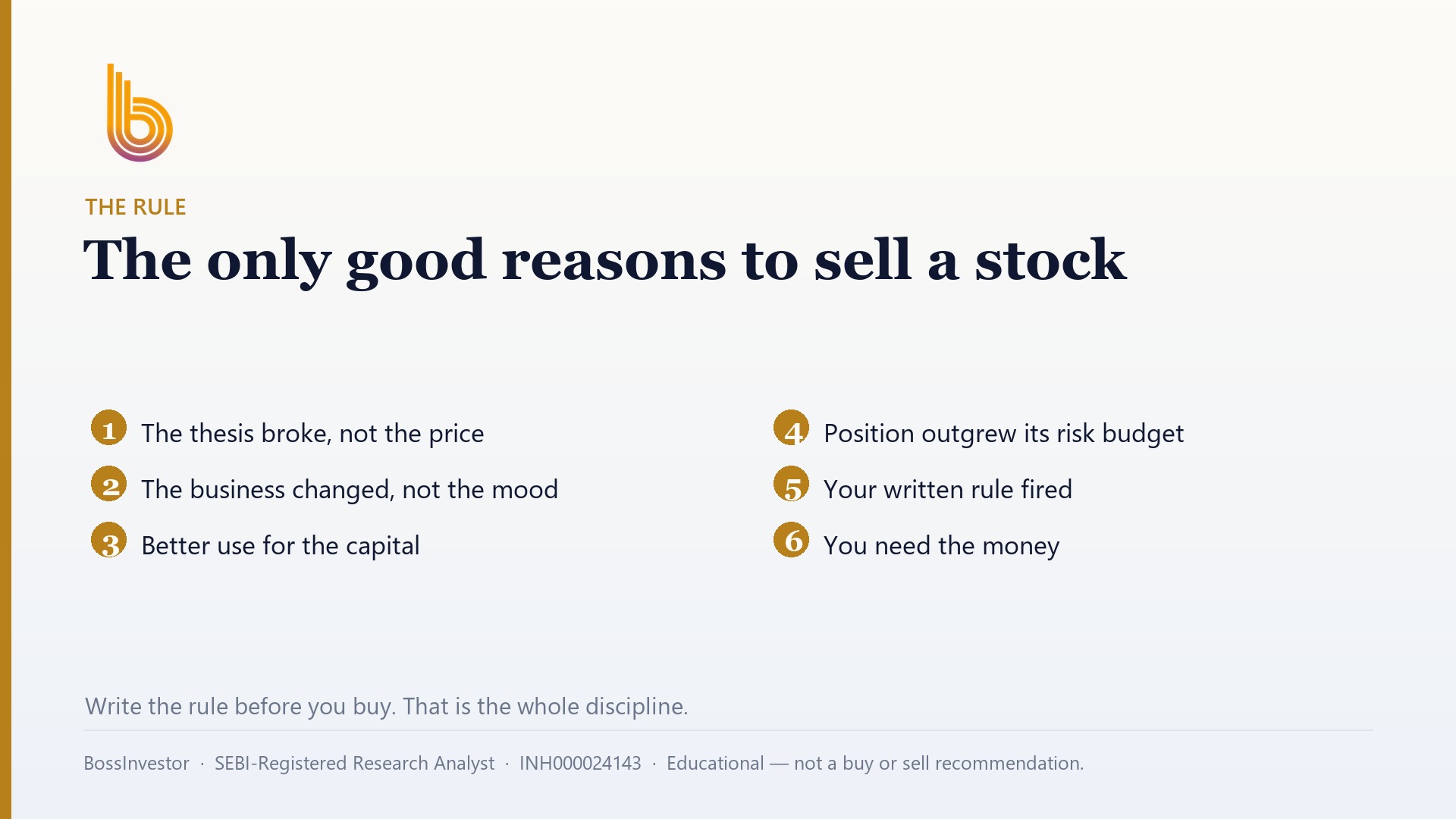
When does booking profit actually make sense, and when is holding the better choice?
Book profit only when the business case has broken, the price has run far ahead of earnings, or one position has grown too large for your comfort. A rising price alone is not a reason. Ask whether the company still clears your quality bar; if it does, holding usually beats trading.
Key Takeaways
- Profit is not a reason to sell — it is only the reason the question came up.
- Split your gain: did earnings grow, or did the market simply agree to pay more?
- Only 22.0% of 1,518 Indian companies with full-year fundamentals clear a basic quality bar (BossInvestor universe, as of August 2026).
- Median PE in our universe is 24.0 as of August 2026 — use it as a reference point, not a rule.
- Short-term gains are taxed harder than long-term gains in India, so churning costs real money.
- Trimming a position that has grown too big is risk management, not a market call.
What actually decides whether to book profit or keep holding?
Three things decide it, and the current price is not one of them. First: does the business still earn well? Second: has the price run far ahead of those earnings? Third: has this one stock become so big in your portfolio that a bad quarter would genuinely hurt you? If the answer to all three is comfortable, you are holding a good position, not a lucky one. Profit is not a reason to sell. It is only the reason the question showed up in your head.
Most investors get this backwards. They sell the stock that is up 40% because the gain feels fragile, and they hold the stock that is down 30% because selling would make the loss official. Notice that neither sentence contains a single fact about the company. Before you touch the sell button, write one line: why did I buy this? If that line is still true today, you have found no reason to sell — only a reason to feel nervous, which is a different thing.
Is my stock up because the business grew or because the market simply paid more?
Only two engines push a share price. One is earnings growth — the company genuinely makes more money per share than it used to. The other is re-rating — the market decides to pay a higher multiple for each rupee of the same profit. Split your gain between them, because they behave very differently. Earnings are slow to build and slow to fall. Mood can reverse in a month, and usually does so on a day when nothing about the business has changed at all.
Here is an illustrative example with made-up numbers. Say you bought at ₹200 when earnings per share were ₹10 — a PE of 20. The stock is now ₹400. If EPS has grown to ₹20, the PE is still 20: the business paid you, and nothing is stretched. If EPS is still ₹10, the PE is now 40: the market paid you, and the market can stop paying whenever it likes. Same 100% gain, completely different decision. This is the single most useful five-minute check most retail investors never do.
How do I check whether the quality I originally bought is still there?
Re-run the test you should have run before buying. Three numbers do most of the work: return on equity above 15%, return on capital employed above 15%, and debt-to-equity below 1. ROE tells you what the company earns on shareholder money. ROCE tells you what it earns on all the capital it uses, borrowed money included. Debt-to-equity tells you how much of the business is built on borrowings. Pull the latest full-year figures from the annual report or any NSE/BSE data page and compare them with the year you bought.
This bar is harder to clear than people assume. Across our universe of 1,852 listed Indian companies, 1,518 have full-year fundamentals, and only 22.0% of those clear all three tests at the same time (BossInvestor universe, as of August 2026). One caution: a flat debt-to-equity rule is unfair to banks and NBFCs, because borrowing is their business model, not a warning sign. Judge lenders on asset quality and capital adequacy instead. If your company still clears its version of this bar, the case for holding is intact.
How expensive is my stock compared with the rest of the Indian market?
Valuation is not a verdict on its own, but it tells you how much good news is already in the price. In our universe the median PE is 24.0 as of August 2026. If your holding trades far above that, you are paying for growth that has not arrived yet, and the company has to deliver just to keep you where you are. If it trades well below, either the market has missed something or it knows something you do not — and your job is to work out which.
Quality and a sensible price rarely travel together. When we add a valuation filter of PE under 40 to the same three quality tests, the share of companies clearing everything drops from 22.0% to 15.9% (BossInvestor universe, as of August 2026). That gap is the whole difficulty of this decision in one number. A wonderful business at a punishing price can still be a poor holding for the next three years, even though nothing goes wrong at the company.
What does booking profit actually cost me in tax and charges?
In India, selling is never free, and the tax rule pushes hard in one direction. Listed equity held for more than twelve months is taxed as long-term capital gains at a concessional rate, with a yearly exemption on the first slice of gains; held for twelve months or less, it is taxed as short-term gains at a materially higher rate. Add STT, brokerage, exchange charges and stamp duty on both legs. Confirm the current rates for the financial year you are selling in, because these numbers have been revised more than once.
The bigger cost is invisible. Take an illustrative case: a ₹5 lakh gain taxed at a short-term rate of 20% leaves roughly ₹1 lakh with the government instead of compounding for you. Over a decade, the money you never had is worth far more than the tax you paid. This is why frequent profit-booking quietly loses to patient holding even when every individual sell decision looked clever. Tax is not a reason to hold a broken business. It is a strong reason not to trade a good one.
Should I sell the entire position or trim it in parts?
Full exits should be reserved for full breakdowns: the numbers have deteriorated badly, the promoter is doing things you cannot explain, or the reason you bought has simply stopped being true. Everything else is a trimming problem. Decide the weight you want this stock to have in your portfolio — say 8% — and sell only enough to bring it back to that weight. You keep the compounding and you remove the sleeplessness. That is a completely different decision from calling a top.
Two practical habits help. First, stagger sales across financial years so you use the long-term exemption more than once instead of packing a large gain into a single year. Second, decide where the money goes before it lands in your account. Cash sitting idle after a good sale is how disciplined investors turn into impatient ones. If you cannot name the next home for that money — another holding, a debt allocation, an actual expense — you are probably not ready to sell yet.
Which reasons for selling are actually bad reasons?
These come up constantly, and none of them are about the business: the stock has doubled; it hit a round number like ₹1,000; the Nifty fell today; a friend booked profit; the stock has gone nowhere for six months; you want to feel clever once this year. Also on the list — selling because you need to prove to yourself that the gain was real. A gain in your demat is exactly as real as a gain in your bank account, minus tax you have not yet paid.
There is one more that quietly destroys returns: selling because the price is above what you paid, while holding losers because the price is below. Your purchase price is a fact about your past, not about the company's future. The market has no memory of it. If you would not buy this stock today at today's price with fresh money, that is a genuine signal worth examining. If you would, then selling it is just churn wearing a serious face.
When is it right to sell even though the company is still good?
Four situations qualify. One: concentration — the position has grown so large that a normal 30% fall would change your life plans, not just your mood. Two: you need this money within about three years, for a house, a fee, a wedding; equity money with a deadline attached is not really equity money. Three: the reason you bought has actually played out — the turnaround turned around, the order book converted — and what remains is a different, more expensive story. Four: serious governance problems, which are not worth waiting out.
Notice that three of these four are about you, not the company. That is the point. The same holding can be right for one investor and wrong for another on the very same day, because their time horizons and their portfolio weights differ. This is also why a generic sell call from social media is close to useless. It knows nothing about your holding period, your other positions, your income, or your tax year.
What should I write down before I press the sell button?
Keep a one-page sell note for every exit, written before you place the order. Four lines: what has changed in the business; what the numbers say now versus when I bought; what the valuation says versus the market; where this money goes next. If you cannot fill all four honestly, you are reacting to the price, not deciding. Date the note. Six months later it will teach you more about yourself as an investor than any screen ever will.
Then build a review rhythm instead of a reaction rhythm. Look at each holding after quarterly results, not after every red candle, and re-run your quality and valuation checks then. Pre-commit your trimming rule in writing — for example, review any position that crosses a chosen share of your portfolio. A rule written on a calm day is worth ten decisions taken on a day the market is down 3% and everyone on your feed sounds certain.
Click Here – See BossInvestor's Data-Driven Stock Screens
Conclusion
Booking profit is not a reward and holding is not stubbornness — both are just outputs of the same four checks: is the business still good, is the price still sane, is the position still the right size, and do I still have the time horizon I started with. Run those checks on a calm day, write down the answer, and act on the note rather than the mood. If you want the specific view on a particular name — which is a different job from the method — that sits behind KYC in the BossInvestor app, where it can be matched to your actual holding.
BossInvestor is a SEBI Registered Research Analyst (INH000024143). This article is for educational and informational purposes only. It explains a method and is not investment advice, nor a recommendation to buy, sell or hold any security. Market-wide figures are computed from our universe as of August 2026; past metrics do not guarantee future results. Always do your own research or consult a registered adviser before investing.
Frequently Asked Questions
Should I book profit when a stock doubles?
No — doubling is a fact about the price, not about the company. The useful question is why it doubled. If earnings per share roughly doubled too, the valuation has not changed and nothing is stretched, so the case for holding is intact. If earnings are flat and only the multiple expanded, the market has already paid you for growth that must still arrive. Check that first, then decide whether to trim the position back to your intended weight.
How do I know if my stock has become too expensive?
Compare its PE with what the business actually earns and with the broader market. In the BossInvestor universe the median PE is 24.0 as of August 2026, which gives you a reference point rather than a rule. A high multiple is only a problem when the company cannot deliver the growth baked into it. Look at whether earnings are still compounding, whether margins are holding, and whether debt is rising. Expensive plus slowing is the combination that hurts.
Is it better to sell everything or trim slowly?
Trim slowly unless the business itself has broken. Set the portfolio weight you want a stock to have, sell only enough to get back to it, and keep the rest compounding. Staggering sales across financial years also lets you use the long-term capital gains exemption more than once. Full exits are for real breakdowns — deteriorating fundamentals, governance problems, or a thesis that has clearly stopped being true. Panic and boredom are not breakdowns.
What tax do I pay if I book profit on Indian shares?
It depends entirely on how long you held. Listed equity sold after more than twelve months is taxed as long-term capital gains at a concessional rate, with an annual exemption on the first slice of gains. Sold within twelve months, it is taxed as short-term gains at a significantly higher rate. On top of that you pay STT, brokerage, exchange charges and stamp duty on both buying and selling. Verify the current rates for your financial year before you sell.
How do I check if a company is still fundamentally strong?
Re-run three checks on the latest full-year numbers: return on equity above 15%, return on capital employed above 15%, and debt-to-equity below 1. Very few companies clear all three at once — just 22.0% of the 1,518 Indian companies with full-year fundamentals in our universe, as of August 2026. Banks and NBFCs are an exception, since a flat debt rule unfairly penalises lenders whose business is borrowing; judge them on asset quality and capital adequacy instead.
Should I sell if the market looks overheated?
Selling good businesses because an index level feels high is a timing bet, and timing bets need you to be right twice — once on the exit and once on the re-entry. Most investors get the second one wrong and sit in cash through the recovery. A better response to an uncomfortable market is to check concentration, make sure money you need within three years is not sitting in equity, and rebalance oversized positions back to your target weights.
Related Blogs
How to Analyse a Stock Before Buying: A 10-Point Checklist
Published: Mon Sep 07 2026Read more…

How to Calculate Your Financial Freedom Number and Achieve It
Published: Tue May 20 2025Read more…
 (1).jpg)
From Signal to Strategy: The Moving Averages
Published: Tue May 20 2025Read more…

Market Share: The Silent Signal of Competitive Power and Investment Opportunity
Published: Wed May 14 2025Read more…