SIP vs lumpsum: which is better?
This page settles the SIP-versus-lumpsum argument the way it should be settled: by looking at where your money actually comes from, not by guessing where the market goes next. You get the decision rule, the tax difference, the STP middle path, and the mistakes that quietly wreck both methods.

BOSSINVESTOR
Mon Sep 07 2026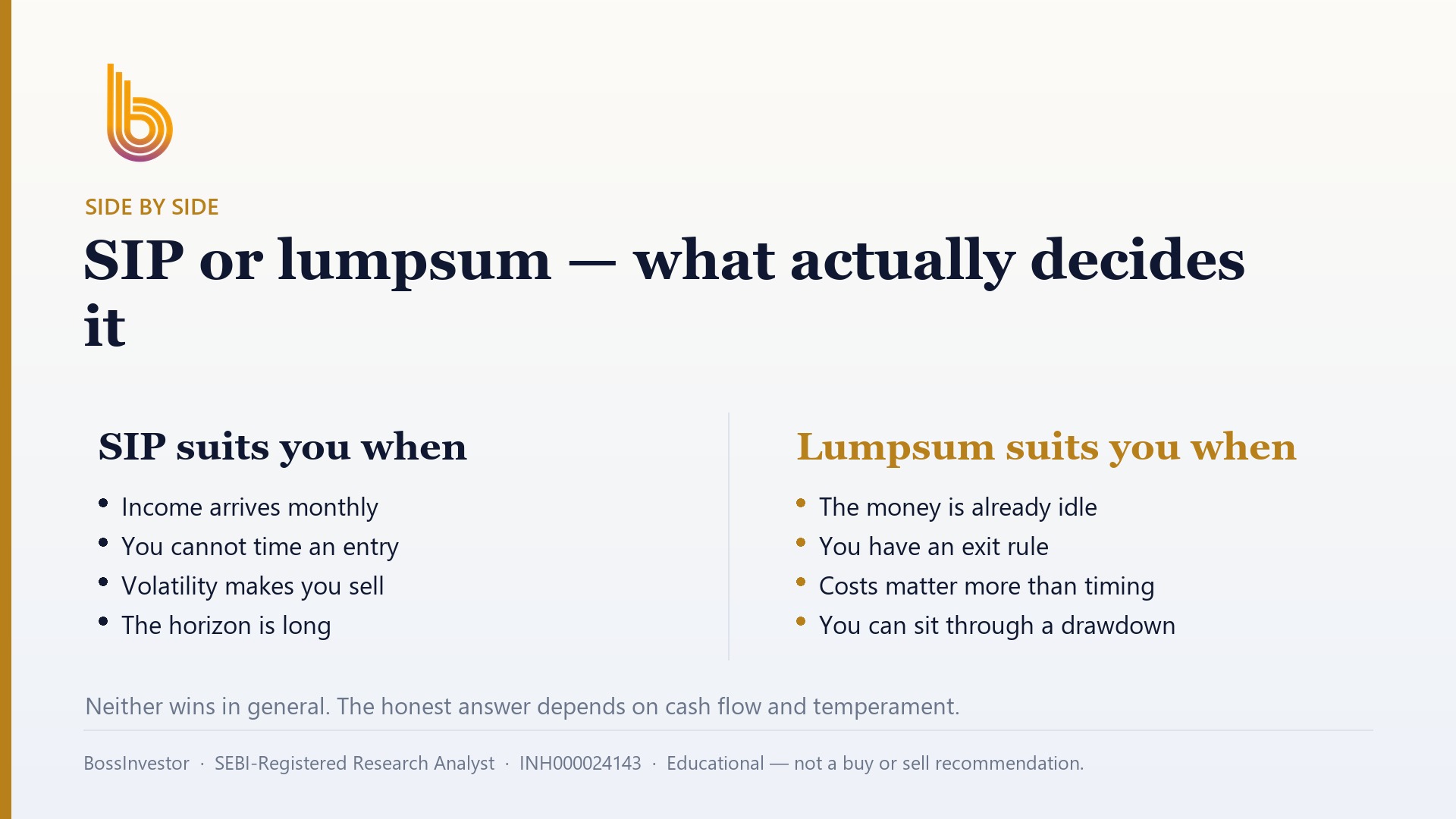
Should you invest monthly through a SIP or put the whole amount in at once?
Neither wins always. A lumpsum usually ends ahead when markets rise, because your full amount is invested from day one. A SIP wins when you don't have the money upfront, or when you would panic and sell. Match the method to your cash flow, not to a forecast.
Key Takeaways
- A SIP is not safer than a lumpsum — it is just slower, and slower helps only if you would otherwise panic.
- If the money arrives monthly, you are a SIP investor. If it arrives in one piece, you are a lumpsum investor. That is most of the decision.
- Cash waiting for a dip in a savings account is a guaranteed real loss after inflation, not a risk-free position.
- An STP over 6 to 12 months is the honest middle path for a large amount you feel nervous about.
- Every SIP instalment carries its own holding period, so redemptions follow first-in-first-out and part of a recent SIP is taxed as short-term.
- For direct stocks, quality and price come first — staggering entry into a weak business only spreads out the same mistake.
What is the difference between a SIP and a lumpsum, in plain terms?
A SIP means you invest a fixed rupee amount on a fixed date — say ₹10,000 on the 5th of every month — into the same fund. The money leaves your bank account whether the market is up or down. A lumpsum means you invest the whole amount once — ₹6,00,000 on a single day — and it stays invested. That is the only real mechanical difference between the two: the number of entry dates.
Everything people argue about flows from that one difference. One entry date means one price. Twelve entry dates mean twelve prices, and your cost becomes an average of them. Neither is a strategy by itself. A SIP into a poor fund is still a poor investment. A lumpsum into a sound fund at a sane price is still a sound one. The container is not the contents, and most investors spend their energy debating the container.
Which one actually gives higher returns over ten years?
Over long periods, a lumpsum wins more often than it loses, for a boring reason: money invested earlier stays invested longer. Indian equity has spent most of its listed history going up, so the money you hold back to invest next month usually buys fewer units, not more. Averaging is not free. It costs you the time your idle cash spends sitting in a savings account doing almost nothing.
But 'more often' is not 'always'. If your lumpsum lands a few weeks before a serious fall — 2008, or March 2020, or any of the smaller drawdowns the Nifty has produced since — a SIP running through the same stretch ends ahead, sometimes by a wide margin. The gap between the two methods is decided by something nobody knows in advance: what the market does in the twelve months after you invest. Which is why the honest answer to 'which is better' is 'which one will you actually stick with for ten years'.
When is a lumpsum the right choice?
Whenever the money already exists and is doing nothing. A bonus, a maturing fixed deposit, proceeds from selling property, gratuity, an inheritance. Money parked in a savings account while you wait for a dip is not sitting risk-free. It is losing purchasing power every month, with certainty, in exchange for a discount that may never arrive. Waiting has a price and most people never put a number on it.
A lumpsum also fits when your horizon is genuinely long — seven years or more — and the money is truly surplus. Ask yourself a blunt question before you press the button: if this amount falls 30% next year and stays down for two more years, does anything in my life break? If the answer is yes, the amount is too large or the asset is wrong. Phasing it in does not fix that; reducing it does. And a simple rule worth keeping: never put money you might need within three years into equity, in any form.
How do I check whether the market is expensive before deploying a large amount?
You cannot time the market, but you can measure what you are paying. Two things are worth a look before a big deployment: where the broad index trades relative to its own history, and how much genuine quality is still available at a fair price. The second is more useful, because it tells you whether the market is broadly rich or only rich in a few pockets.
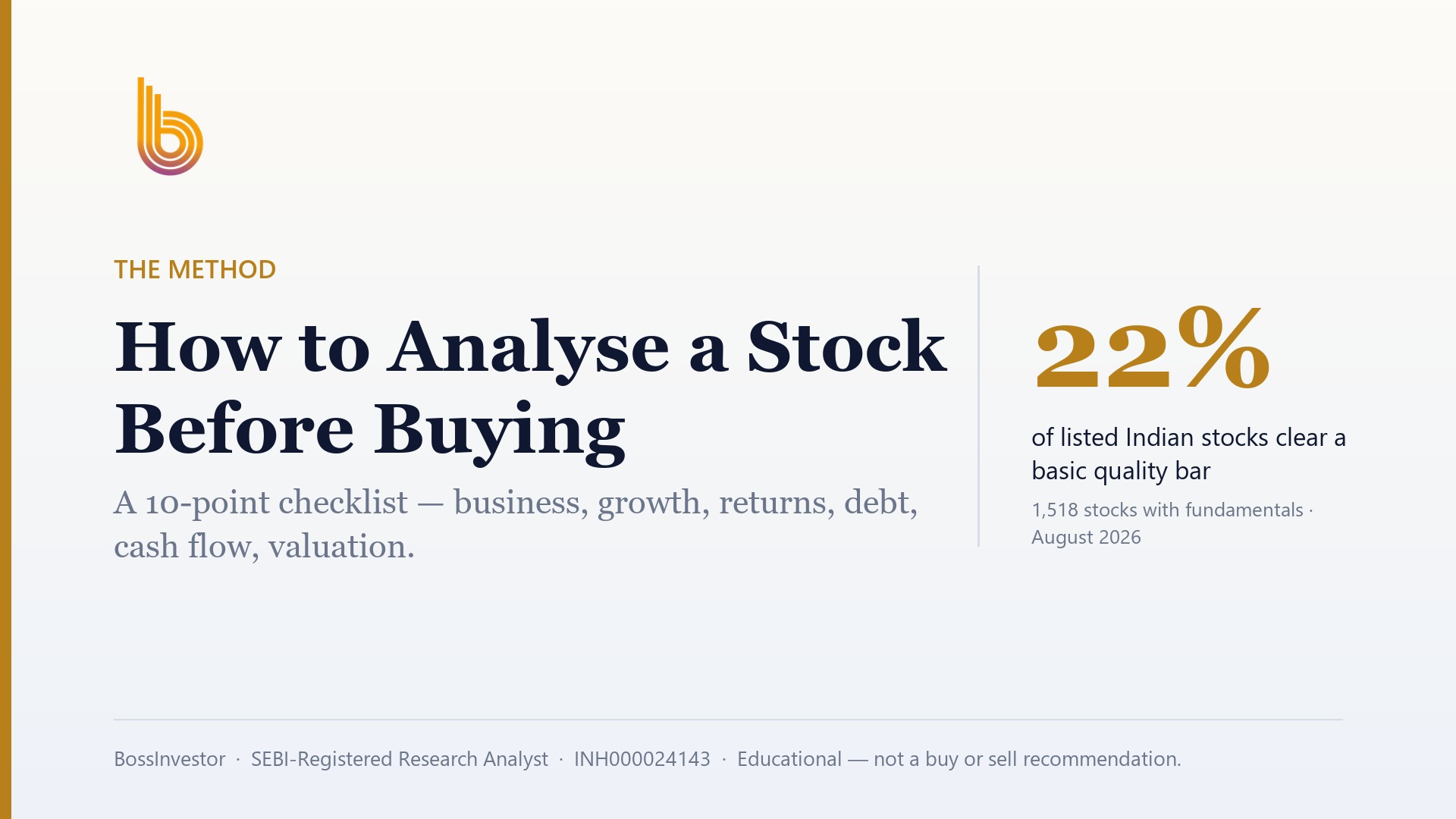
Our own screen of the listed Indian market gives a sense of that. As of August 2026, we track 1,852 listed companies, of which 1,518 have full-year fundamentals. Only 22.0% of those — 334 companies — clear a basic quality bar all at once: ROE above 15%, ROCE above 15%, and debt-to-equity below 1. Add a simple valuation check of PE under 40, and 15.9%, or 241 companies, survive. The median PE across the set is 24.0. One caveat worth stating plainly: a flat debt-to-equity rule is unfair to banks and NBFCs, because borrowing is their business model, so that screen excludes them rather than judging them. The point is not the precise number. It is the shape: quality at a fair price is always a minority of the market, and when that minority is thin, deploying across a few tranches costs you very little.
Can I stop choosing and use an STP instead?
Yes, and for most people with a large sum this is the practical answer. A Systematic Transfer Plan means you put the lumpsum into a liquid or ultra-short debt fund of the same fund house, then transfer a fixed amount into the equity fund every week or month. Your money earns debt-fund returns while it waits instead of savings-account returns, and you still get a staggered entry into equity.
Here is an illustrative example — the figures are chosen only to show the mechanics, not as a recommendation. You place ₹12,00,000 in a liquid fund and set up a transfer of ₹1,00,000 into an equity fund on the 1st of each month for twelve months. Your average purchase price becomes the average of twelve NAVs. The cost is that each transfer is a redemption from the debt fund, so those gains are taxed at your slab rate. Keep the window short — six to twelve months is usually enough. Stretching an STP across three years is just a slow SIP with extra paperwork and more idle cash.
Does my type of income decide this for me?
For most salaried Indians, the question answers itself. You are paid monthly, so you invest monthly. There is no lumpsum to debate, because a SIP is simply the only shape your savings can take. What matters far more than this whole argument is setting the SIP date within two or three days of your salary credit. That single change removes the month where you invest whatever happens to be left over, which is the real reason most SIPs stay small.
If your income is lumpy — business owner, consultant, commission-based, annual bonus, farm income — you are a lumpsum investor by default, and your risk is a different one. Your problem is cash that piles up between good quarters and then gets deployed in one nervous decision, usually after a rally has already happened. The fix is a calendar, not a forecast. Pick fixed deployment dates, say the 10th of every quarter, and invest whatever surplus exists on that date. You are converting an emotional decision into an administrative one, which is most of what discipline actually means.
How are SIP and lumpsum taxed differently in India?
The tax rules do not care whether you invested monthly or all at once. They care about how long each unit was held. For equity mutual funds and listed shares on the NSE and BSE, gains on units held more than a year are long-term; under a year, short-term at a higher rate. Equity long-term gains currently carry an annual exemption of ₹1.25 lakh across all your equity gains for the year, with 12.5% on the excess, and short-term gains are taxed at 20%. Debt funds purchased after April 2023 are taxed at your slab rate regardless of holding period. Budgets change these numbers, so confirm the current year's rates before planning around them.
Where the two methods genuinely differ is at exit. Every SIP instalment is a separate purchase with its own clock, and redemptions follow first-in-first-out. So if you run a SIP for three years and redeem everything today, the most recent twelve months of instalments are still short-term, and that slice of your gain is taxed at the higher rate. A lumpsum has one date and one clock — simpler to track and easier to plan an exit around. This is an argument for redeeming thoughtfully, in tranches, rather than an argument for picking one method over the other.
What mistakes make both SIP and lumpsum fail?
The mistake that kills SIPs is stopping them. A SIP works precisely because it keeps buying when prices fall — and that is exactly the moment people cancel the mandate. Stop your SIP after a 20% fall and you have converted an averaging plan into a machine that buys high and refuses to buy low. Pausing 'until things are clearer' is the same mistake wearing a suit. Things are never clearer; the price is just higher by the time they feel clearer.
The mistake that kills lumpsums is size. People invest an amount that is emotionally too big for them, watch it drop 15%, and sell near the bottom, turning a temporary drawdown into a permanent loss. Two more errors are common to both methods. First, spreading money across eight funds that hold broadly the same forty stocks — that is duplication, not diversification, and it quietly guarantees you index-like returns at higher cost. Second, judging a ten-year plan by six-month returns. And if you are still in regular plans out of habit, the commission built into them compounds into a genuinely large number over fifteen years.
Does this question work the same way for direct stocks?
No, and this is where the SIP habit gets people hurt. In a fund, monthly investing averages your cost across a whole portfolio that someone is rebalancing for you. In a single stock, a 'SIP' averages you into one business — and if that business is deteriorating, you are systematically buying more of something that is getting worse. Averaging helps only when the underlying thing is sound. Otherwise it is just a disciplined way to lose more money.
So for direct equity the sequence flips. First establish quality: returns on capital, the debt position, and whether reported earnings are turning into actual cash. Then decide what price you are willing to pay for it. Only after both of those does the question of one tranche or four tranches even arise. Our August 2026 screen found 22.0% of the 1,518 companies with full-year fundamentals clearing the quality bar, and 15.9% clearing quality plus a PE under 40 — a reminder that the filtering work matters far more than the instalment schedule. Staggering your entry into a business you have not checked does not reduce risk. It spreads the same mistake over more dates.
Click Here – See BossInvestor's Data-Driven Stock Screens
Conclusion
SIP versus lumpsum is a cash-flow question, not a forecast question. If your money arrives monthly, invest monthly and set the date next to your salary credit. If it arrives in one piece and you can hold through a bad year without breaking, put it to work — through an STP over six to twelve months if the valuation of the market makes you uneasy. The method is only the container; what you put inside it, and whether you leave it alone, decides the outcome. When you want the specific names and price levels our analysts are working with, that sits behind KYC inside the BossInvestor app.
BossInvestor is a SEBI Registered Research Analyst (INH000024143). This article is for educational and informational purposes only. It explains a method and is not investment advice, nor a recommendation to buy, sell or hold any security. Market-wide figures are computed from our universe as of August 2026; past metrics do not guarantee future results. Always do your own research or consult a registered adviser before investing.
Frequently Asked Questions
Is a SIP safer than a lumpsum?
No. A SIP is not lower risk, it is lower regret. Both end up fully invested in the same asset, exposed to the same falls. What a SIP changes is the entry price and your behaviour — it spreads your cost across many dates and stops you from staking everything on one day's price. If a 30% fall would make you sell, a SIP genuinely helps. If it would not, a lumpsum in a rising market usually leaves you better off.
Can I run a SIP and invest lumpsums at the same time?
Yes, and most disciplined investors do exactly this. The monthly SIP handles your salary, running quietly in the background. Separately, whenever a bonus, maturing FD, or one-off surplus arrives, you deploy it as a lumpsum or through a short STP into the same funds. There is no conflict between the two. The only rule is that both must go into investments you have already decided you want to own, not into whatever has recently performed well.
I have ₹10 lakh in the bank right now. SIP or lumpsum?
First separate the money you might need within three years — that should not touch equity at all, whichever method you use. For the rest, if your horizon is seven years or more and you can sit through a bad year, deploying it now is statistically the stronger choice. If that thought keeps you awake, park it in a liquid fund and run an STP into equity over six to twelve months. That is a legitimate compromise, not a cop-out.
Does a SIP guarantee positive returns?
It does not. A SIP guarantees only that you buy at many different prices instead of one. If the fund you chose is weak, or if you exit during a downturn, you can still lose money after ten years of monthly instalments. There is a long stretch in most SIPs where the returns look flat or negative — that is normal and is exactly when the cheapest units get purchased. The guarantee lies in the discipline, not in the outcome.
Is a lumpsum better when the market is falling?
On paper, yes — you buy more units at lower prices. In practice, almost nobody can do it, because a falling market always comes with a convincing story about why it will keep falling. If you genuinely want to buy declines, decide the rule in advance and write it down: fixed amounts deployed at fixed intervals during the fall, not one large bet at what you hope is the bottom. A pre-committed rule beats conviction formed in the middle of a crash.
Related Blogs
How to Analyse a Stock Before Buying: A 10-Point Checklist
Published: Mon Sep 07 2026Read more…

How to Calculate Your Financial Freedom Number and Achieve It
Published: Tue May 20 2025Read more…
 (1).jpg)
From Signal to Strategy: The Moving Averages
Published: Tue May 20 2025Read more…

Market Share: The Silent Signal of Competitive Power and Investment Opportunity
Published: Wed May 14 2025Read more…