How do I start investing in stocks with little money?
Most people wait to start investing because they think ₹2,000 a month is too small to matter. It isn't. This page walks through the full method — the account, the safety buffer, the monthly amount, and the checks that separate a business worth owning from a ticker that just moved.

BOSSINVESTOR
Mon Sep 07 2026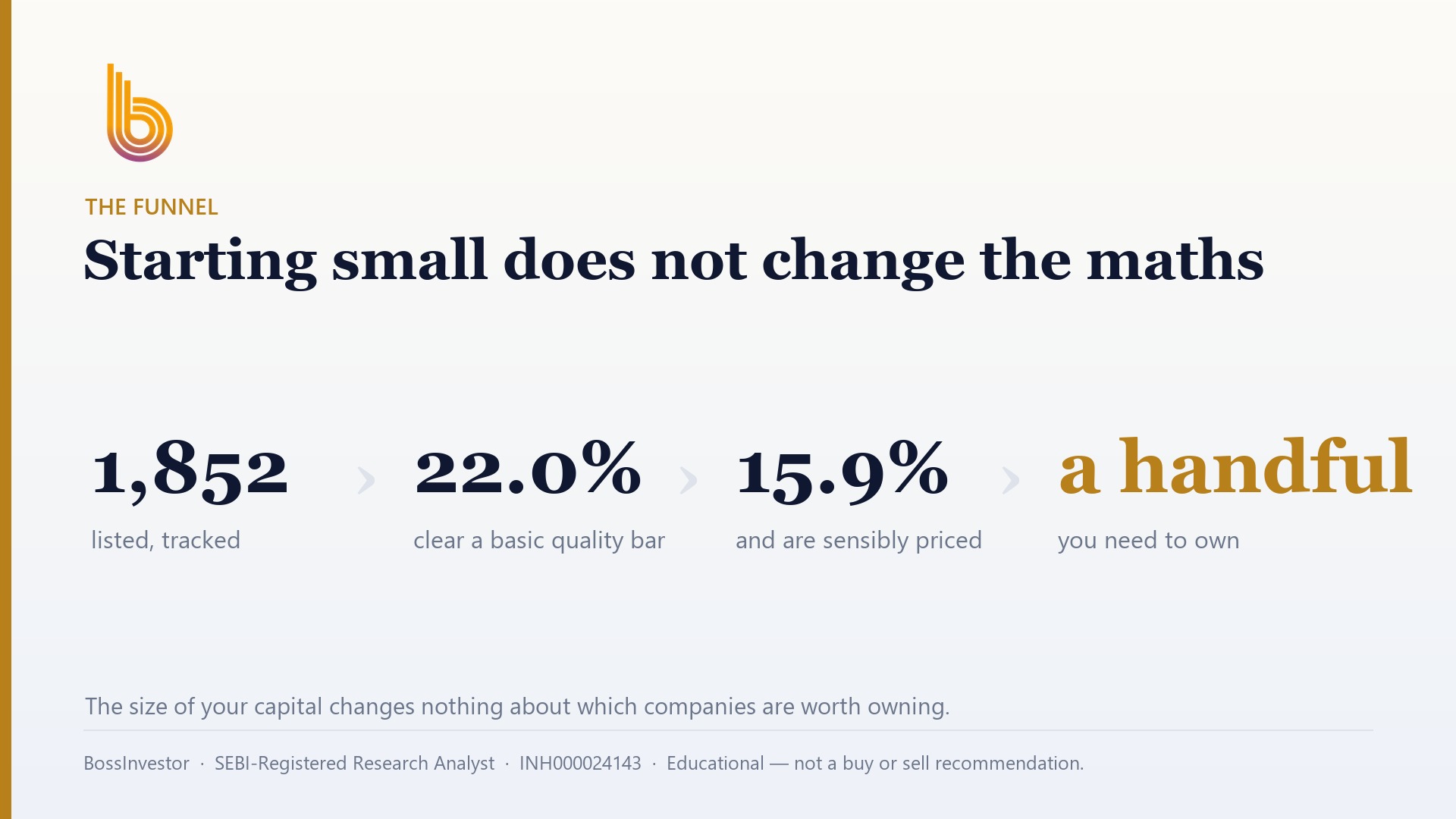
What is the smallest sensible way to begin buying Indian stocks?
You can start with ₹500. India has no fractional shares, so your true minimum is the price of one share on the NSE or BSE. Open a demat and trading account, keep a six-month emergency fund aside, then invest a fixed amount every month into a few quality businesses you have actually checked.
Key Takeaways
- There is no minimum investment in Indian stocks — only the price of one whole share.
- Emergency fund and credit card dues come before your first trade, always.
- A fixed monthly amount beats a large one-time amount you are scared to deploy.
- As of August 2026, only 22.0% of the 1,518 companies we track with full-year fundamentals clear a basic quality bar.
- Small tickets get eaten by flat charges — fewer, larger buys beat many tiny ones.
- Holding for over 12 months changes how your gains are taxed, so plan the exit before the entry.
How much money do I actually need to buy my first share in India?
Less than you think. There is no rule on the NSE or BSE that says you must buy 10 shares or 100 shares. You can buy one. If a company's share trades at ₹340, you need ₹340 plus a few rupees of charges. That is the entire barrier. Unlike the US market, India does not allow fractional shares in the cash segment, so the price of one whole share is your genuine floor — you cannot buy half of a ₹4,000 share.
This matters practically. Some very well-known Indian companies trade in the tens of thousands of rupees per share. If you have ₹2,000 a month, those are simply not available to you yet, and that is fine. Thousands of listed businesses trade at prices where one share fits comfortably inside a small monthly budget. You are not missing out by starting where your money reaches.
The more useful question is not "how much do I need" but "how much can I leave alone." Money that you might need for a wedding, a laptop, or a deposit in eighteen months does not belong in equities. The stock market is honest over long periods and completely random over short ones. If ₹1,000 a month is what you can genuinely forget about, that is your number.
What do I need to set up before I can invest anything at all?
Four things, in this order. First, a bank account with net banking or UPI. Second, PAN and Aadhaar — these are mandatory for KYC and there is no way around them. Third, a demat account, which is where your shares are held electronically with CDSL or NSDL. Fourth, a trading account with a SEBI-registered broker, which is the pipe that connects your bank to the exchange. Most brokers open the demat and trading account together in one online application, and it is usually done in a day or two.
Read the charges sheet before you sign. Brokers differ on annual maintenance charges for the demat account, on brokerage per trade, and on what they charge when you sell. Some offer a zero-maintenance plan. For someone investing ₹2,000 a month, a ₹300 annual charge is a real fraction of your returns, not a rounding error.
One habit to build on day one: switch on the CDSL or NSDL consolidated account statement and the SMS alerts. Every share credited or debited from your demat account will ping you. It takes two minutes to enable and it is the simplest protection a small investor has against something going wrong in the account without their knowledge.
Should a beginner with small savings start with mutual funds or direct stocks?
Honest answer: for most people starting with ₹1,000 to ₹5,000 a month, an index fund or a diversified equity fund is the sturdier default. One purchase gives you dozens of companies. You are not exposed to a single business making a single bad decision. You do not need to read an annual report to sleep at night.
Direct stocks are worth it when you actually want to learn how businesses work, and you are willing to put in reading time every month. The learning is genuinely valuable and it compounds faster than the money does in the early years. But it is a skill, not a shortcut, and buying individual shares because a fund feels boring is the most common way small portfolios get hurt.
A practical middle path many people use: put the bulk of the monthly amount into a fund and carve out a smaller slice — a fifth, say — for direct stocks. The fund does the compounding while you are still learning. The slice teaches you what it feels like to hold something through a 30% fall, which no amount of reading can teach you. Over two or three years, if your stock picks are holding up, you can shift the ratio.
How do I choose a stock when I can only afford one or two?
When you can only own a few positions, each one carries a lot of weight. So the filter has to be strict. A workable starting bar has three parts: return on equity above 15%, return on capital employed above 15%, and debt-to-equity below 1. In plain terms — the business earns a decent return on the owners' money, it earns a decent return on all the money it uses, and it is not leaning heavily on borrowings to do it.
That bar is harder to clear than most beginners assume. Across our universe of 1,852 listed Indian companies as of August 2026, 1,518 had full-year fundamentals available. Of those, only 22.0% cleared all three tests at the same time. Add a simple valuation check — a price-to-earnings ratio under 40 — and you are down to 15.9%. For context, the median PE across that set is 24.0. So roughly six out of every seven listed companies fail a basic first-round screen. If you own three stocks and picked them from a WhatsApp forward, the odds are not with you.
One caveat on the debt rule: it is unfair to banks and NBFCs. Borrowing is literally their business model, so a flat debt-to-equity filter throws them out automatically. If you want to look at lenders, you need a different set of checks — asset quality, provisioning, capital adequacy — and that is a heavier lift for a first-year investor.
What does a small monthly investing plan actually look like in practice?
Here is an illustrative example — the figures are made up to show the mechanics, not a suggestion about how much anyone should invest. Suppose Rhea has ₹3,000 a month spare. She keeps ₹2,000 going into an index fund by automatic debit on the 5th. The remaining ₹1,000 she lets collect in her trading account. She does not buy anything in month one or month two.
By month three she has ₹3,000 sitting there. She has spent those weeks reading about two businesses she already understands from daily life. One of them clears the quality bar. She buys as many whole shares as ₹3,000 allows and writes down, in a notes app, exactly why she bought it and what would make her think she was wrong. Then she repeats the cycle.
Two things make this work. First, the automatic debit — it removes the monthly decision of whether to invest, which is the decision people get wrong most often. Second, letting cash pool for a quarter before buying stocks, so each purchase is large enough that fixed charges do not swallow it, and so you are never forced to buy something just because money arrived. Waiting is a position. Cash in your trading account is not a failure.
What charges and taxes quietly eat a small investor's returns?
Every buy and sell in India carries a stack: brokerage, securities transaction tax, exchange transaction charges, GST on the brokerage, SEBI turnover fees, and stamp duty on purchases. On a ₹50,000 trade this stack is small. On a ₹700 trade it is not, because several components behave like flat fees rather than percentages. The depository participant charge levied when you sell is the sharpest of these for tiny positions — it can be a meaningful slice of a small sale.
This is the strongest practical argument against buying one share every week. Fewer, larger purchases cost less in total than many small ones for the same money invested. Batching your buys is free money for a small portfolio.
On tax, the line that matters is 12 months. Equity shares sold after being held more than a year are taxed at a lower long-term rate, with an annual exempt amount before tax applies. Sold within a year, gains are taxed at the higher short-term rate. Dividends are added to your income and taxed at your slab. None of this is a reason to hold a bad business, but it is a reason not to churn — and for someone investing small amounts, frequent trading is the fastest way to convert a decent year into a flat one.
What mistakes hurt new investors most in the first year?
Three, mostly. The first is treating small capital as a reason to gamble — the logic that says "₹5,000 can't change my life, so let me find something that goes up 10x." That logic finds penny stocks and options, and it is how most first-year money disappears. Your ₹5,000 is not there to change your life. It is there to teach you a process that will run on ₹5 lakh later.
The second is checking prices daily. A stock you bought for good reasons will still fall 20% at some point, for reasons that have nothing to do with the business. If you watch it every hour, you will sell it at the bottom. Checking your portfolio once a month is plenty; checking the businesses once a quarter, when results come out, is what actually matters.
The third is buying on tips. Anonymous Telegram calls, a confident YouTube thumbnail, an uncle at a wedding — none of these carry accountability. If someone names a stock without showing you the numbers behind it and without telling you what would make them wrong, you have received a rumour, not research. In India, anyone giving stock recommendations for a fee should be registered with SEBI as a Research Analyst or Investment Adviser, and that registration number is checkable.
How do I stay consistent when the amounts feel too small to matter?
Change what you are measuring. In year one, your returns are noise — a 15% gain on ₹20,000 is ₹3,000, which will not feel like anything. What is genuinely growing is your contribution rate and your judgement. Track those instead: how much you invested this quarter versus last, and how many businesses you can now read a results announcement for without getting lost.
Then automate the part that requires willpower. The transfer should happen on payday, before spending, not on the 28th out of what is left. Almost everyone who builds a portfolio from small amounts does it this way, and almost everyone who fails to build one was waiting for a surplus that never appeared.
And raise the amount when your income rises. Going from ₹2,000 to ₹3,000 a month when you get an increment does more for your final corpus than any stock pick you will make this year. The market gives you returns; the savings rate is the only lever you fully control.
Click Here – See BossInvestor's Data-Driven Stock Screens
Conclusion
Starting small is not a compromise — it is the correct way to start, because the first year is for building a process, not a corpus. Get the account open, keep the emergency fund untouched, automate a fixed monthly amount, and hold your stock picks to a real bar rather than a story. When you want to see which companies currently clear that bar in our universe, the screened list and our specific calls sit behind KYC in the BossInvestor app.
BossInvestor is a SEBI Registered Research Analyst (INH000024143). This article is for educational and informational purposes only. It explains a method and is not investment advice, nor a recommendation to buy, sell or hold any security. Market-wide figures are computed from our universe as of August 2026; past metrics do not guarantee future results. Always do your own research or consult a registered adviser before investing.
Frequently Asked Questions
What is the minimum amount needed to start investing in stocks in India?
There is no regulatory minimum. Your practical floor is the price of one share, because India does not permit fractional shares in the cash market. If a share trades at ₹250, you need ₹250 plus small transaction charges. What you do need beyond that is a demat and trading account with a SEBI-registered broker, PAN, Aadhaar, and money you will not need for at least five years.
Can I invest in stocks with ₹500 a month?
Yes, but be smart about how. Rather than buying one share every month, let the ₹500 collect for three or four months and make one larger purchase. Several transaction charges behave like flat fees, so many tiny trades cost far more in total than a few batched ones. Alternatively, a ₹500 monthly SIP into an index fund gives you broad exposure with no per-trade cost drag at all.
How many stocks should a beginner with small capital own?
Somewhere between three and eight is workable for a small portfolio. Fewer than three and one bad business can undo everything. More than eight and you cannot realistically track quarterly results for all of them, which means you are collecting tickers rather than owning businesses. Add positions slowly as your capital grows, not all at once, and only when a company clears your quality checks.
Is it safe to start investing in stocks without any experience?
Equities carry real risk of permanent loss, and that does not change with account size. What makes it survivable for a beginner is structure: an emergency fund kept separate, no borrowed money, a fixed monthly amount, a holding period measured in years, and a written reason for every purchase. Starting with an index fund while you learn direct stock analysis is the lower-risk on-ramp most new investors should take.
How do I know if a company is good enough to buy?
Start with three checks: return on equity above 15%, return on capital employed above 15%, and debt-to-equity below 1. As of August 2026, only 22.0% of the 1,518 companies in our universe with full-year fundamentals cleared all three together, so it is a genuinely selective filter. Note that banks and NBFCs fail the debt test unfairly, since borrowing is their business, and need a different framework entirely.
Related Blogs
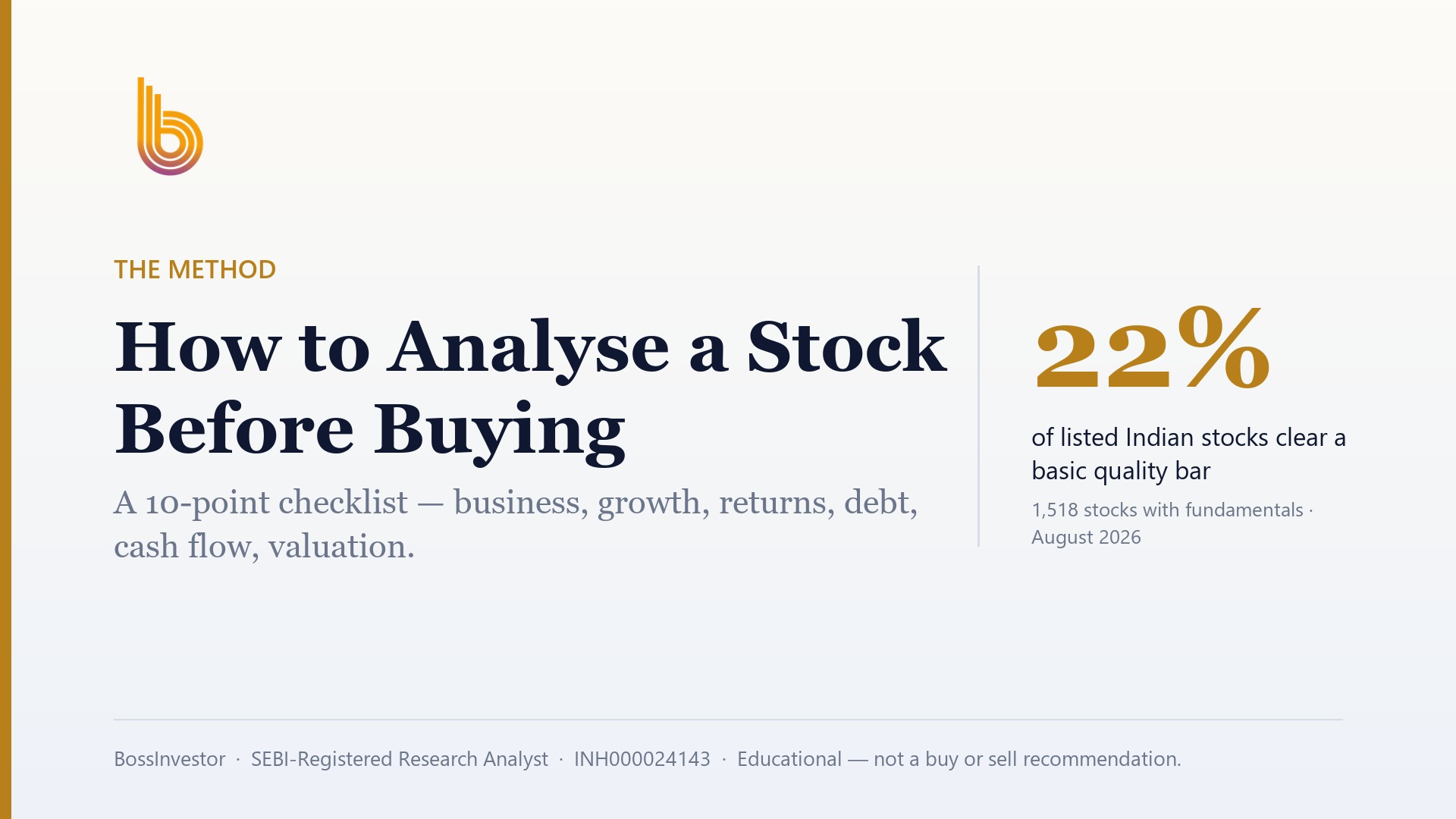
How to Analyse a Stock Before Buying: A 10-Point Checklist
Published: Mon Sep 07 2026Read more…

How to Calculate Your Financial Freedom Number and Achieve It
Published: Tue May 20 2025Read more…
 (1).jpg)
From Signal to Strategy: The Moving Averages
Published: Tue May 20 2025Read more…

Market Share: The Silent Signal of Competitive Power and Investment Opportunity
Published: Wed May 14 2025Read more…