Stocks vs mutual funds: which is better?
This page settles the stocks-versus-mutual-funds argument the boring, useful way: what each one actually asks of you in time, cost, tax and temperament. You will leave with a split you can defend, and a way to check whether your own stock picking is working.

BOSSINVESTOR
Mon Sep 07 2026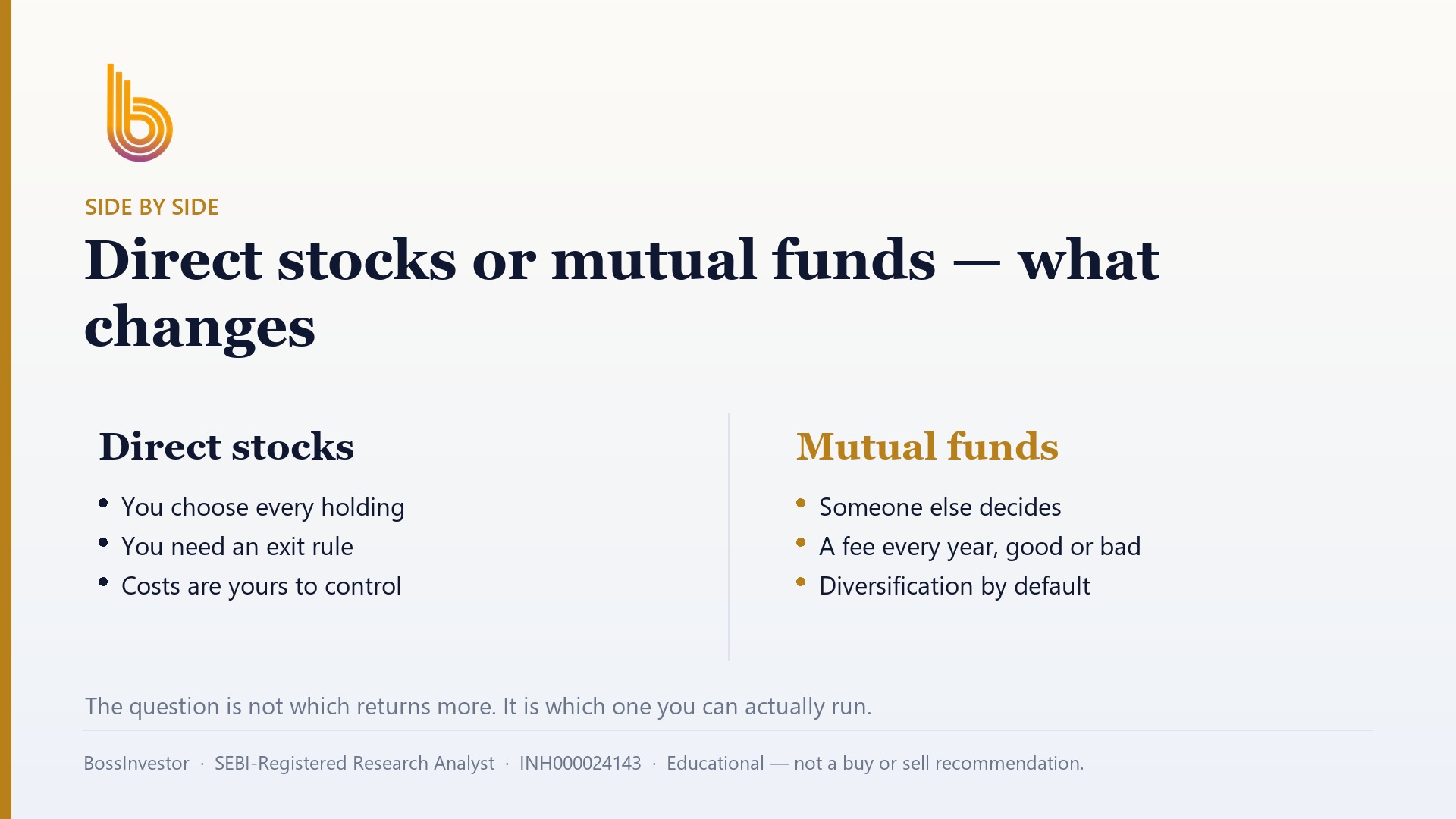
So should an Indian investor buy stocks directly or go through mutual funds?
Neither is universally better — they solve different problems. Mutual funds give you diversification, professional management and one decision a month, which suits most working investors. Direct stocks can pay more, but only if you can research and hold. Our August 2026 data shows just 22.0% of 1,518 Indian companies clear a basic quality bar.
Key Takeaways
- A mutual fund is a decision about your time; a single stock is a decision about one business.
- A weak fund makes you lag the market. A weak stock can permanently destroy your capital.
- Of 1,518 Indian companies with full-year fundamentals, only 22.0% clear a basic quality bar (August 2026).
- Funds cost you a small percentage every year; stocks cost you hours every quarter.
- Most people are best served by a fund core plus a small, capped direct-stock sleeve.
- Judge your own stock picking against what the same money in an index fund would have done — over three years, not three months.
What is the actual difference between buying a stock and buying a mutual fund?
When you buy a share on the NSE or BSE, you own a slice of one business. Your money now rides on one management team, one industry cycle, one balance sheet. If that company loses a large customer, gets a tax notice, or the promoter pledges shares quietly, you feel all of it. Nobody is standing between you and that outcome.
A mutual fund pools money from thousands of investors. A fund manager, working inside SEBI's rules, buys a basket of stocks with it and you hold units of that basket. Your money is spread across dozens of companies. One blow-up hurts, but it does not end you. You are buying the manager's process and, just as importantly, buying back your weekends.
The cleanest way to see the difference is to look at how each one fails. A poor mutual fund quietly lags the index for years — annoying, recoverable. A poor stock choice can take 60 or 70 percent of that position and never give it back. Different risk shapes need different amounts of your attention.
Which one should a beginner start with in India?
Start with mutual funds. Not because stocks are dangerous in some vague way, but because in your first two years the thing you are really studying is yourself — how you behave when a holding falls 30%, whether you keep investing in a bad month, whether you actually read anything. A monthly SIP into a broad, diversified equity fund teaches you that with much lower tuition fees.
There is a practical reason too. Direct stocks only work when you can hold through a bad stretch, and holding requires two things most beginners do not have yet: a reason you wrote down before you bought, and enough money elsewhere that you are not forced to sell. Build a fund base first. It becomes the ballast that lets you take real stock risk later.
Once you have a running SIP, an emergency fund, and roughly a year of watching your own reactions, you can carve out a small direct-equity portion. Small means small — an amount that, if it halved, would annoy you but not change your plans. That is the honest test.
How much time does each one honestly take every month?
A mutual fund portfolio needs about half an hour a quarter. You check that the SIP went through, glance at whether the fund is doing what it said it would, and rebalance once a year. That is the whole job. Any more attention than that usually makes returns worse, not better, because it tempts you to switch funds after every weak quarter.
Direct stocks are a different animal. For each company you own, expect several hours to build an initial view — the annual report, three or four years of numbers, who the promoters are, how the business actually earns money — plus an hour or so every quarter when results come out. Own twelve companies and you have signed up for a serious part-time hobby.
Be brutally honest here, because this is where most people quietly lose. If you buy ten stocks and then never read a single quarterly result, you do not own a stock portfolio. You own ten lottery tickets you paid research prices for. Choosing mutual funds because your job and family already fill your week is not a defeat. It is correct planning.
How are stocks and mutual funds taxed in India?
Structurally, equity shares and equity mutual funds are taxed along the same lines. Gains on holdings sold within a year are treated as short-term and taxed at a flat, higher rate. Hold beyond a year and gains become long-term, taxed at a lower rate, with a small annual exemption before the tax starts biting. Debt-oriented funds follow different, generally harsher rules. Rates change with each Budget, so confirm the current numbers with your CA before you plan around them.
The quiet advantage sits inside the fund. When a fund manager sells one holding and buys another, that churn does not create a tax event for you. Your tax clock only starts and stops when you buy or redeem units. In a direct stock portfolio, every switch you make is a taxable sale, so an itchy trading habit is taxed twice — once by the government and once by your own brokerage bill.
Dividends, whether from shares or funds, are added to your income and taxed at your slab rate, with tax deducted at source above a threshold. So a high-dividend strategy is not automatically tax-friendly for someone in the top slab.
What do stocks and mutual funds actually cost me?
Stocks charge you at the moment of action. Brokerage, securities transaction tax, exchange fees, stamp duty, GST and depository charges all show up on the contract note. Individually tiny; collectively brutal if you trade often. Hold a share for eight years and you pay almost nothing in between. Trade it eight times a year and the costs quietly eat a meaningful slice of your return.
Mutual funds charge you for time instead. The expense ratio is deducted daily from the fund's value, so you never see a bill — which is exactly why people ignore it. Choose direct plans over regular plans wherever you can; regular plans carry a distributor commission inside that ratio, and over fifteen years that gap compounds into real money. Watch for exit load if you redeem early.
An illustrative example, using made-up round numbers purely to show the shape: on ₹10 lakh, a fund charging 1% costs you ₹10,000 a year, every year, whether markets rise or fall. A stock portfolio you barely touch might cost a few thousand rupees in total over the same period. The trade is simple — funds charge rent on your money, stocks charge tolls on your activity.
How many Indian listed companies are actually good enough to own directly?
This is the part that changes most people's minds. As of August 2026, our universe covers 1,852 listed Indian companies, of which 1,518 have full-year fundamentals we can screen on. Apply one plain quality bar — return on equity above 15%, return on capital employed above 15%, and debt-to-equity below 1, all at the same time — and only 22.0% clear it. Add a simple valuation check, price-to-earnings under 40, and you are left with 15.9%.
Break it apart and it is even more sobering. 30.2% of these companies have ROE above 15%. 30.6% clear ROCE above 15%. 84.5% carry debt-to-equity below 1, and 65.1% trade at a PE between 0 and 40, with the median PE sitting at 24.0. Each filter alone looks generous. It is passing all of them together that thins the field to roughly one company in five.
One fair caveat: a flat debt-to-equity rule unfairly punishes banks and NBFCs, because borrowing is literally their business model. They need a separate lens. But the broad message stands. If you are picking stocks yourself, you are hunting in a small pond while ten thousand other people fish the same water — and a diversified fund quietly does this filtering for you.
How should I split my money between mutual funds and direct stocks?
Use a core-and-satellite structure. The core is diversified equity mutual funds bought through SIPs — this is the part that must work whether or not you have time this year. The satellite is your direct stock sleeve, funded with money you are willing to see fall hard. Emergency fund and insurance come before either.
An illustrative split, using round figures only to show proportions: a working investor putting ₹50,000 a month into equities might send ₹40,000 to funds and ₹10,000 to direct stocks. Inside that ₹10,000, no single company gets more than a fifth of the sleeve, and the sleeve stays capped as a share of total equity even if it does well. Cap first, celebrate later.
Two rules save people from themselves. First, if you cannot hold at least twelve to fifteen stocks properly, hold fewer and put the difference in funds — a concentrated portfolio you cannot track is the worst of both worlds. Second, never fund the stock sleeve by pausing the SIP after a bad month. That is the exact moment the SIP is doing its job.
How do I know whether my stock picking is actually working?
Keep a scorecard, and make it a fair one. Compare what your direct stock sleeve did against what the same money, invested on the same dates, would have done in a plain index fund. Include dividends on both sides. Include your brokerage and taxes on your side. Most people compare their best holding to their worst fund and declare victory — that is not measurement, that is comfort.
Give it three years at minimum. One good year proves nothing; a rising market makes everyone look sharp, and a falling one makes everyone look foolish. Also record the reason you bought each company, in one paragraph, on the day you bought it. When you review, you find out whether you were right for the reason you thought, or right by accident. Accidents do not repeat.
If after three honest years your sleeve is behind the index fund, move most of that money back into funds. This is not failure — it is information, and it is far cheaper to learn at 30 than at 55. If you are ahead, and you can explain why in plain language, then slowly widen the sleeve. Earn the size.
Click Here – See BossInvestor's Data-Driven Stock Screens
Conclusion
The stocks-versus-mutual-funds question is really a question about how much of your own time, attention and nerve you can commit — not about which product is superior. Funds ask for a small annual fee and give you back your weekends. Stocks ask for genuine work and, when the work is done well, pay for it. Decide honestly, cap the risky sleeve, and measure yourself against a boring index fund every year. When you do want a specific view on a specific company, that research sits behind KYC inside our app, where it belongs.
BossInvestor is a SEBI Registered Research Analyst (INH000024143). This article is for educational and informational purposes only. It explains a method and is not investment advice, nor a recommendation to buy, sell or hold any security. Market-wide figures are computed from our universe as of August 2026; past metrics do not guarantee future results. Always do your own research or consult a registered adviser before investing.
Frequently Asked Questions
Can I invest in both stocks and mutual funds at the same time?
Yes, and most sensible portfolios do exactly that. Keep diversified equity mutual funds as the core through monthly SIPs, since that part works even in months when you are too busy to read anything. Add a smaller direct-stock sleeve on top, capped as a percentage of your total equity, funded only with money whose fall would not disturb your plans. The two are not rivals — the fund core is what lets you take real risk with the stock sleeve.
Do mutual funds give lower returns than direct stocks?
On average, a diversified fund will not match your single best stock — but it will also never match your worst one. A fund holds dozens of companies, so extremes get averaged away in both directions. Direct stocks have a wider range of outcomes: bigger gains are possible, and so are permanent losses. The right comparison is not fund returns versus your best pick, but fund returns versus your entire stock portfolio, after brokerage and taxes, over at least three years.
How many stocks should I hold if I pick them myself?
Enough that one mistake cannot wreck you, and few enough that you can actually track them. For most working investors that means roughly twelve to twenty companies, with no single position dominating. Below about ten, a single bad outcome does serious damage. Above twenty-five, you almost certainly cannot read every quarterly result properly, at which point you are paying stock-picking prices for fund-like diversification. If you cannot track that many well, hold fewer and put the balance into funds.
Are index funds a middle path between stocks and active mutual funds?
In practice, yes. An index fund simply holds the companies in an index such as the Nifty 50 or a broader benchmark, in the same proportions, with no manager trying to beat it. Costs are usually lower than active funds, and there is no risk of the manager's judgement going wrong. What you give up is any chance of doing better than the index. For a core holding you plan to leave alone for a decade, that is often a fair trade.
Is it too late to start investing directly in stocks in India?
No, but be realistic about the field. As of August 2026, of 1,518 Indian companies with full-year fundamentals in our universe, only 22.0% clear a basic bar of ROE above 15%, ROCE above 15% and debt-to-equity below 1 together, and 15.9% survive after adding a PE-under-40 check. The median PE is 24.0. Good businesses exist in every market; the work is separating them from the rest. Start small, keep records, and let the fund core carry the load meanwhile.
Related Blogs
How to Analyse a Stock Before Buying: A 10-Point Checklist
Published: Mon Sep 07 2026Read more…

How to Calculate Your Financial Freedom Number and Achieve It
Published: Tue May 20 2025Read more…
 (1).jpg)
From Signal to Strategy: The Moving Averages
Published: Tue May 20 2025Read more…

Market Share: The Silent Signal of Competitive Power and Investment Opportunity
Published: Wed May 14 2025Read more…