What is a good dividend yield?
Dividend yield is the easiest number in investing to look up and the easiest one to misread. This page shows you how to calculate it properly, how to tell a real payout from a trap, what tax actually leaves you with, and where yield sits inside a proper quality check.

BOSSINVESTOR
Mon Sep 07 2026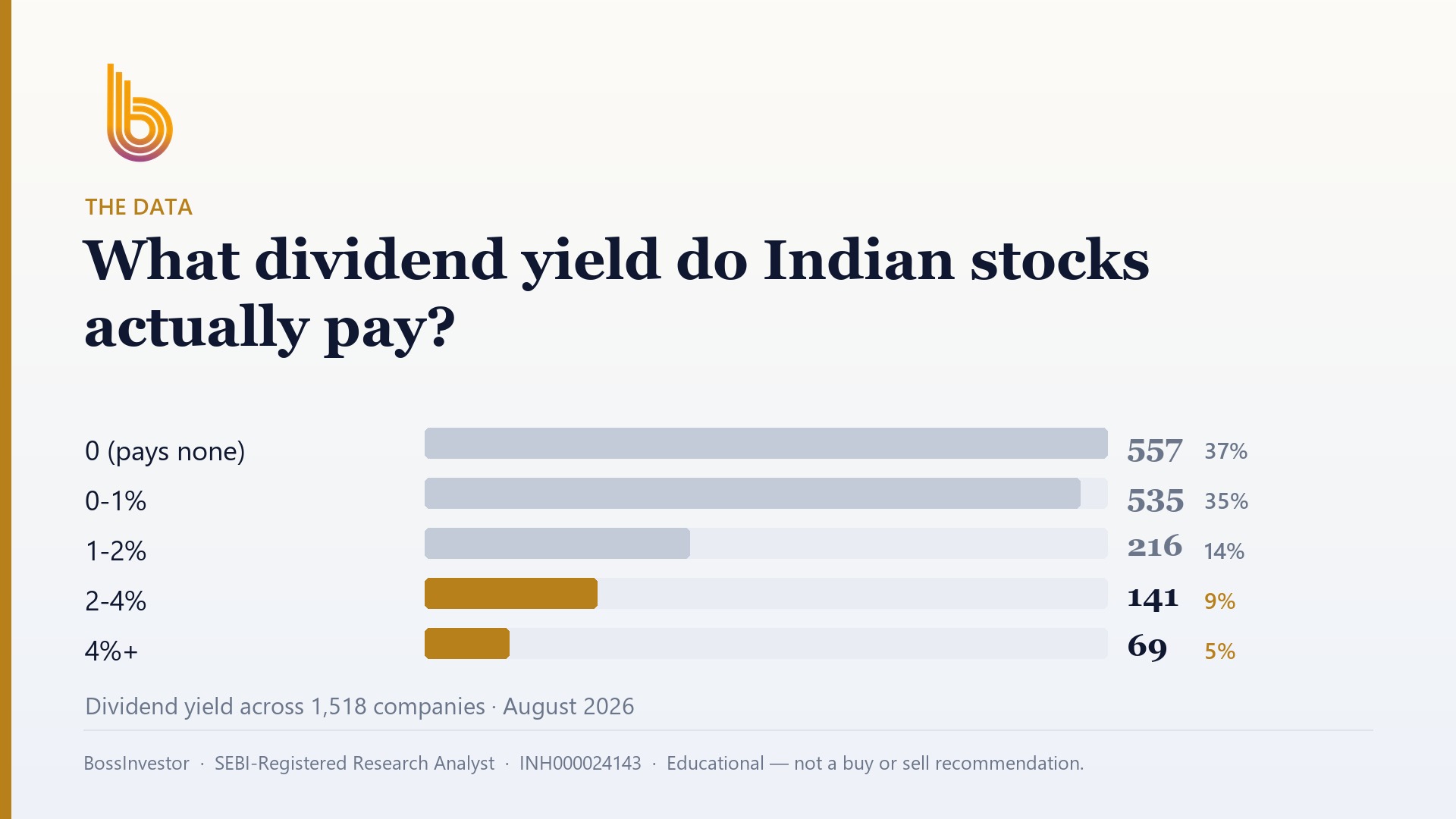
What counts as a good dividend yield for an Indian stock?
In India, a good dividend yield is roughly 2% to 5%, paid by a company that earns it comfortably. Below 1.5%, the cash barely matters. Above 6%, it usually signals a falling share price or a one-off special dividend, not generosity. Yield only counts when profit, cash flow and payout stay stable.
Key Takeaways
- Dividend yield = dividend paid per share over the last 12 months, divided by today's price.
- 2-5% is a healthy, believable range for an Indian stock; above 6% needs an explanation.
- A high yield is often a falling price in disguise, not a generous management.
- Payout ratio and operating cash flow tell you whether the dividend survives a bad year.
- Dividends are added to your income and taxed at your slab rate, so compare post-tax.
- Of 1,518 Indian companies with full-year fundamentals, only 22.0% clear a basic quality bar (as of August 2026).
What dividend yield is considered good in the Indian market?
For a listed Indian company, a dividend yield of about 2% to 5% is the sensible zone. In that band, the company is usually profitable, comfortable with its cash, and not starving its own growth to pay you. Anything under about 1.5% means the dividend is a rounding error in your returns; you are buying that business for growth, and that is a perfectly fine reason to buy it.
Above 6%, treat the number as a question rather than an answer. Very high yields cluster in a few pockets of the market: public sector undertakings that pay out heavily because the government needs the cash, utilities and power companies with fixed returns, and commodity or cyclical businesses that just had a record year. Some of those payouts are real and repeatable. Many are not.
The honest answer is that no single yield number is 'good' on its own. A 3% yield from a company whose profit grows every year is worth far more than an 8% yield from a company whose profit is shrinking. Yield tells you what the company paid. It tells you nothing about whether it can pay again.
How do I calculate dividend yield the right way?
The formula is simple: add up the dividends per share the company actually paid over the last twelve months, then divide by the current share price on the NSE or BSE. Multiply by 100. That is your yield. It moves every single day, because the price moves every single day.
Illustrative figures only: a stock trading at ₹400 that paid ₹6 as an interim dividend and ₹6 as a final dividend has paid ₹12 in the year, so the yield is 3%. If that same stock falls to ₹300 and the dividend stays at ₹12, the yield jumps to 4% — and nothing good has happened to the business. The yield rose because the price fell.
Two traps in the arithmetic. First, screeners often bundle a one-time special dividend into the trailing figure, which inflates the yield for a year and then collapses it. Strip special dividends out and check what the ordinary payout looks like. Second, once you own the stock, your personal yield is calculated on what you paid, not on today's price. If a company keeps raising its dividend, your yield on cost quietly climbs over the years even when the screen shows a modest number.
Why is a very high dividend yield often a warning sign?
Yield is a fraction. It goes up when the top number rises, and it also goes up when the bottom number falls. Most extreme yields on Indian screeners come from the second cause. The market has already decided that earnings are heading down, the price has dropped, and the yield you see is calculated from a dividend the company has not yet cut but probably will.
The second common cause is peak-cycle profit. A metals, sugar, shipping or chemicals company at the top of its cycle earns unusually well and pays out unusually well. The trailing yield looks spectacular. Then the cycle turns, profit halves, and the dividend follows. You bought the yield at exactly the wrong point in the cycle.
The third cause is a genuine one-off: an asset sale, a stake sale, a special dividend to clear surplus cash. That money is real, but it arrives once. Judging a business by a special dividend is like judging someone's salary by their Diwali bonus. Before you get excited by a double-digit yield, find out which of these three things you are looking at. It is almost always one of them.
How do I check whether a company can keep paying its dividend?
Start with the payout ratio: dividend per share divided by earnings per share. Below roughly 40%, the dividend is comfortably covered and there is room to raise it. Between 40% and 70%, it is a mature business returning most of what it makes, which is fine if earnings are steady. Above 80%, the company is paying out nearly everything it earns, and a single weak year forces a cut.
Then go past profit to cash. Profit is an accounting opinion; cash flow from operations is closer to fact. Open the annual report and compare cash generated from operations against dividends paid plus capital expenditure. If the company is paying dividends while borrowing more, it is handing you money it does not have. That is not income. That is your own capital coming back with extra risk attached.
Finally, look at the record across at least seven to ten years, deliberately including the bad ones — the FY2020 and FY2021 stretch is a useful stress test for most Indian businesses. A company that kept paying, or paid a smaller amount without stopping, has told you something about its balance sheet and its management's attitude. A company that skipped the dividend the moment things got difficult will do it again.
How much tax will I actually pay on dividends in India?
Since the dividend distribution tax was scrapped, dividends land in your hands and get added to your total income. They are taxed at your slab rate. If you are in the highest slab, a meaningful part of every rupee of dividend goes to tax before it is yours. The company also deducts TDS once your dividend from that one company crosses a modest annual threshold, and you claim credit for it when you file.
This changes the maths completely. Illustrative figures only: a 5% dividend yield for someone in the 30% bracket is worth about 3.5% after tax, before surcharge and cess. Meanwhile, if the same stock rises and you sell after holding it long enough, that gain is taxed at a flat long-term capital gains rate that is lower than the top slab. So for a high-income investor, a rupee of price appreciation is worth more than a rupee of dividend.
Two practical notes. If you borrowed money to invest, the Income Tax Act allows a limited deduction of that interest against dividend income, capped at a share of the dividend received. And if your total income is below the taxable limit, you can file the appropriate declaration with the company or registrar so TDS is not deducted in the first place. Small things, but they are the difference between the yield on the screen and the yield in your bank account.
Is a high-dividend stock better than a fixed deposit?
They are not the same instrument, and comparing the headline numbers is how people get hurt. A fixed deposit returns your capital intact. A dividend stock can pay you 5% and lose you 20% of your capital in the same year. The yield is a consolation prize, not a floor. There is no floor under a share price.
What equity offers instead is growth in the payment itself. An FD pays the same rupee amount every year until it matures. A good dividend payer raises its dividend as profits rise, so the cash you receive grows and the share price usually grows with it. Over ten or fifteen years that difference dominates. Over one year, it is invisible, and the volatility is all you feel.
Since interest and dividends are both taxed at your slab rate, at least the comparison is clean on the tax side. The real question is not which yield is higher but which risk you are being paid to take. If you need the money in three years, an FD or a debt fund is the correct answer and no dividend yield fixes that. If you are investing for a decade, chasing yield alone is the wrong lens entirely.
Where does dividend yield fit alongside quality and valuation checks?
Yield should be the last filter you apply, not the first. Sorting the market by highest yield hands you a list dominated by the exact traps described above. The better order is: is the business good, is the price sane, and only then, does it pay me anything while I wait.
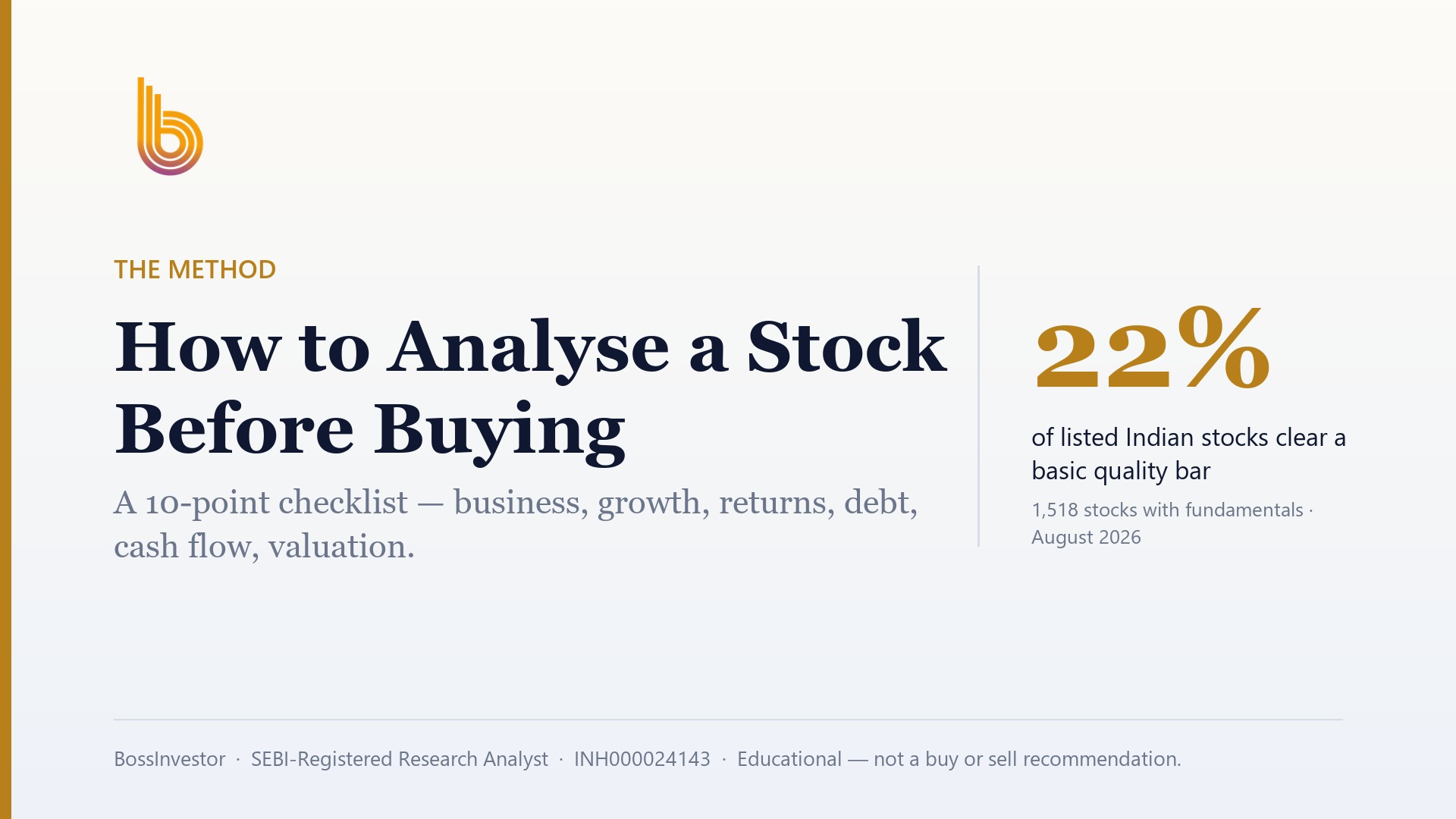
The first two questions eliminate most of the market. From our own universe of 1,852 listed Indian companies, 1,518 had full-year fundamentals as of August 2026. Only 22.0% of those cleared a basic quality bar of return on equity above 15%, return on capital employed above 15% and debt-to-equity below 1, all at the same time. Add a simple valuation check — price-to-earnings under 40 — and just 15.9% survive. Median PE across the universe stood at 24.0 as of August 2026.
One fairness note on that debt screen: a flat debt-to-equity rule unfairly penalises banks and NBFCs, because borrowing is literally their business model. Judge lenders on capital adequacy, asset quality and provisioning instead. For everyone else, the point stands — roughly four out of five listed companies fail a plain quality-and-price test before dividends even enter the conversation. Screening for yield inside that surviving group is a completely different exercise from screening the whole market for yield.
What should I check before buying a stock only for its dividend?
Run a short, boring checklist. Strip out special dividends and recalculate the ordinary trailing yield. Check the payout ratio against earnings and against operating cash flow. Read the last ten years of dividend history. Confirm the company is not borrowing to pay you. Ask whether this year's profit is normal or cycle-peak. Then convert the yield to a post-tax number at your own slab.
Also understand how the ex-dividend date works. On the ex-date, the share price typically adjusts downward by roughly the dividend amount. Buying a few days before the record date to 'capture' the dividend does not create free money — you receive cash and your holding falls by about the same amount, and now you owe tax on the cash. The tax department has specific rules aimed at this kind of dividend stripping. It is not a strategy.
The last check is the one people skip: what does the dividend say about management's intent? A company paying out heavily because it genuinely has no better use for the cash is being honest with shareholders. A company paying out heavily because a large shareholder needs the money, while its own plants need investment, is telling you something quite different. The number on the screen is the same in both cases. The outcome five years later is not.
Click Here – See BossInvestor's Data-Driven Stock Screens
Conclusion
A good dividend yield is one you can explain. Two to five percent, covered by profit and by actual cash, from a business that has paid through at least one bad year, at a price that is not absurd — that is the whole standard. Everything above that band deserves suspicion until proved otherwise, and everything below it means you are buying for growth and should judge the stock on growth. Work through the checklist yourself on any name you are holding; if you would rather see the specific stocks that clear our quality, valuation and payout filters, that list sits behind KYC in the BossInvestor app.
BossInvestor is a SEBI Registered Research Analyst (INH000024143). This article is for educational and informational purposes only. It explains a method and is not investment advice, nor a recommendation to buy, sell or hold any security. Market-wide figures are computed from our universe as of August 2026; past metrics do not guarantee future results. Always do your own research or consult a registered adviser before investing.
Frequently Asked Questions
Is a 10% dividend yield good?
Almost never, at least not for the reason you hope. A 10% yield on an Indian stock is usually the result of a share price that has collapsed, a one-time special dividend that will not repeat, or a cyclical company reporting peak-cycle profit that is about to normalise. Before treating it as income, check the payout ratio, operating cash flow and the last ten years of dividends. If the dividend cannot survive a weak year, the yield is a mirage.
Do I pay tax on dividends in India?
Yes. Dividends are added to your total income and taxed at your applicable slab rate, so a top-bracket investor keeps meaningfully less than the headline yield. The company also deducts TDS once your dividend from that single company crosses a modest annual threshold, and you claim credit for it while filing your return. If your income is below the taxable limit, you can file the relevant declaration to avoid the deduction upfront. Always compare yields on a post-tax basis.
Which is better, dividend yield or capital appreciation?
For most Indian investors with a long horizon, capital appreciation matters more, and it is usually taxed more kindly than dividend income at higher slabs. Dividends earn their place differently: they force discipline on management, they give you cash without selling, and a rising dividend is decent evidence that reported profit is real. The best outcome is not one or the other but a company whose earnings grow and whose dividend grows alongside them.
How do I find high dividend yield stocks on NSE?
Screeners on NSE and BSE data will sort by trailing yield in seconds, but that list is a trap list by construction — it ranks falling prices at the top. Screen for quality and valuation first, then look at yield inside whatever survives. From our universe as of August 2026, only 22.0% of the 1,518 companies with full-year fundamentals cleared a basic ROE, ROCE and debt test, and 15.9% cleared it with a PE under 40. Start there.
What is a good dividend payout ratio for an Indian company?
Below roughly 40% is comfortable: the company is covering the dividend easily and retaining enough to grow. Between 40% and 70% suits a mature business with steady earnings and limited reinvestment needs. Above 80% leaves no cushion, so one weak year forces a cut. Utilities and some PSUs run high payouts by design, which is acceptable when cash flows are regulated and predictable. Always cross-check the ratio against operating cash flow, not just reported profit.
Related Blogs
How to Analyse a Stock Before Buying: A 10-Point Checklist
Published: Mon Sep 07 2026Read more…

How to Calculate Your Financial Freedom Number and Achieve It
Published: Tue May 20 2025Read more…
 (1).jpg)
From Signal to Strategy: The Moving Averages
Published: Tue May 20 2025Read more…

Market Share: The Silent Signal of Competitive Power and Investment Opportunity
Published: Wed May 14 2025Read more…