What Is a Good ROCE for Indian Stocks?
"ROCE above 15%" is the answer everyone repeats — and it is only half right. The number is meaningless until you compare it to the cost of capital, to five years of the company's own history, and to its sector peers. Here is how to read ROCE properly, compute it yourself, and use it as a measurement rather than a slogan.

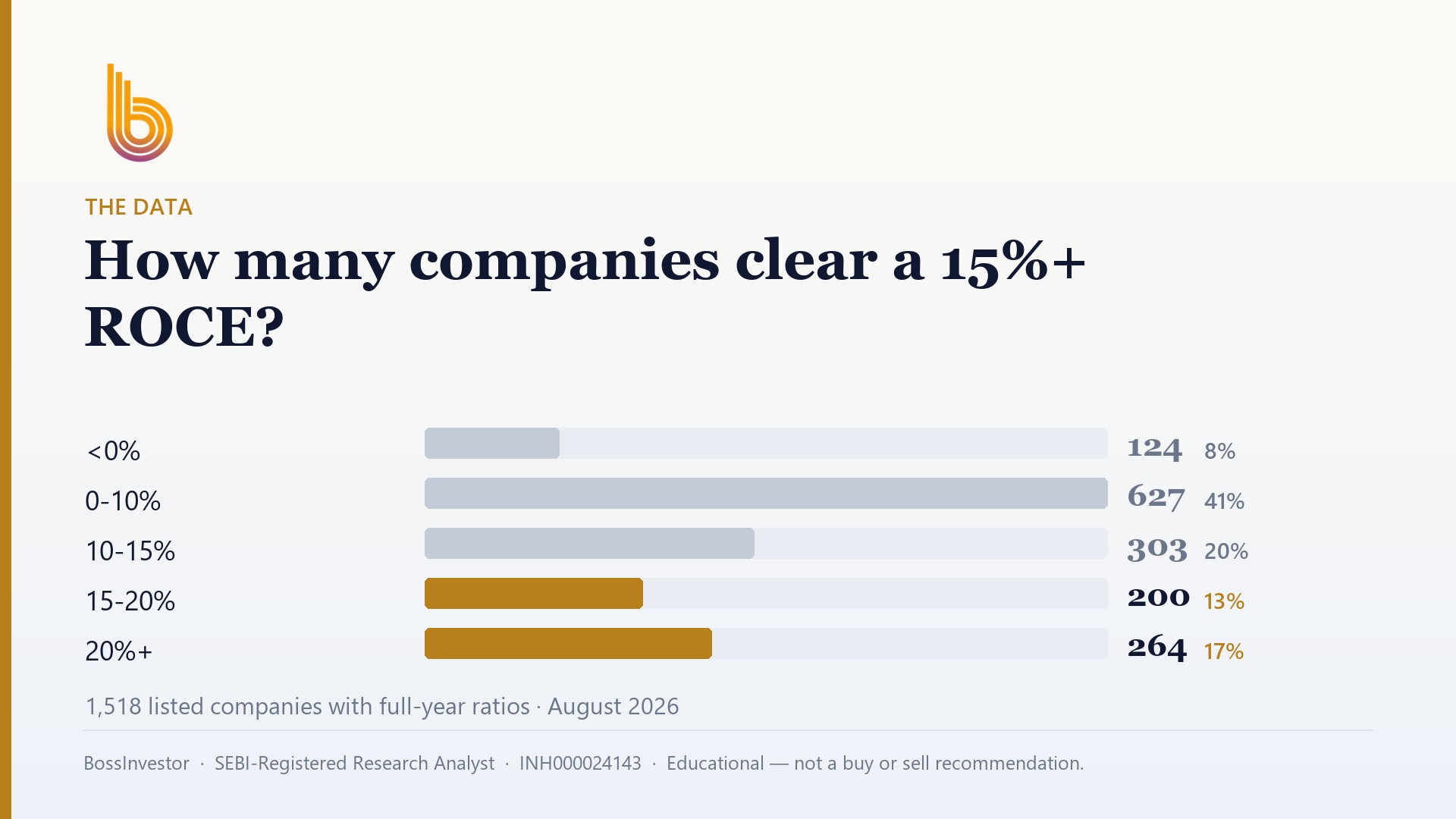
What Counts as a Good ROCE for an Indian Stock?
As a general rule, a Return on Capital Employed (ROCE) above 15% is considered good, and above 20% is considered strong for Indian stocks. But that threshold is a starting point, not a verdict. A ROCE only signals quality when it clears three tests: it must exceed the company's cost of capital (otherwise the business is destroying value even while it grows), it must be consistent over at least five years (a single high year can be a one-off), and it must rank well against sector peers (12% can be excellent for a utility and mediocre for an asset-light software firm). Read in isolation, the 15% rule of thumb is one of the most over-quoted and least understood numbers in investing.
Key Takeaways
- ROCE = EBIT ÷ Capital Employed, where Capital Employed = Total Assets − Current Liabilities.
- Rule of thumb: above 15% is good, above 20% is strong — but always sector-relative.
- The real test: ROCE must beat the company's cost of capital (WACC) to create value.
- Consistency beats a single number — track ROCE across 5+ years, not one quarter.
- ROCE is harder to inflate with debt than ROE, which is why it is a favourite of quality investors.
- The right way to judge "good" is as a percentile within the peer sector, not a fixed line.
What Is ROCE and How Do You Calculate It?
Return on Capital Employed measures how efficiently a company turns all the capital it uses — both equity and debt — into operating profit. The formula is:
ROCE = EBIT ÷ Capital Employed
Capital Employed = Total Assets − Current Liabilities
EBIT (Earnings Before Interest and Tax) is the operating profit before the effects of how the company is financed and taxed. Capital Employed is the money tied up in the business to generate that profit. Here is a worked example with illustrative figures for a hypothetical "Company X" (these numbers are made up to show the arithmetic, not drawn from any real company):
| Line item (illustrative) | Amount (₹ crore) |
|---|---|
| EBIT (operating profit) | 300 |
| Total Assets | 2,000 |
| Current Liabilities | 500 |
| Capital Employed (2,000 − 500) | 1,500 |
| ROCE (300 ÷ 1,500) | 20% |
A 20% ROCE means Company X generates ₹20 of operating profit for every ₹100 of capital employed in the business. Whether that is "good" is the question the rest of this article answers.
Why Isn't There a Single "Good" ROCE Number?
The 15% rule of thumb fails the moment you apply it across sectors. Capital-intensive businesses — utilities, infrastructure, metals, cement — need enormous asset bases to operate, so their structural ROCE ceiling is lower. Asset-light businesses — software, branded consumer, some financial services — can post very high ROCE because they employ relatively little capital. Comparing a steel maker's ROCE to a software firm's tells you almost nothing about which is the better-run business.
This is why the professional way to read ROCE is relative, not absolute. The useful question is not "Is 18% good?" but "Where does 18% sit within this company's own sector, and how has this company's ROCE moved over the last five years?" A 14% ROCE in the top decile of a capital-heavy sector is a far stronger signal than a 22% ROCE that ranks in the middle of an asset-light one.
What Is the Single Most Important ROCE Test?
Above every benchmark sits one rule: ROCE must exceed the company's cost of capital. A company's weighted average cost of capital (WACC) is the blended return its lenders and shareholders require. If ROCE is above WACC, each rupee reinvested in the business creates value. If ROCE is below WACC, the company is destroying value with every rupee it deploys — even if profits are rising in absolute terms. A firm growing fast at a ROCE below its cost of capital is running to stand still, or worse. This is the test that separates genuine compounders from businesses that merely look big.
Why Does Consistency Matter More Than a Single Number?
A single year's ROCE is easy to distort. A one-off asset sale can inflate EBIT; a temporarily shrunken capital base can flatter the denominator; an accounting quirk can move the number several points. What is hard to fake is a high and stable ROCE sustained across a full business cycle — typically five years or more. A company that earns 20%+ ROCE year after year, through good times and bad, is demonstrating a durable competitive advantage. One that spikes to 25% for a year and then collapses is a very different proposition. Always read the trend line, not the last dot.
ROCE vs ROE: Which Should You Use?
ROE (Return on Equity) and ROCE answer different questions, and the gap between them is itself informative. ROE measures the return to shareholders on equity alone — and it can be inflated by piling on debt, because borrowing boosts returns to equity when things go well. ROCE measures the return on all capital, equity plus debt, so leverage cannot flatter it in the same way. When a company shows a high ROE but a much lower ROCE, that gap is usually the fingerprint of heavy borrowing. Quality-focused investors look at both and treat a large ROE-minus-ROCE gap as a flag to investigate the balance sheet.
How Should You Actually Use ROCE in Screening?
Treated as a slogan, "ROCE above 15%" invites two errors: rejecting good capital-heavy businesses, and waving through mediocre asset-light ones. Treated as a measurement, ROCE becomes powerful. The disciplined approach is to compute each company's ROCE as a percentile within its sector, overlay a five-year consistency check, and confirm the level clears a reasonable cost-of-capital hurdle. That converts a vague benchmark into a ranked, comparable, sector-neutral signal.
This is exactly the kind of computation BossInvestor runs across the listed Indian universe — building sector-relative percentile bands and multi-year consistency scores rather than applying one flat line to every stock. The point of doing it with data is to stop guessing whether 15% is "good" and start measuring where a given company actually stands.
Click Here – Explore BossInvestor's Data-Driven Stock Screens
Conclusion
"What is a good ROCE?" has a headline answer — above 15% is good, above 20% is strong — and a real answer, which is that the number only earns meaning through context. A good ROCE beats the company's cost of capital, holds up across at least five years, and ranks well against sector peers. Use it as a measurement, not a slogan: compute it, compare it within the sector, and read the trend. Done that way, ROCE is one of the most reliable quality signals available to an Indian equity investor.
BossInvestor is a SEBI Registered Research Analyst (INH000024143). This article is for educational and informational purposes only. It explains how to read and compute a financial ratio and is not investment advice, nor a recommendation to buy, sell or hold any security. The "Company X" figures are illustrative and do not refer to any real company. Any screening framework described is a method of measurement; past performance and historical metrics do not guarantee future results.
Frequently Asked Questions
What is a good ROCE percentage for Indian stocks?
As a general rule, a ROCE above 15% is considered good and above 20% is considered strong for Indian stocks. But the threshold is not absolute: a good ROCE must exceed the company's cost of capital to create value, and it must be judged against the company's own history and its sector peers. A 12% ROCE can be excellent in a capital-heavy sector like utilities and unremarkable in an asset-light software business.
How do you calculate ROCE?
ROCE = EBIT (Earnings Before Interest and Tax) ÷ Capital Employed, where Capital Employed = Total Assets − Current Liabilities. The result is expressed as a percentage. For example, a company with EBIT of ₹300 crore and capital employed of ₹1,500 crore has a ROCE of 20%.
Is ROCE better than ROE for judging a company?
They answer different questions. ROE measures the return to shareholders on their equity alone and can be flattered by high debt. ROCE measures the return on all capital employed, both equity and debt, so it is harder to inflate with leverage and is often preferred for comparing companies with different capital structures. Strong investors look at both, and are wary when ROE is high but ROCE is low — which usually signals heavy borrowing.
Why should ROCE be measured over several years?
A single year's ROCE can be distorted by one-off gains, asset sales, or a temporarily low capital base. A durable business shows a high and stable ROCE across a full cycle, typically five years or more. A ROCE that is consistently above 15-20% year after year is a far stronger signal of quality than a single high reading, which is why analysts track the trend, not just the latest number.
Related Blogs
How to Analyse a Stock Before Buying: A 10-Point Checklist
Published: Mon Sep 07 2026Read more…

How to Calculate Your Financial Freedom Number and Achieve It
Published: Tue May 20 2025Read more…
 (1).jpg)
From Signal to Strategy: The Moving Averages
Published: Tue May 20 2025Read more…

Market Share: The Silent Signal of Competitive Power and Investment Opportunity
Published: Wed May 14 2025Read more…