What is a good ROE for a stock?
ROE is the single number most retail investors quote and least understand. This page explains what return on equity actually measures, what level is genuinely good in the Indian market, and the three ways a high ROE can lie to you. By the end you will be able to check any NSE or BSE listed company yourself.

BOSSINVESTOR
Mon Sep 07 2026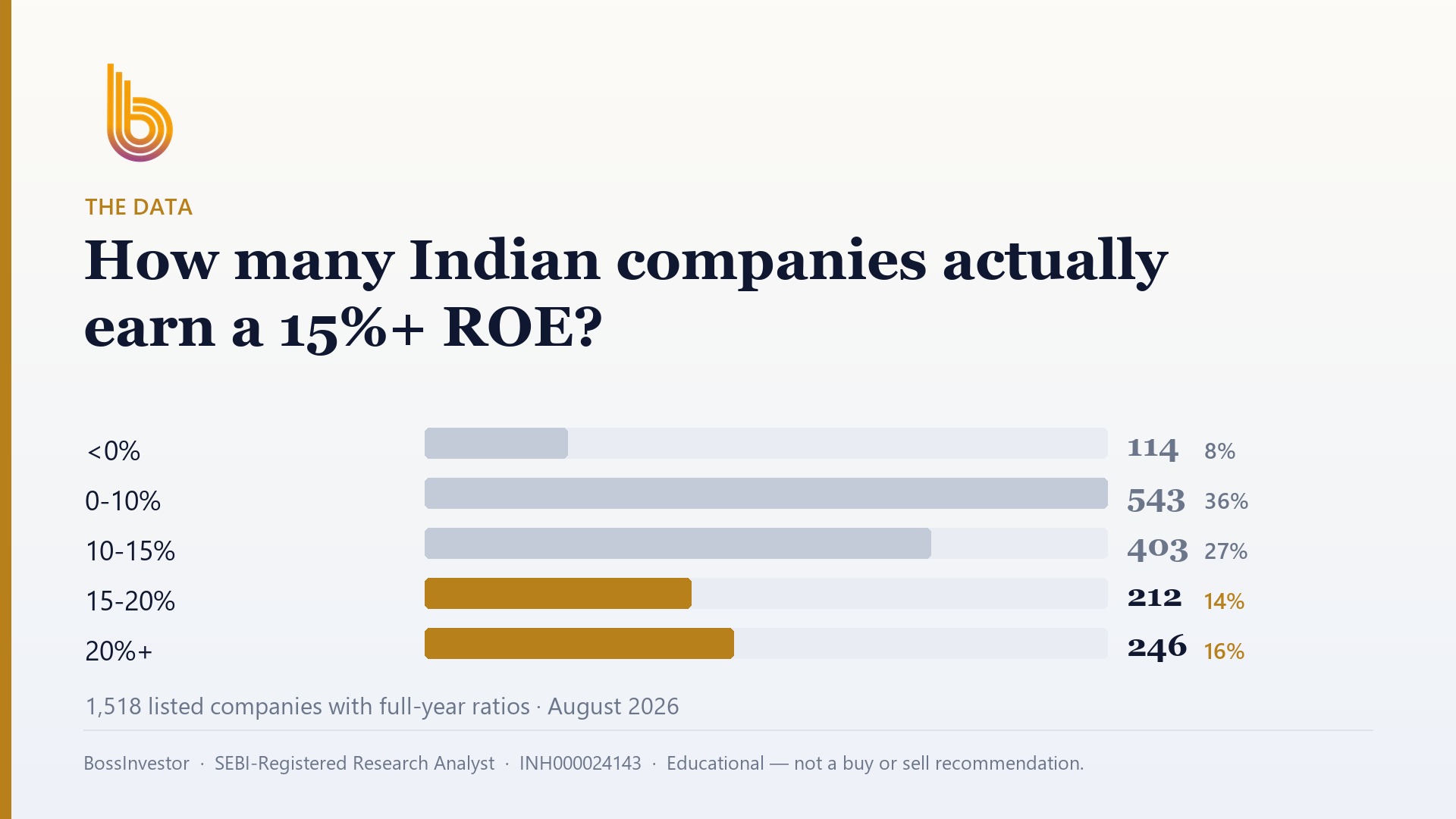
What ROE should an Indian stock have before you call it good?
For an Indian stock, an ROE above 15% is the usual quality bar, and above 20% held steady for five years is genuinely good. Below 12%, the business is barely beating what a plain debt fund pays. As of August 2026, only 30.2% of 1,518 listed Indian companies with full-year fundamentals cleared 15%.
Key Takeaways
- ROE = net profit divided by shareholders' money in the business, shown as a percentage.
- Above 15% is good, above 20% sustained for five years is genuinely strong, below 12% is weak.
- As of August 2026, only 458 of 1,518 Indian companies with full-year fundamentals (30.2%) had ROE above 15%.
- Debt can push ROE up without the business improving — always check ROCE and debt-to-equity alongside.
- A flat debt-to-equity screen unfairly punishes banks and NBFCs, because borrowing is their business model.
- High ROE at any price is not a good investment — median PE in our universe was 24.0 in August 2026.
What does ROE actually mean in plain English?
ROE stands for return on equity. Take the net profit a company earned in a full year. Divide it by the shareholders' money sitting inside the business — the capital owners originally put in, plus all the profits the company kept instead of paying out as dividend. Turn that into a percentage. That is ROE.
It answers one blunt question: for every ₹100 of owners' money the company is holding, how many rupees of profit did it produce this year? A company running at 20% ROE turned ₹100 of your capital into ₹20 of profit. A company at 8% turned the same ₹100 into ₹8. Same rupee, very different business.
Here is an illustrative example, not real company data. Suppose a company shows ₹500 crore of shareholders' equity on its balance sheet and reports ₹90 crore of net profit for the year. ₹90 crore divided by ₹500 crore is 18%. That is an 18% ROE. If the company keeps most of that ₹90 crore inside the business and can put it back to work at a similar rate, the equity base grows and next year's profit grows with it. That compounding is the whole reason ROE matters more than the profit figure by itself.
How high should ROE be before a business is worth owning?
Use a simple ladder. Below 10% is poor — the business is destroying or barely preserving value once you account for what safe alternatives pay. Between 10% and 15% is ordinary. Above 15% is good. Above 20%, held for five years or more without wild swings, is genuinely strong. Anything above roughly 40% deserves suspicion rather than excitement, because it usually means the equity base has been shrunk by buybacks or the company is running on borrowed money.
The reason 15% is the common Indian bar is straightforward. Equity is risky. Your money can go to zero. A fixed deposit or a plain debt fund pays you a modest return with far less pain. If a business cannot clearly beat that safe return after taking on all the risk of running a factory, a brand or a lending book, you are not being paid for the risk you carry.
One more thing about holding period. In India, gains held long term are taxed more lightly than gains booked quickly, and that quietly rewards owning a compounding business for years rather than trading it. A high ROE only helps you if you stay long enough for the compounding to show up in the share price. A 22% ROE business held for six months does nothing for you that a 9% ROE business held for six months does not.
How many listed Indian companies actually clear a 15% ROE?
Fewer than most people assume. As of August 2026, our universe covered 1,852 listed Indian companies, of which 1,518 had full-year fundamentals we could measure. Of those 1,518, exactly 458 companies — 30.2% — had an ROE above 15%. So roughly seven out of ten listed companies with reported numbers did not clear the basic quality bar.
It gets tighter when you insist on quality rather than just one flattering ratio. Also as of August 2026, 464 companies (30.6%) had ROCE above 15%, and 1,282 companies (84.5%) had debt-to-equity below 1. But only 334 companies — 22.0% of the 1,518 — cleared ROE above 15%, ROCE above 15% and debt-to-equity below 1 all at the same time. That is the real number to hold in your head. Roughly one listed Indian company in five is a genuinely clean, unlevered, high-return business by these three tests.
One caveat on that debt screen. A flat debt-to-equity rule is unfair to banks and NBFCs, because borrowing money is literally their business model, not a sign of stress. If you run that filter across the whole market you will screen out most lenders automatically. Judge financial companies on separate ground — asset quality, net interest margin, capital adequacy — and keep the debt-to-equity test for manufacturers, consumer companies and service businesses where it actually means something.
Can a company fake a high ROE using debt?
Yes, and this is the most common trap. ROE has shareholders' equity in the denominator. If a company borrows heavily instead of raising equity, the denominator stays small while the borrowed money goes to work generating profit. ROE shoots up. Nothing about the underlying business got better — the risk simply moved onto the balance sheet, where a casual investor does not look.
The fix is to check ROCE alongside ROE. Return on capital employed measures profit against all the money the business uses — equity plus debt. If a company shows 24% ROE and 9% ROCE, the gap is the leverage talking. If ROE and ROCE are both in the high teens or better, the returns are coming from the business itself. In our August 2026 data, 30.2% of companies cleared 15% ROE and 30.6% cleared 15% ROCE — similar headline percentages, but only 22.0% cleared both plus a debt check together, which tells you the two lists are far from identical.
There are two other ways ROE flatters. One is a large one-off gain — selling land, selling a subsidiary, an insurance payout — that inflates a single year's profit. The other is aggressive buybacks that shrink equity. Neither is fraud. Both make one year's ROE meaningless on its own.
Why is ROE misleading for banks, NBFCs and cyclical companies?
For lenders, high leverage is normal and expected. A bank takes deposits and lends them out; the whole enterprise runs on other people's money. A bank showing 16% ROE with a debt-to-equity ratio that would terrify you in a cement company may be perfectly healthy. Judging it by manufacturing rules gives you the wrong answer twice — you reject good lenders and you have no framework for the bad ones.
Cyclical businesses have the opposite problem. Metals, sugar, commodity chemicals, shipping and real estate swing hard with the commodity cycle. At the top of a cycle these companies can print 30% ROE and look like the best businesses on the NSE. Two years later the same company posts a loss. If you buy at peak ROE and peak price, you usually buy at the worst possible moment. For cyclicals, look at the average ROE across a full cycle — seven to ten years — not the latest number.
Asset-light service businesses need a third lens. A consultancy or an asset manager may carry very little capital on the balance sheet, so even modest profit produces a spectacular ROE. That is real, but it also means the number is easy to distort. Ask whether the profit is large and durable, not just whether the ratio is large.
How do you tell if a high ROE will actually last?
Pull ten years of numbers, not one. Consistency is the whole signal. A company that has held ROE between 18% and 24% for a decade is telling you something structural — a brand people pay up for, a distribution network competitors cannot copy quickly, a cost position, a licence, switching costs. A company that jumped from 6% to 27% last year is telling you something happened last year, and you have to find out what.
Then ask where the profit went. A business earning 20% ROE that pays out almost everything as dividend is not compounding your money at 20% — it is handing it back for you to reinvest somewhere else, probably at a lower rate. A business earning 20% and reinvesting most of it, while keeping ROE at 20%, is the genuinely rare thing. Watch whether ROE stays high as the equity base grows. Many companies earn beautiful returns on a small base and mediocre returns once they are large.
Finally, read the consolidated numbers, not standalone, for any company with subsidiaries. Standalone accounts can hide loss-making arms. And check whether profit is converting into actual cash from operations. Profit that never turns into cash usually turns into a problem two or three years later.
Does a high ROE stock automatically deserve any price you pay?
No. Quality and price are two separate decisions, and confusing them is how good businesses become bad investments. A company can be excellent and still be a poor purchase if the market has already priced in a decade of excellence. Your return depends on what the business earns and on what you paid to own that earning power.
Our August 2026 data shows how much this narrows the field. Of the 1,518 companies with full-year fundamentals, 988 (65.1%) traded at a PE between 0 and 40, and the median PE across the universe was 24.0. But when we added that valuation check to the quality bar — ROE above 15%, ROCE above 15%, debt-to-equity below 1, and PE under 40 — only 241 companies survived. That is 15.9% of the measured universe. So roughly one listed Indian company in six was both a clean, high-return business and available at a price that was not obviously stretched.
That is not a list of things to buy. It is a starting shortlist. Valuation is context-dependent: a 35 PE on a business growing steadily with a 25% ROE can be more sensible than a 14 PE on a business whose returns are quietly eroding. The screen removes the obviously overpriced. Judgement handles the rest.
How do you actually check ROE for an NSE or BSE listed company?
Start with the source. Every listed company files quarterly and annual results with the exchanges, and the annual report carries the audited balance sheet and profit and loss statement. Net profit sits in the P&L. Shareholders' equity — share capital plus reserves and surplus — sits in the balance sheet. Divide one by the other. Most screening websites compute it for you, but knowing where the two inputs come from means you can spot when a site's number looks odd.
Then run this order every single time. First, five to ten years of ROE, looking for consistency rather than one big year. Second, ROCE next to it, to see whether debt is doing the work. Third, debt-to-equity — skipping this test for banks and NBFCs, where borrowing is the business. Fourth, cash flow from operations against reported profit. Fifth, and only then, the price you are being asked to pay.
Do this on twenty companies and something useful happens. You stop being impressed by a single ratio on a screener page and start seeing the shape of a business. Most of what looks exciting on a stock tip fails the second or third test within ten minutes. That is not wasted time — that is the ten minutes that saves you a year of holding something you never understood.
Click Here – See BossInvestor's Data-Driven Stock Screens
Conclusion
A good ROE is above 15%, a strong one is above 20% sustained across years, and neither number means anything until you have checked it against ROCE, debt and cash flow. The August 2026 data makes the scale of the filter clear: only 22.0% of 1,518 measured Indian companies cleared a basic three-part quality bar, and 15.9% cleared it at a sensible price. Run that check yourself on any stock before you act on it. If you want the shortlist and the actual research calls that come out of this method, that sits behind KYC inside our app.
BossInvestor is a SEBI Registered Research Analyst (INH000024143). This article is for educational and informational purposes only. It explains a method and is not investment advice, nor a recommendation to buy, sell or hold any security. Market-wide figures are computed from our universe as of August 2026; past metrics do not guarantee future results. Always do your own research or consult a registered adviser before investing.
Frequently Asked Questions
Is a 25% ROE always better than a 15% ROE?
Not automatically. A 25% ROE built on heavy borrowing is weaker than a 15% ROE on a debt-free balance sheet, because the higher figure is leverage rather than business quality. Check ROCE next to ROE — if the gap is wide, debt is doing the work. Also check whether the 25% is a one-year spike from an asset sale or a cycle peak. A steady 15% held for a decade usually beats a volatile 25%.
What is the difference between ROE and ROCE?
ROE measures profit against shareholders' money alone. ROCE measures profit against all capital the business uses — shareholders' money plus borrowings. That is why the two separate leveraged businesses from genuinely productive ones. In our August 2026 universe, 30.2% of 1,518 companies had ROE above 15% and 30.6% had ROCE above 15%, but only 22.0% cleared both alongside a debt-to-equity below 1. Always read them together, never one alone.
Should I use ROE to judge banks and NBFCs?
You can use ROE for lenders, but you must drop the debt-to-equity test. Borrowing is a bank's raw material, so a flat leverage rule unfairly penalises the entire financial sector. For lenders, look at ROE alongside asset quality, provisioning, net interest margin and capital adequacy instead. A bank with 16% ROE and deteriorating loan quality is a worse holding than one with 14% ROE and a clean book that has survived a credit downturn.
How many years of ROE data should I look at?
At least five years, and ten if the company is in a cyclical industry like metals, sugar, chemicals, shipping or real estate. One year of ROE tells you almost nothing, because a single asset sale, a tax writeback or a buyback can move it sharply. What you are looking for is a stable band — say 18% to 23% across a decade. That stability is the evidence that the business has a real, durable advantage rather than a lucky year.
Can I buy a stock just because its ROE is above 20%?
No. ROE tells you about business quality, not about whether the current price is sensible. Of the 1,518 Indian companies we measured in August 2026, 22.0% cleared the three-part quality bar, but only 15.9% did so while also trading under a PE of 40 — median PE across the universe was 24.0. Treat a high ROE as a reason to research further, not as a reason to place an order.
Related Blogs
How to Analyse a Stock Before Buying: A 10-Point Checklist
Published: Mon Sep 07 2026Read more…

How to Calculate Your Financial Freedom Number and Achieve It
Published: Tue May 20 2025Read more…
 (1).jpg)
From Signal to Strategy: The Moving Averages
Published: Tue May 20 2025Read more…

Market Share: The Silent Signal of Competitive Power and Investment Opportunity
Published: Wed May 14 2025Read more…