When should I sell a stock?
Most Indian investors have a buying process and no selling process at all. This page gives you the full method: what actually counts as a sell signal, what is just noise, how Indian tax and liquidity change the maths, and how to write your exit rules before you ever put money in.

BOSSINVESTOR
Mon Sep 07 2026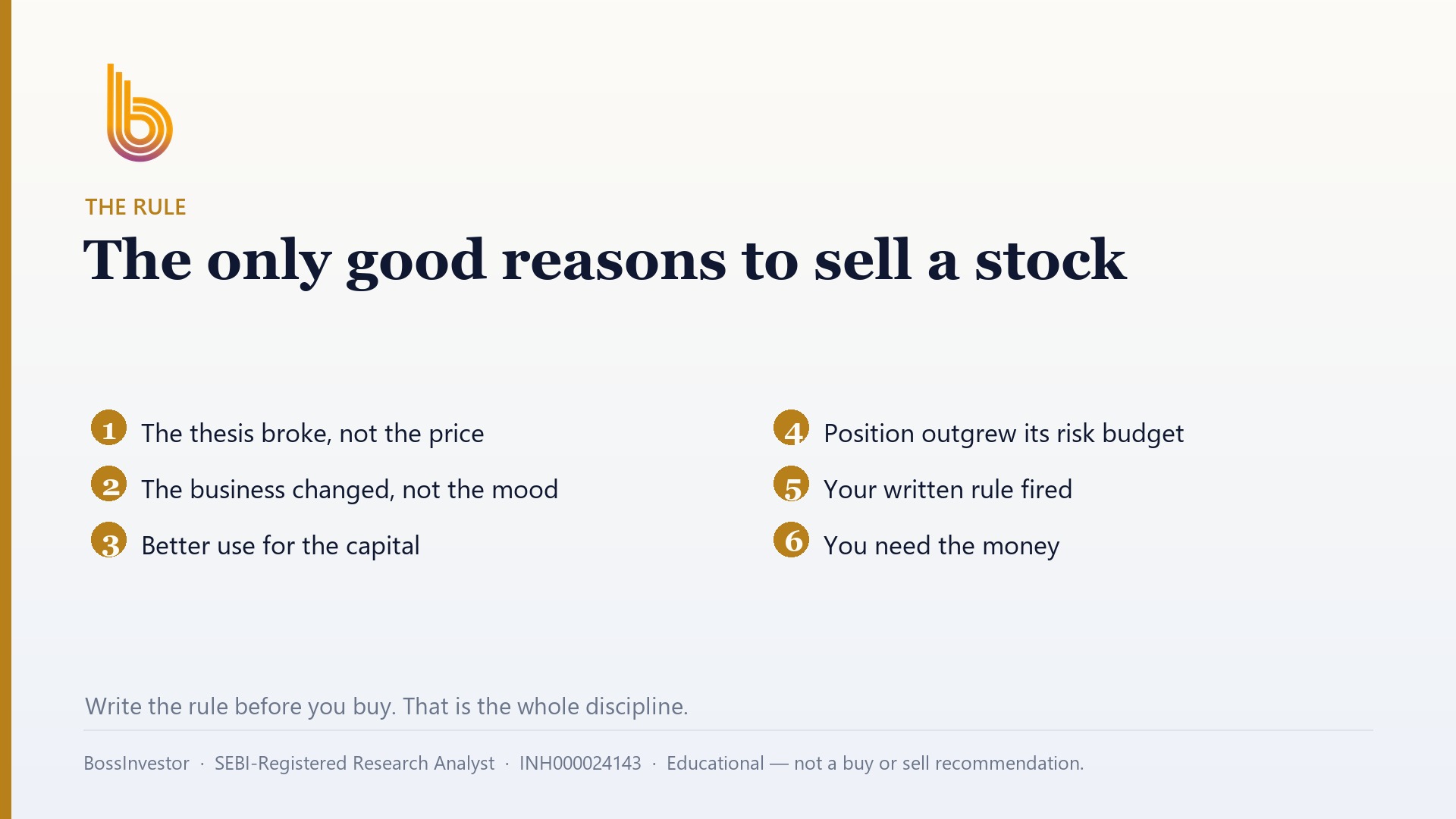
What are the real signals that it is time to exit a stock?
Sell a stock when the business has genuinely deteriorated, when the reason you bought it has stopped being true, when the price has run far ahead of profits, or when you need the money. Do not sell because the price fell or because a headline scared you. Decide the rules before you buy.
Key Takeaways
- Price falling is not a sell signal; the business breaking is.
- Only four honest reasons to sell: broken business, broken thesis, stretched price, or a real money need.
- As of August 2026, only 22.0% of the 1,518 Indian companies we track with full-year fundamentals clear a basic quality bar — so genuine compounders are rare and worth defending.
- Write your exit conditions on the day you buy, when you have no ego in the position.
- The 12-month holding line and transaction costs should break ties, never override a broken business.
- Trimming a position is a valid answer; it is not all-or-nothing.
Why is selling so much harder than buying?
When you buy, you are only making a promise to yourself. When you sell, you are grading your own past decision in public. Selling at a loss means admitting the purchase was a mistake. Selling at a gain means risking the pain of watching it double after you leave. Both feel awful, so most people do neither. They freeze.
But freezing is not neutral. Holding a stock today is exactly the same decision as buying it today at today's price. If you would not buy it now, knowing everything you know, you are already choosing to own it for reasons that have nothing to do with the business.
The way out is to move the decision earlier in time. You write the selling rules on the day you buy, before there is any profit or loss attached to your name. Then, when the moment comes, you are not searching your feelings. You are reading a checklist you wrote when you were calm.
What are the only good reasons to sell a stock?
There are four. First, the business has deteriorated in a way that looks structural rather than temporary. Second, the specific reason you bought has stopped being true — the new plant never came, the margin expansion never arrived, the management changed direction. Third, the price has run so far ahead of the profits that future returns have already been paid to you in advance. Fourth, you need the money for a real goal, or the position has become so large that a single company decides your family's outcome.
Now notice what is not on that list. 'It is up 50%' is not a reason. 'It is down 30%' is not a reason. 'The market looks toppish' is not a reason. 'Someone on a Telegram channel said exit' is not a reason. None of those tell you anything about whether the company you own earns more money this year than last year.
Everything below is just the detail of how to check those four honestly.
How do I know if the business itself has actually broken?
Pick a small set of numbers and read the same ones every quarter, from the company's own filings on the NSE and BSE websites. Return on equity. Return on capital employed. Debt-to-equity. Operating margin. Cash flow from operations compared with reported profit. Then the governance signals that no ratio captures: promoter shares pledged, auditors resigning mid-term, related-party transactions growing, receivables ballooning while sales stay flat.
It helps to know how rare a good business actually is. In our universe of 1,852 listed Indian companies, 1,518 had full-year fundamentals as of August 2026. Only 22.0% of them — 334 companies — cleared return on equity above 15%, return on capital employed above 15% and debt-to-equity below 1 at the same time. That is the whole point. If a company you own was in that small group and has now dropped out for several quarters in a row, that is a real event, not a mood swing.
One caveat before you apply this blindly. A flat debt-to-equity rule is unfair to banks and NBFCs, because borrowing money is their business model, not a warning sign. For lenders, read capital adequacy, gross and net NPAs, provision coverage and the pace of loan growth instead. And separate one bad quarter caused by a plant shutdown or a monsoon from three or four bad quarters with debt quietly rising. The first is weather. The second is climate.
Does a falling share price on its own mean I should sell?
No, and this is where most portfolios are lost. The price and the business are two different things, and they only agree with each other over long periods. When the price falls, run one test: has anything in my written thesis changed? If the answer is no, the fall is either irrelevant or an opportunity. If the answer is yes, then the fall is information, and the loss you are sitting on is not the reason to act — the broken business is.
The most expensive habit in Indian retail investing is averaging down into a company that is deteriorating. It feels disciplined. It is actually doubling your bet on being wrong. Use a hard rule: you may only add to a losing position if you would happily buy it fresh today at this price, with today's information, and with no existing holding.
Also decide, honestly, what the position was. If you entered for a two-week move, exit like a trader on your own pre-set level. If you entered to own the business for years, do not apply a trader's exit to it. The damage is done when people buy as traders and, once it falls, promote it to a long-term investment.
When is a stock simply too expensive to keep holding?
Expensive is not a sell trigger by itself. Good businesses stay expensive for years. But it changes the odds against you, and it changes how much you should own. For context, the median PE across our fundamentals universe was 24.0 as of August 2026. And when we add a simple valuation check — PE under 40 — to that quality bar, the survivors drop from 22.0% to 15.9%, or 241 companies. Quality at a sane price is rarer than quality alone.
The practical test is to split your gain into two parts: how much came from the company earning more, and how much came from the market agreeing to pay a higher multiple. Take an illustrative example with made-up numbers. You buy at ₹200 when earnings per share is ₹10, so the PE is 20. Three years later earnings per share is ₹15 but the price is ₹600, so the PE is 40. Profits grew 50%; your money tripled. Two-thirds of your gain came purely from re-rating.
That re-rating portion is borrowed, not earned. It can be handed back in a single bad quarter. When you see that pattern, the usual sensible answer is not a full exit — it is trimming the position back to a size you can live with if the multiple halves.
How do Indian tax rules and costs change my selling decision?
For listed equity on the NSE and BSE, the twelve-month holding period is the line between short-term and long-term capital gains. Long-term gains are taxed at a lower rate and carry a small annual exemption; short-term gains are taxed at a higher flat rate. So selling a few weeks before that twelve-month mark can hand over a meaningful chunk of your gain for no investing reason at all. Check the current year's rates with your CA before you place the order.
Then add the frictions people forget: securities transaction tax, brokerage, exchange charges, stamp duty, and the spread you actually pay in a thinly traded smallcap. Someone who churns their portfolio four times a year pays these costs four times a year, and they compound against you exactly the way returns compound for you.
Use tax as a tie-breaker, never as a veto. If the decision is finely balanced and you are three weeks from long-term treatment, wait the three weeks. If the company's auditor has just resigned, do not wait a single day for a tax rate. Separately, if you are booking gains in a financial year, look at whether you are also carrying unrealised losses that could be set off in the same year — the set-off and carry-forward rules are specific, so take proper advice.
Should I sell the whole position or just part of it?
Exit fully when the reason is binary and about trust: suspected fraud, governance failure, a promoter acting against minority shareholders, or a thesis that has been definitively disproved. There is no partial answer to 'I no longer believe the numbers.'
Trim when the issue is a matter of degree. Position size is the most common one. If a stock has quadrupled and now represents a third of your portfolio, selling a slice is not a view on the company — it is a decision about how much of your future you want riding on one management team. Valuation is the other one: stretched but not absurd, business still fine, so reduce rather than abandon.
For anything sizeable, stagger the sale over several sessions rather than dumping it in one order. It reduces the chance that a single bad day defines your entire exit price, and in smallcaps with thin order books it stops you from walking the price down against yourself. Look at delivery volumes before you decide how many days you need.
How do I write a sell rule before I even buy?
Keep one page per holding. Write five things. One sentence on why you bought. What must be true about this business in three years for you to be right. The three numbers you will track every quarter. The three specific developments that would prove you wrong. The maximum share of your portfolio this stock is allowed to occupy.
That fourth line is the one that does the work. 'I will sell if debt-to-equity crosses a level I have named, or if operating margin falls for three consecutive quarters, or if the promoter pledges shares' is a rule. 'I will sell if things go bad' is a wish.
Then set your review rhythm to the results calendar, not to the ticker. Read the quarterly numbers when they come out; ignore the daily price. If you check the price every day and the fundamentals once a quarter, the price will win every argument in your head, ninety times to one.
What selling mistakes do Indian retail investors repeat most?
Booking small profits on winners to feel clever, while holding losers indefinitely to avoid feeling foolish. Over a decade this single habit does more damage than any bad stock pick, because it systematically removes the few positions that were going to pay for everything else.
Then: averaging down into a deteriorating business; selling an entire portfolio because the Nifty had a bad fortnight; acting on an anonymous tip with the same seriousness as an annual report; and waiting for a dead stock to 'come back to my buying price'. The market has never seen your buying price and never will. It is a fact about your bank account, not about the company.
The last one is subtler. People hold because selling would make the loss real. It is already real. The only question that matters is where that money earns the most from today onwards.
Click Here – See BossInvestor's Data-Driven Stock Screens
Conclusion
Selling well is not a talent, it is a filing system. Decide the exit conditions before you buy, track a handful of business numbers every quarter instead of the price every day, and let tax and liquidity break ties rather than make decisions. If the business is intact and the reason you bought is still true, the honest answer is usually to do nothing. If you want the specific, stock-level calls that come out of this method, those sit behind KYC in our app, where they belong.
BossInvestor is a SEBI Registered Research Analyst (INH000024143). This article is for educational and informational purposes only. It explains a method and is not investment advice, nor a recommendation to buy, sell or hold any security. Market-wide figures are computed from our universe as of August 2026; past metrics do not guarantee future results. Always do your own research or consult a registered adviser before investing.
Frequently Asked Questions
Should I sell a stock that has fallen 30% from my buying price?
Not because of the fall. Go back to your original reason for buying and check whether it still holds. Read the last three quarterly results and look at debt, margins and cash flow from operations. If the business is unchanged, a 30% fall is a price event, not a business event. If the numbers have deteriorated for several quarters, or governance has slipped, then sell — but you are selling because of the deterioration, not because of the loss on your screen.
Is it wrong to sell a stock just because it has doubled?
Doubling is not a reason on its own. What matters is why it doubled. If profits doubled too, nothing has changed and you can keep holding. If profits grew a little and the PE did the rest, the market has already paid you for years of future growth, and that part can be taken back quickly. In that case, trimming the position back to a size you are comfortable with is usually more sensible than exiting completely.
How often should I review the stocks I own?
Once a quarter, after results, is enough for a long-term portfolio. Read the results, update your three tracked numbers, check the shareholding pattern for promoter pledging or a sharp drop in promoter stake, and note anything the management said that contradicts what they said last quarter. Add one annual review where you re-read your original thesis in full. Watching the price daily adds no information and reliably makes you trade more than you should.
Does a company falling out of a quality screen mean I must sell?
It means you must investigate, not act reflexively. Quality is genuinely rare — as of August 2026, only 22.0% of the 1,518 Indian companies we track with full-year fundamentals cleared return on equity above 15%, return on capital employed above 15% and debt-to-equity below 1 together. Falling out for one quarter can be a one-off, like a capex year or a plant shutdown. Falling out for several quarters, with rising debt and weakening cash flow, is the pattern that justifies an exit.
Should I hold a stock past twelve months only to save tax?
Only when the decision is otherwise finely balanced. For listed equity, crossing the twelve-month holding period moves you from short-term to long-term capital gains treatment, which is taxed at a lower rate with a small annual exemption. That is worth a few weeks of patience when nothing is wrong. It is never worth it when the business has broken, when governance is in question, or when the position is dangerously large. A tax saving on a collapsing stock is not a saving.
Should I use a stop loss on long-term investments?
A stop loss is a trading tool built for positions where the price itself is the thesis. On a long-term holding, where your thesis is about earnings over years, a fixed percentage stop will regularly throw you out of good businesses during ordinary volatility. Use business-based exit triggers instead: named thresholds on debt, margins, cash conversion and governance. The critical thing is to decide which kind of position you are taking on the day you enter, and then not to switch categories after the price moves against you.
Related Blogs
How to Analyse a Stock Before Buying: A 10-Point Checklist
Published: Mon Sep 07 2026Read more…

How to Calculate Your Financial Freedom Number and Achieve It
Published: Tue May 20 2025Read more…
 (1).jpg)
From Signal to Strategy: The Moving Averages
Published: Tue May 20 2025Read more…

Market Share: The Silent Signal of Competitive Power and Investment Opportunity
Published: Wed May 14 2025Read more…